Germany's Coalition Faces Existential Strain After State Election Wipeouts
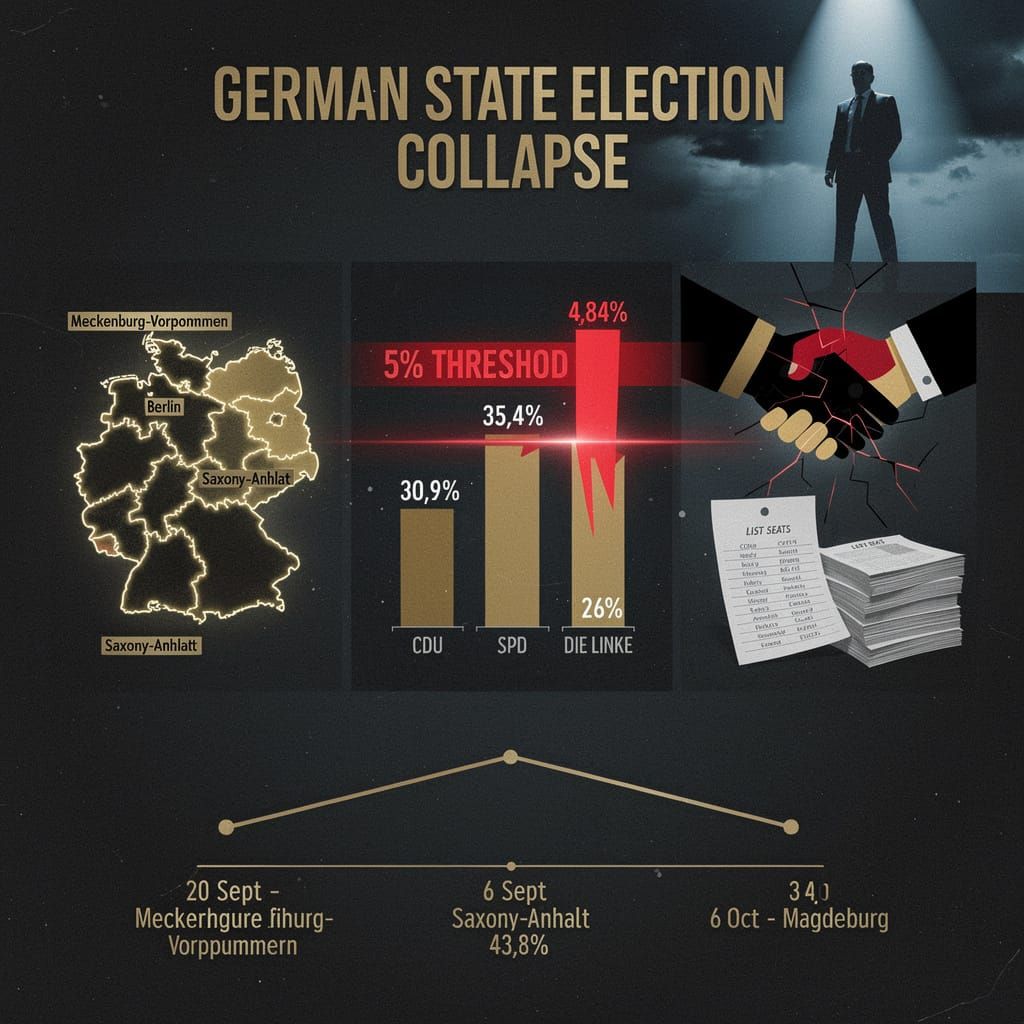
Germany's CDU just hit 4.84% in Mecklenburg-Vorpommern — its worst result in FRG history and a first exit from that state parliament since 1990. 📉 That's less than the 5% survivability line, and far below the 13.3% it won in 2021. Meanwhile the AfD doubled to 35.4%, and Die Linke bagged a 26% landslide in Berlin. The coalition's answer? "Cutting lists," not reforms. 🔧 With the chancellor on the ropes and a finance minister admitting the government "cannot continue as it stands," voters in three states have spoken loudly. Will Berlin's coalition listen — or just keep making lists? How should 🇩🇪 respond? 🤔
One would think watching Germany's governing coalition right now counts as a spectator sport, given how much high-stakes drama is erupting from three little state elections. A chancellor on the ropes, a party knocked out of a parliament for the first time since reunification, and a finance minister publicly announcing his own government "cannot continue as it stands." That's not a policy platform; that's a season finale.
Let's start with the headline act: the September 20 election wipeout in Mecklenburg-Vorpommern (MV). Chancellor Friedrich Merz's CDU didn't just lose there — it imploded. A 4.84% result — the party's worst in FRG history — booted the CDU out of the state parliament for the first time since 1990, in a region it had governed since then. At 4.84%, it didn't even clear the 5% survivability line the party had been nervously eyeing all summer. The collapse was telegraphed, too: as far back as August, polls had the CDU hovering at 7%, more than double what it would actually scrape together — and down from 13.3% in 2021. Yet somehow, reality still managed to be worse than the worst projections. That led CDU Spitzenkandidat Daniel Peters to admit he was "fighting for existence," while former party chief Eckhardt Rehberg warned of an outright exit from the Landtag. Turns out their worst-case scenario planning was dead accurate — and why not? The SPD's polarizing "Frau gegen Blau" campaign had been kneecapping them for weeks.
Merz himself called the result a "deep shock," which is diplomatic for "our brand is dissolving."
Meanwhile, the AfD cleaned up. Exit polls put them at 35.4% — more than doubling on 2021 — while the SPD finished second at 30.9% despite Manuela Schwesig's towering personal popularity, a paradox worth a double take. The AfD absorbed roughly 45,000 former SPD voters and 67,000 previous non-voters to claim its win. The result? A likely red-red-green coalition and an AfD that won the election yet must stew in opposition — that is, if the Greens clear the 5% threshold and unlock a majority without the AfD or BSW. Per the electoral system's charming quirks, any majority government that excludes those parties depends on three-figure math nobody's eager to test. Good luck drawing that Venn diagram.
Berlin, meanwhile, went full left. Die Linke bagged a landslide in the capital — 26%, enough to make Elif Eralp the first anti-capitalist mayor since reunification — and the business community is clutching its pearls. It's worth noting the playbook came straight out of NYC: Zohran Mamdani's team apparently shaped Die Linke's strategy, and it centered squarely on a housing crisis where rents have soared 70% in a decade and 84% of Berliners rent. Trigema's Wolfgang Grupp is railing against "expropriation fantasies," while Vonovia CEO Luka Mucic and the BDI are begging the government to finally deliver modernization. Note: the election results "changed nothing" about the actual problems to solve — they just made the people holding the solutions weaker.
Then there's the reform theater at the federal level. The government's June commission floated 33 reform suggestions; a draft law isn't expected before October. Meanwhile, the Young Union's Johannes Winkel demands immediate action or face "economic collapse," the CDU warns against moving too fast, and the SPD insists we're just cutting lists, not reforming. Saarland's Minister-President Anke Rehlinger says the federal approach is all top-down, no empathy. For a coalition that promised competence, the phrase "managed decline" is starting to feel generous.
Oh, and don't forget the race to reset leadership. Daniel Peters resigned as CDU-MV chair after the debacle; Philipp Amthor — fresh off his July promotion to Digital Minister during Merz's panicked summer reshuffle — was tapped as interim party leader until a congress early next year. And should you wonder how thin Merz's bench is at the federal level — his most loyal caucus ally is Thorsten Frei, the same Frei who took the Union faction leader post on July 22 and who just spent July publicly blaming the chancellor's rushed cabinet reshuffle for "traffic ministry" chaos. Loyal and vocal about it, apparently.
What happens next? Watch October 6, when Saxony-Anhalt's Landtag convenes in Magdeburg and BSW-Fraktionschef Thomas Schulze keeps flirting with AfD "content-based dialogue" while publicly denying a coalition — that after Saxony-Anhalt handed the AfD a record 43.8% on September 6. Watch whether the Berlin red-red-green experiment normalizes expropriation talk nationally. And watch whether Uncle Merz survives his own caucus after a pair of existential state losses.
The German voter has spoken, loudly, in three accents at once. Whether the coalition listens — or just keeps making lists — is the only question that matters. And honestly? The polls suggest the audience has stopped trusting the cast.

Comments ()