Tether's 60% Problem: MiCA's deposit rule spurs ECB to rewrite stablecoin rules
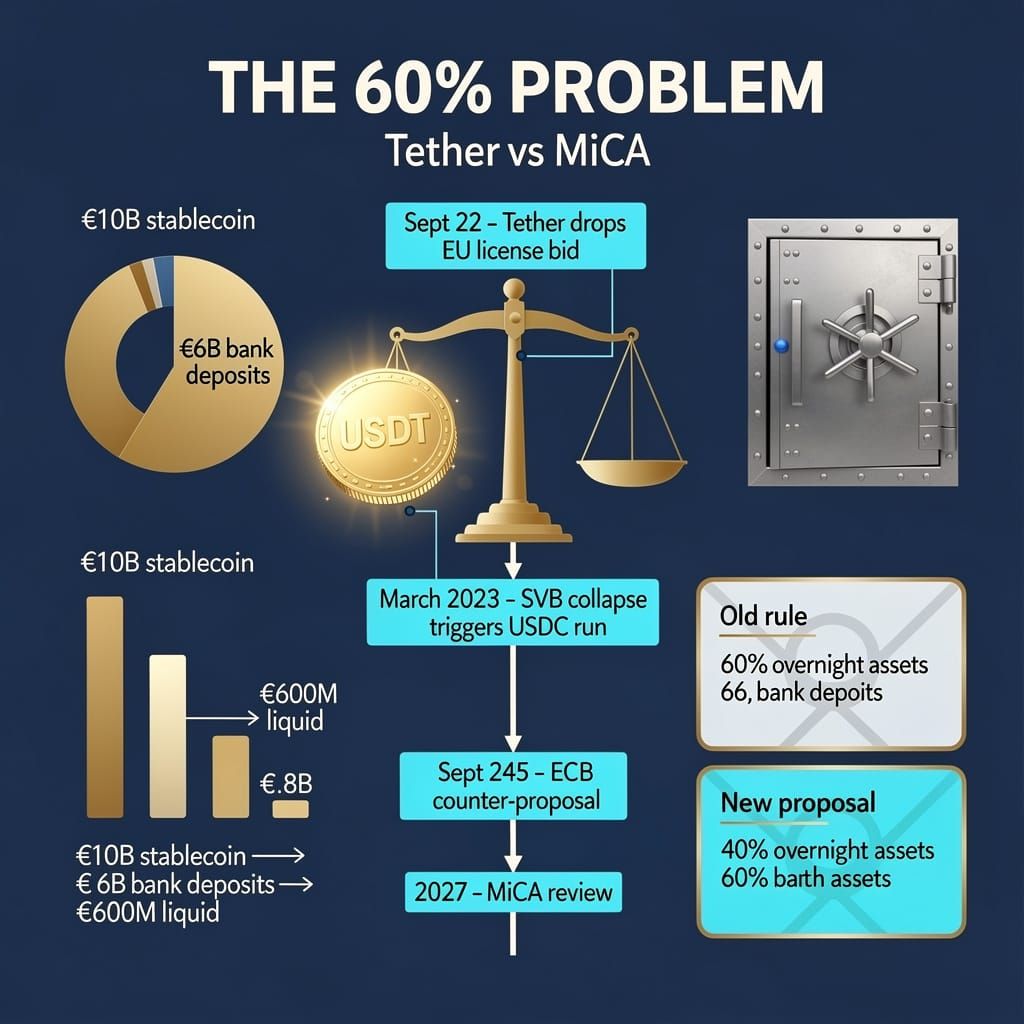
60% of a $10B stablecoin means $6B parked in banks — but only $600M stays liquid. 💶 That's the arithmetic that made Tether walk away from the EU's MiCA rules on September 22. Now the ECB is rewriting the deposit mandate itself. Tether says no to the 60% requirement. The ESCB wants asset-maturity liquidity instead. The rulebook is being redrawn mid-game. European platforms still touching unlicensed USDT are betting on an enforcement gap. Who blinks first: the regulator or the world's largest stablecoin? 🇪🇺
Here's a fun fact about the European Union's flagship stablecoin law: it was designed so that the people holding your digital dollars don't have to worry that your digital dollars are actually... gone. Noble goal. And yet, when the rulebook finally went live, the biggest name in the crypto game looked at it, said "no thanks," and walked away. Now Europe's central bankers are busy redrafting the whole thing mid-game.
Coincidence? The calendar suggests otherwise. Let's untangle the knots.
What exactly happened?
On September 22, Tether CEO Paolo Ardoino officially dropped the company's EU Markets in Crypto-Assets (MiCA) license application. The reason, delivered with all the diplomacy of a man refusing a parking ticket: the 60% reserve requirement is "too restrictive" and doesn't fit Tether's reserve management strategy.
That headline is straightforward. But here's the twist: Ardoino's move wasn't the first sign of trouble with this rule — it was the loudest public confirmation of a fight European central banks had already been waging. Tether, in other words, walked away from a rule its own regulators were already trying to kill.
Indeed, the ESCB — that's the ECB plus the 27 national central banks that make up the Eurosystem — had separately called on Brussels to scrap the deposit mandate entirely. Their beef: a stablecoin issuer's deposit looks like lovely liquid collateral to the issuer, but to the bank holding it, that same cash is a liability. During a market shock, everyone wants out at once.
How we got to 60%
Here's the transmission path. Under MiCA, a "significant" stablecoin issuer must back roughly 60% of its reserves in commercial bank deposits. For a company holding a hefty chunk of USDT outstanding — Tether reported a $6.8 billion surplus over liabilities in an August 13, 2026 KPMG audit, its first full-year unconditional opinion — parking 60% of reserves in banks is less "liquidity cushion" and more "counterparty roulette."
The March 2023 Silicon Valley Bank collapse already demonstrated the connection: it triggered a run on rival Circle's USDC. Ardoino has since played the arithmetic out loud: a €10 billion stablecoin would require €6 billion in bank deposits — and if the bank lends out 90% of that, only €600 million stays liquid. That's the escalation from the proposal's 30% floor to the final rule's 60% threshold for significant issuers, and the difference between a rule on paper and a rule with teeth.
So Tether, which technically could comply, decided it would rather not exist in the regulated EU market than concentrate half its balance sheet in someone else's balance sheet.
Then the ECB blinked
Here's where it gets delicious. On September 24, the European System of Central Banks published its counter-proposal: scrap the fixed deposit thresholds entirely and replace them with liquidity requirements tied to asset maturity.
Under the draft, significant stablecoins would hold 40% of reserves in assets maturing within one working day and 60% within five working days — think overnight repo agreements and short-term sovereign bonds. Smaller issuers get a gentler tier. The stated rationale: stablecoin deposits are less stable than retail deposits and more sensitive to market shifts, so a run on a giant stablecoin shouldn't detonate the banks holding its cash.
Note the shift in philosophy: from "keep the money in banks" to "keep the money somewhere it can move fast."
What's still on the table
The hard part: current MiCA rules are law, not a suggestion. The ESCB's liquidity framework is a proposal, pending intergovernmental negotiation and final approval — the consultation runs only until September 30 — with a formal MiCA review expected in 2027. Translation: nobody's reserve requirement has actually changed yet. Tether remains outside the EU licensing regime for now, and any EU-based platform touching non-compliant USDT is still playing the "licensing enforcement gap" lottery, since enforcement of unlicensed access remains spotty for firms operating outside EU borders.
Three things to watch:
- Whether the ESCB's maturity-based thresholds survive negotiation, or whether the 60% deposit rule gets a second life before the 2027 review.
- Whether Tether's rejection — and its separate, eyebrow-raising accumulation of $122 billion in U.S. Treasuries — pressures other significant issuers to follow suit or gives challengers a marketing edge.
- Whether the EU's stated ambition to close enforcement gaps on unlicensed stablecoin access actually catches up with the platforms still serving EU customers.
For now, the headline is simple: Europe wrote a stablecoin rulebook, its own central banks are already rewriting it mid-game, and the world's largest stablecoin has chosen to sit this licensing round out. MiCA's rules are up for grabs; the only question is who blinks first.
This article is reporting and analysis, not legal or business advice.

Comments ()