Tata board-vs-trust fight heads to court with RBI's listing mandate looming
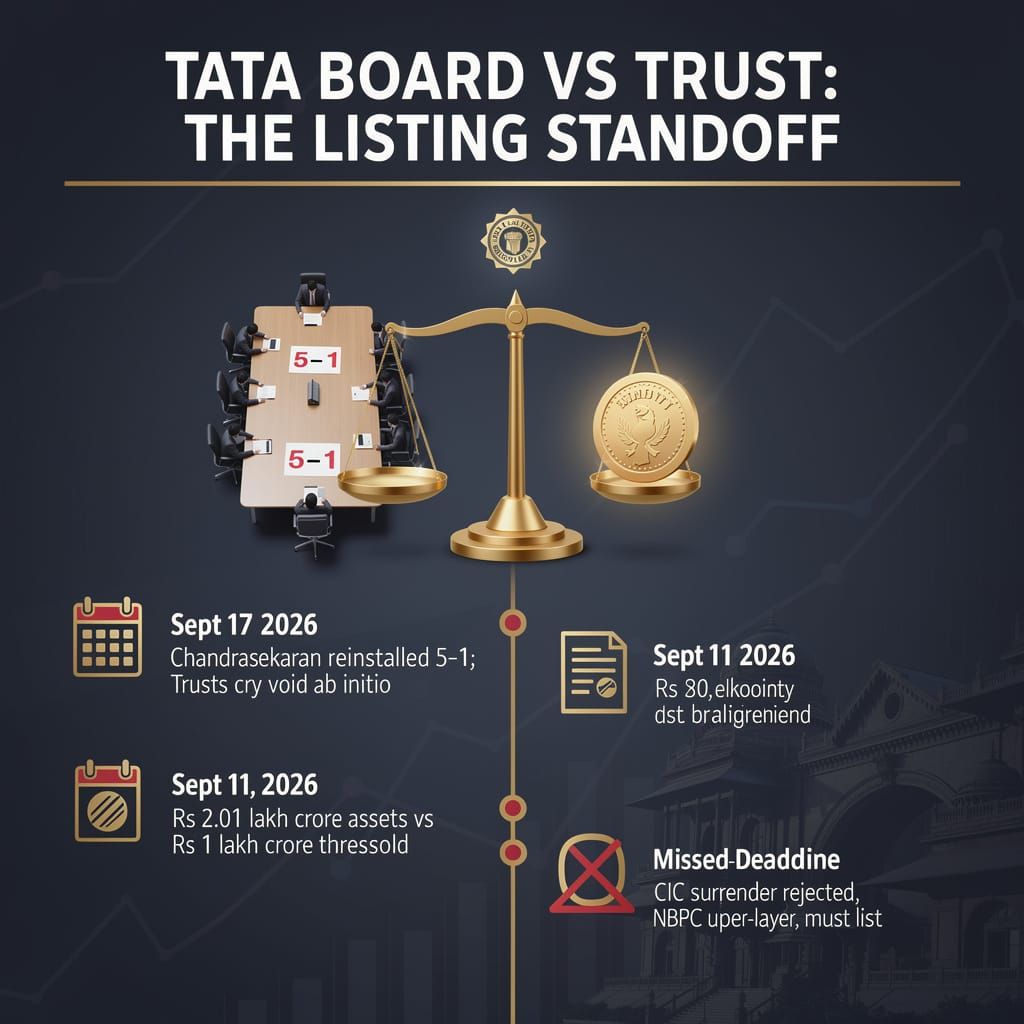
Tata Sons' board voted 5–1 to keep Chandrasekaran as chairman for five more years. The Trusts, its 66% controller, call the vote "void ab initio."⚖️ The RBI just made it thornier: it refused to drop Tata Sons' CIC registration, reaffirming the listing mandate on ~Rs 2 lakh crore of standalone assets. Three legal threads—the board vote, the RBI's listing push, and the Charity Commissioner's leash on the Trusts—now head toward the Bombay High Court. Will a 66% shareholder really be out-voted by a board room, and what does that mean for every Indian public company? Track the case near you👇
Let's be honest about the irony. The Tata Group built its brand on a hundred-plus years of doing the quietly correct thing—so much so that "Tata" became a synonym for trustworthy in Indian households. Now, the conglomerate is locked in a board-vs-trustee knife fight where both sides are waving legal briefs thick enough to prop up an economy, and the referee is a bemused Reserve Bank of India.
The narrative, compressed: On September 17, 2026, Tata Sons' board voted 5–1 to reinstall N. Chandrasekaran as chairman for five more years. Noel Tata—who chairs Tata Trusts, the group's 66% controlling shareholder—voted no, citing Article 121 of the company's articles of association, which requires trust consent for such moves. Tata Trusts promptly declared the resolution "void ab initio," which is legalese for "that vote never happened, and we'll pay lawyers to prove it." (Sports fans will note the board room reportedly ran about three hours deep; nobody emerged jaunty.)
Curiously absent from the vote: any visible trust mandate. The Trusts have now enlisted senior advocate Abhishek Manu Singhvi, who is channeling quiet fury and citing the Supreme Court's Tata-Mistry precedent to argue that shareholder-owner rights can't be nullified by a board acting alone. The Trusts, per filings, insist there was never a formal deadlock—just one aggrieved nominee director's veto turned into an existential crisis.
Now the regulatory spice. The RBI has declined to let Tata Sons surrender its Core Investment Company (CIC) registration—meaning Tata Sons remains an NBFC. This is not a proposal; it is a final regulatory position, delivered by letter dated September 11, 2026, and rooted in the RBI's revised Upper-Layer NBFC framework. Let's Give the number its due: the central bank pegged Tata Sons' standalone assets at approximately Rs 2.01 lakh crore as of March 31, 2026—more than double the Rs 1 lakh crore threshold that drops a company into the comply-and-list bucket. The RBI also reiterated its upper-layer classification for fiscal 2026-27, making the September 2026 rejection behaviorally final, not merely provisional.
To be clear, being debt-free since March 2024 bought Tata Sons precisely nothing. The upper-layer rule is an asset test, not a solvency test. The central bank wants the privately held holding company to list publicly, and it has filed a caveat petition in the Bombay High Court so it gets a hearing before any order lands.
The transmission path. The deadline was never 6–9 months out; it was already missed. The original listing date for upper-layer entities was September 30, 2025—a date that came and went with Tata Sons still unlisted. Tata Capital, by contrast, went public cleanly in October 2025. So the RBI's rejection doesn't create a fresh countdown clock; it reopens a settled-but-ignored obligation. Notably, the board's September 17 session did kick off the listing process—so Chandrasekaran and his supporters appear to be treating the RBI mandate as settled and executable even as the Trusts brand the underlying vote void. Also lurking: the Shapoorji Pallonji Group, holding roughly 18% and wanting liquidity, finds listing very attractive indeed. Their enthusiasm is not a matter of sentiment; it's a balance-sheet necessity.
Where it stands now: The board decision is contested, not settled; the RBI's rejection is final-rule territory but, per legal observers, subject to judicial review—and the caveat petition signals the central bank expects a courtroom. Expect the Bombay High Court and the Charity Commissioner (who has separately ordered the Trusts to avoid permanent policy decisions) to host the drama. That's three distinct legal threads: the board vote, the RBI listing mandate, and the Charity Commissioner's leash on the Trusts.
Bluntest read: Nobody loses this fight quickly. Tata Sons can't comfortably list while the ownership structure's legality is disputed; the Trusts can't enforce trust primacy while the Charity Commissioner restrains them; and every Indian public company watches, because if a 66% controlling shareholder can be out-voted by a board room, minority rights just got a new, alarming chapter.
The drama will move fast for lawyers and glacially for everyone else. Watch for three things: whether the Bombay High Court stays the Chandrasekaran extension, how the Charity Commissioner reconciles his order with the Trusts' litigation push—and note Chandrasekaran has publicly said he won't seek a further term beyond February 2027, so this could be a lame-duck installation wrapped in litigation—and whether a reconvened AGM (pending by December 31, 2026) approves either the reappointment or the listing—or neither, in glorious deadlock. IPO watchers, pencil in three-to-six months of regulatory noise before any prospectus.
Reporting and analysis only—not legal or business advice. Yes, you should consult someone who isn't quoting article numbers from memory.

Comments ()