Two F-16 crashes in five days raise aging-fleet questions
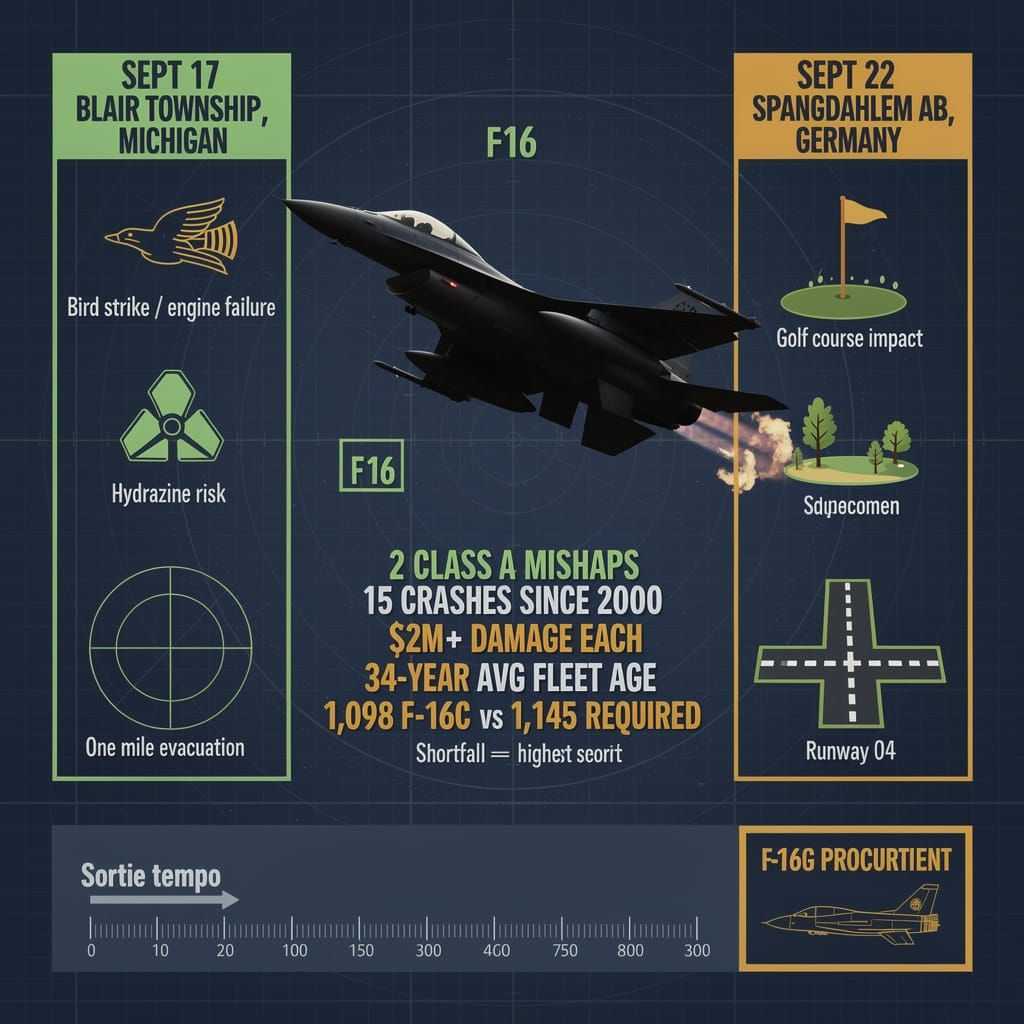
Two F-16s down in five days—one bird-strike engine failure confirmed by ATC audio, one combat-seasoned squadron's jet on a German golf course. ✈️ That's 15 crashes since 2000, and the Air Force keeps calling each one an isolated incident. Pilots ejected safely. But in Michigan, a possible hydrazine leak forced evacuations within a one-mile radius. And the F-16G procurement pipeline stands to benefit from this operational risk. Are these isolated events or a symptom? — How should the Air Force answer for a pair of $2M+ Class A mishaps?
By the numbers, September 2026 was a bad month for the F-16. On September 17, a Fighting Falcon assigned to the 149th Fighter Wing went down in Blair Township, Michigan, near Traverse City. Five days later, on September 22, another F-16—this one from the 52nd Fighter Wing's 480th Fighter Squadron—crashed on approach to Runway 04 at Spangdahlem Air Base in Germany, landing on a golf course adjacent to the airfield.
Two Class A mishaps (damage exceeding $2 million each, by the military's own definition), two pilots ejecting safely, zero fatalities. That is the version the Air Force is putting forward, and it is technically accurate.
It is also almost certainly incomplete.
The Same Script, Punctually Repeated
Let's be clear about what this is not: a coincidence. The 480th Fighter Squadron specializes in Wild Weasel suppression-of-enemy-air-defenses missions and recently returned from two deployments to the Middle East. Both the 480th and 555th Fighter Squadrons cycled back to Europe in early September, weeks before the Spangdahlem crash. High sortie tempo, hot desert operations, sustained combat strain against Iranian air defenses. Those are precisely the conditions under which airframes and their maintenance backlogs start to speak for themselves.
The crash sequence followed a familiar outline. Four aircraft were flying an Agile Combat Employment exercise; one lost altitude during approach. The pilot pulled the ejection handle—the one mechanical system on the F-16 that arguably works too well, masking the failures of everything else. Fire crews from the Eifelkreis Bitburg-Prüm district responded. The smoke plume over the B50 highway and the golf course near the base was, per local press, visible from a considerable distance.
Spangdahlem is not new to this. An F-16 crashed near Zemmer-Rodt in October 2019, and another went down near Oberkail in 2006. The Air Force opened an investigation each time, and each time the fleet kept flying.
The Michigan Crash the Air Force Would Rather Not Discuss
Here is the uncomfortable thing about "the 15th crash since 2000" framing: the Michigan mishap may not even qualify as a mechanical failure at all, and the Air Force is still falling back on comfort in the absence of a cause—or, this time, in the presence of a very specific one.
Recorded ATC audio from the September 17 incident tells a different story than the Pentagon's careful press release. The wingman, BUCK 11, advised Minneapolis Center that the other aircraft—BUCK 12, also from the 149th Fighter Wing—may have struck a bird, lost total engine power, and was preparing to eject. The flight was operating the VFR low-level route VR634 on a training mission out of the Alpena Combat Readiness Training Center, part of Operation Northern Cactus. A possible bird strike was the working theory before the Air Force's investigators said anything.
This is worth pausing on. The documented cause chain, per the event records, is a bird strike disabling the engine, total power loss, and an ejection around 2 p.m. EDT on September 17 near Green Lake Township—right at the intersection of County Road 633 and Jeffrey Place. That is not "mysterious loss of power." That is a single-point engine failure on a 34-year-old airframe confirmed in real time by radio traffic.
And then there was the chemical angle. The F-16's Emergency Power Unit runs on hydrazine monopropellant—highly toxic, unmistakable when it leaks. Residents within a one-mile radius of the crash site were told to shelter in place and then to evacuate while responders dealt with the potential spill. The order was lifted around 9:45 p.m. that evening. Local residents reported hearing a loud crash and seeing black smoke. No homes were damaged and no ground injuries were reported, but the psychological impact on residents—the panic, the forced evacuation, the uncertainty about hydrazine exposure—was every bit a real casualty count.
So on September 17, a Texas Air National Guard jet from the 149th Fighter Wing crashed in northern Michigan during Operation Northern Cactus after a bird strike caused total engine failure and leaked toxic fuel, and forced an evacuation—during a routine training flight. Five days later, a combat-seasoned unit from Spangdahlem put a second jet in a German golf course.
This is the 15th F-16 crash since 2000, and the Air Force has now confirmed that figure itself even as it leaves the Michigan incident out of its own count. The relevant question is not "what happened on September 22." It's why the Air Force, facing a $2-million-plus write-off, a possible hydrazine leak, a wounded pilot, and a scorched civilian golf course, keeps treating each incident as an isolated event rather than a symptom.
The Uncomfortable Procurement Angle
One detail is worth flagging: the Air Force's stated outlook includes "potential procurement of the F-16G upgrade." The service is evaluating new-build F-16s for the first time in over 20 years. The math is not flattering. A Congressional Research Service report puts the current F-16C inventory at 1,098 as of May 2026—47 aircraft below the statutory minimum of 1,145 mandated by the fiscal 2028 budget planning cycle—with an average fleet age of 34 years. The service's own target is to grow total fighter capacity to 1,558 aircraft by 2035. Lockheed Martin's Greenville, South Carolina plant is already producing Block 70/72 airframes for export, and the F-16G—with conformal fuel tanks, an IRST pod, and an integrated AN/ALQ-257 IVEWS electronic warfare suite, rated for 12,000 hours of flight time—is the natural vehicle for a future order.
An F-16G block upgrade that would extend the life of a 40-plus-year-old airframe is a tremendous program to justify right after a pair of Class A mishaps. More F-16 flights, on older airframes, to buy time—while two pilots in five days had to yank the handle, and emergency crews treated a one-mile radius in Michigan for toxic hydrazine exposure.
The F-16 remains central to NATO air defense in Europe, and no one is seriously arguing for retiring a workhorse mid-crisis. But the September 2026 record deserves a more honest accounting than "investigation ongoing." Fifteen crashes since 2000, two inside a week, one bird-strike engine failure confirmed by ATC audio over residential Michigan, one soft landing on a German golf course, and a procurement pipeline that stands to benefit from operational risk being papered over.
The ejection seats worked. Everything else is the open question.


Comments ()