UK air traffic failures disrupt thousands twice in two weeks
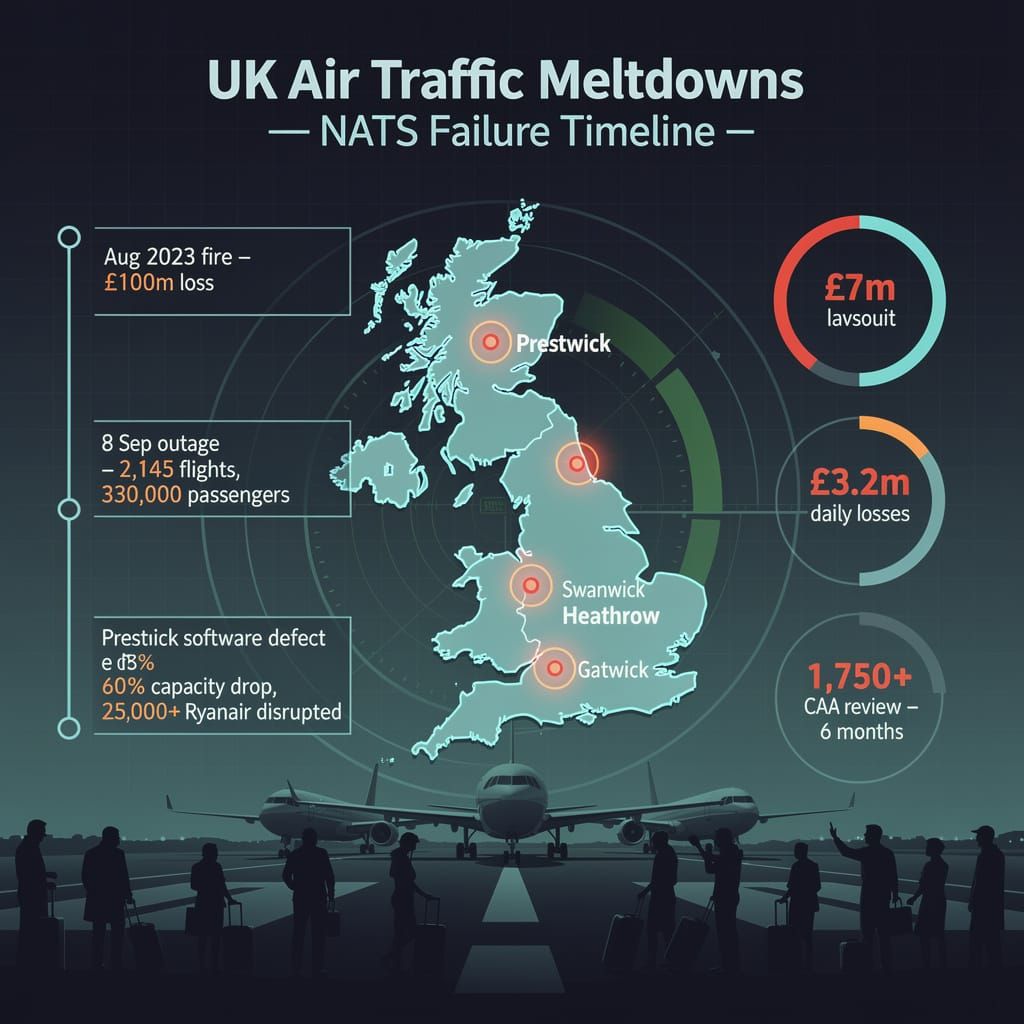
60% of Scottish airspace capacity lost — twice in two weeks ✈️⚠️ NATS suffered its second air traffic control failure this month, a software defect at its Prestwick centre that disrupted 25,000+ Ryanair passengers on Monday, on top of a Sept 8 outage that grounded 2,145 flights and hit 330,000 travelers. That's roughly the population of a mid-sized city grounded by one recurring bug. Ryanair wants CEO Martin Rolfe fired; Transport Secretary Heidi Alexander ordered a report within a week, and the CAA has launched an independent review. With the UK government holding a 49% stake, who holds NATS accountable — and when do stranded passengers stop paying the price? 🛩️
Two air traffic control failures in two weeks. More than 25,000 Ryanair passengers disrupted on Monday alone, on top of a September 8 outage that grounded roughly 2,000 flights and stranded hundreds of thousands. Same culprit both times: NATS, the UK's National Air Traffic Services.
The latest incident, at NATS' Prestwick centre in Scotland, was traced to a "connectivity issue" that engineers later pinned to a software defect in the flight data processing system. Before it was resolved, Scottish airspace capacity fell 60%, and delays rippled through Manchester, Glasgow, Belfast, London Gatwick, and London City. EasyJet cancelled 47 of its 670 scheduled departures; British Airways scrubbed 11 of 513. Flights to Amsterdam, Paris, Bodrum, and Newquay went to the wall.
What makes this pattern more than bad luck is the timeline. The September 8 failure — which NATS now attributes to what CEO Martin Rolfe described as a rogue flight plan that triggered the system's fail-safe mode during a high-traffic window, exposing a design vulnerability in how unique identifiers are validated — knocked out 2,145 flights and hit 330,000 passengers across Heathrow, Gatwick, Manchester, Stansted and Birmingham. A prior meltdown in August 2023 cost the industry £100 million and was itself traced to a fire at the Swanwick centre caused by a rare software error involving duplicate waypoints — an event NATS called "one in 15 million." Repeated incidents have come and gone despite NATS leadership's assurances that mitigations were in place. So the question is less about what broke this time than why the fixes keep failing.
The pushback has been unusually pointed — and has moved from the airline canteens to the Transport Secretary's office. Ryanair's chief operations officer Neal McMahon called for CEO Martin Rolfe to resign or be fired, and the carrier has since filed a lawsuit seeking £7 million-plus (roughly $9.5 million) over the 2023 outage. Ryanair's Michael O'Leary has gone further, publicly disputing Rolfe's claim that the recent failure was "a different issue" from previous incidents, alleging the CEO was lying to protect himself. Wizz Air described a "national confidence crisis," labelling NATS "not fit for purpose." Airlines UK, representing the major carriers, cast NATS as critical national infrastructure operating with insufficient resilience. Even easyJet, which has generally kept operational criticisms measured, explicitly flagged weaknesses in the system.
The response from the authorities has been softer than the mood in the airline canteens, but it has sharpened. Transport Secretary Heidi Alexander has refused to back Rolfe, ordering him to produce a technical report within a week — a mandate the government has framed as a formal investigation into the current failure. She confirmed the issue was resolved but warned of lingering delays as aircraft and crews were repositioned. The Civil Aviation Authority has launched an independent review into NATS resilience, due within six months. It has also, notably, classified the incident as an "extraordinary circumstance," which restricts passenger compensation under UK-261 rules. That is a convenient outcome for the operator and airlines alike, though the stranded passengers — the ones sleeping in terminals or rebooking Disneyland trips — are left absorbing the cost.
There is a structural undercurrent worth watching. The UK government holds a 49% stake in NATS through a public-private partnership. That arrangement gives the state a direct interest in a system that has now failed three times in under three years — and it is the same state that signs off on the technical report into the latest failure. The upcoming Civil Aviation Bill, pushed by the Department for Transport, is explicitly pointed at resilience and accountability — but whether it produces enforceable standards or another round of reports remains to be seen.
The near-term outlook is a waiting game. NATS says the underlying defect is fixed and systems are at full capacity again, though the next two weeks will reveal whether this pattern holds or repeats. The economics are already being tallied: an estimated £3.2 million in daily business earnings lost and over 1,750 cancellations from the September 8 event alone. For a system that moves tens of millions of people annually, the margin for error keeps shrinking — and the failures keep finding it.


Comments ()