📦🚁 Amazon Eyes 500 Cities for Drone Delivery With Little Local Say
A quiet Friday in Texas: 52 Amazon drone overflights in one day over one neighborhood. Amazon's fix? Raise altitude 75 feet and reroute some departures. That's the pattern nationwide. Amazon is scaling Prime Air from 11 hubs to nearly 500 cities by year-end—backed by a single FAA environmental finding that pre-cleans every local site, with noise modeled at 92.1 dB while residents are told ~60 dB. A capacity claim of 1,000 daily deliveries per hub sits against real usage near 150 a day in Richardson. The challenge window closes September 26. 📦🚁 Is drone delivery coming to your city—or is it already overhead? Who decides if 500 communities get a fleet no one voted on?
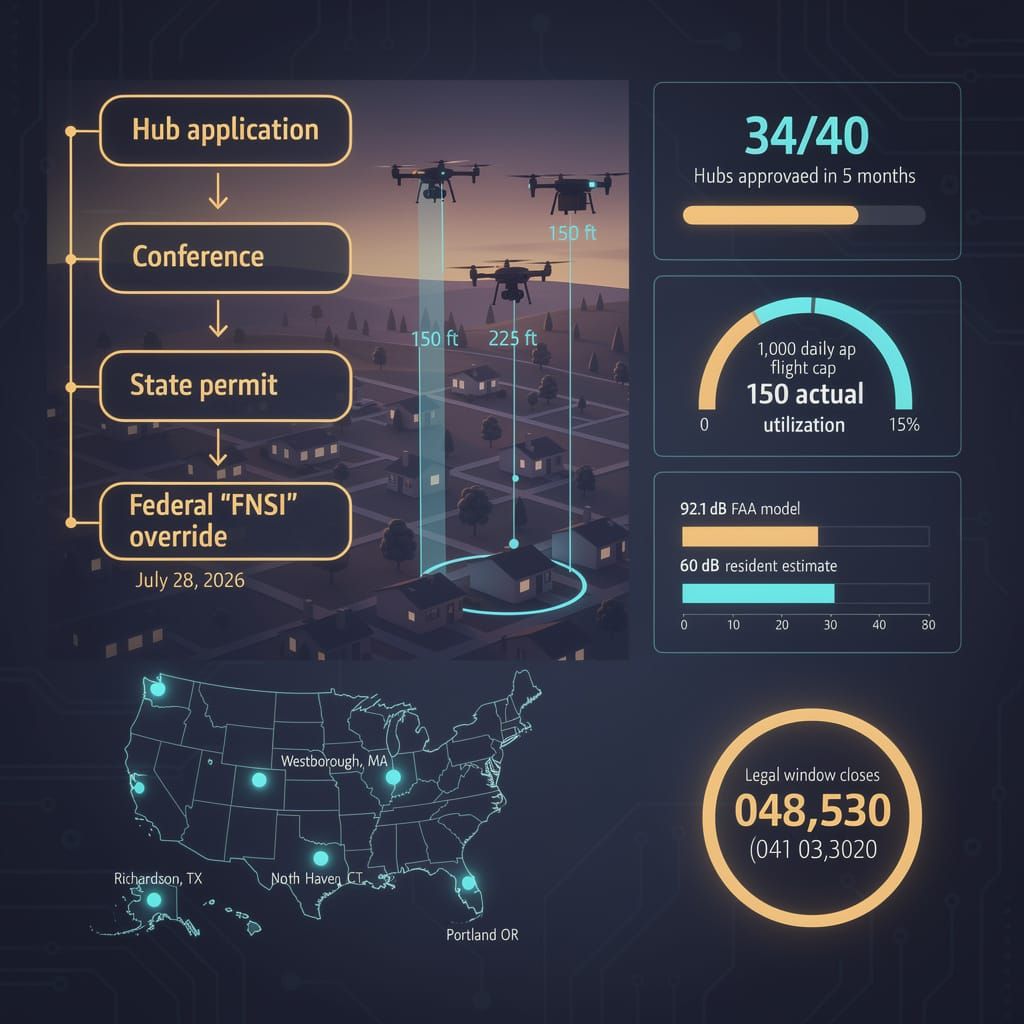
It was a quiet Friday afternoon in Richardson, Texas, when Stephanie Puri logged 52 Amazon Prime Air drone overflights inside a day—three of them cruising between 150 and 170 feet directly over the Anderson family's backyard pool. Amazon's response? Raise the average outbound altitude to 225 feet and reroute some departures. Problem solved, at least in the company's telling.
But the Richardson episode is not an isolated incident. It's a preview of a coordinated, nationwide deployment that is moving through regulatory channels with remarkable speed—and with remarkably little local consent. Federal records confirm the model: at Richardson, the company adjusted its flight envelope in March 2026 under existing FAA-approved parameters, then operated the hub near 150 orders daily against a permitted cap of 1,000. The per-site recalibration is the pattern, not the exception.
The Fast-Track Playbook
Amazon is executing expansion in roughly the same sequence everywhere: file a hub application, hold a pre-application conference, secure a state landing-area permit, then lean on a single federal environmental finding to override objections. The keystone is the FAA's nationwide "Finding of No Significant Impact" for Part 135 drone delivery, signed July 28, 2026. That document sets noise thresholds, setback distances, and operational caps for the entire country—including a 1,150-daily-delivery ceiling and a 600-foot home buffer—meaning one national decision effectively pre-cleans each local site.
The speed is the story. The FAA approved 34 of 40 Amazon hubs in five months during spring 2026, against the agency's typical six-to-eight-month review. The pattern repeats across at least half a dozen states:
- Westborough, MA: A 6,800 sq ft fenced pad in a warehouse parking lot would serve roughly 174 sq mi, including Worcester and Shrewsbury. Planning Board hearing held September 15; public meet-and-greet scheduled September 23. Local governments in Shrewsbury and Southborough report learning about it secondhand—through law enforcement.
- North Haven, CT: A proposal for up to 1,000 MK30 flights per day covering a 7.5-mile radius, with a 15-day DEEP comment window ending October 1. The company targets 365,000 annual deliveries from this single hub.
- Portland, OR: The first Pacific Northwest hub, slated for the Delta Park industrial strip near Interstate 5, with launch planned for early 2027.
- Richardson, TX: Already operational, filling about 150 orders per day—against an FAA-approved capacity of 1,000 daily deliveries.
The Numbers Don't Add Up
Here's where the company's projections strain against the evidence. Amazon claims its hubs can support 1,000 daily flights and 365,000 annual deliveries per location—and now projects a sixfold network expansion to nearly 500 cities by year's end, from 11 current operating sites. Its own materials concede the MK30 doubles range while halving noise, but capacity projections still outpace demonstrated demand. Actual utilization at the operating Richardson hub sits near 150 orders per day—about 15 percent of approved capacity—while the company logged "hundreds of thousands" of deliveries across all sites in 2026 so far.
The noise math is equally revealing. The FAA's own noise filing for the Baton Rouge hub models a 92.1 dB peak at 25 feet for a delivery hover. A resident estimate in Connecticut puts takeoff and landing levels at roughly 60 dB. That's a gap of more than 30 decibels—approximately a thousandfold difference in acoustic energy—between what the company's neighbors are told and what federal modeling assumes.
Who's Actually in the Loop?
Seven states have formally filed objections, and seventeen state attorneys general have requested environmental impact statements challenging the FAA's national finding. Massachusetts requires a state landing-area permit under 702 CMR 5.01. Connecticut's DEEP gets a two-week comment window. But the FAA's national finding means none of these states can meaningfully block flights on noise or environmental grounds.
Richardson's city council concluded the FAA had no legal handle on the flights to begin with. That hasn't stopped residents or HOAs from calling other cities—El Paso and Richmond among them—in an emerging network of warnings.
A Quiet Deadline
The legal window to challenge the FAA's national finding—or Amazon's individual hub approvals—closes September 26. If no challenge lands by then, Portland, Westborough, and North Haven proceed largely on federal terms. Four Amazon metros—Atlanta, Cleveland, Syracuse, and Boise—remain unapproved for now. Amazon is positioning to reach nearly 500 cities by year's end, a sixfold increase from its current footprint.
The question isn't whether drone delivery arrives. It's whether 500 cities get a drone fleet their residents never voted on, governed by a national environmental review that nobody read before it was signed—and whether the projected volumes justify the noise the models already concede.

Comments ()