Europe's 120-tonne airlift gap: a study names it, no one closes it
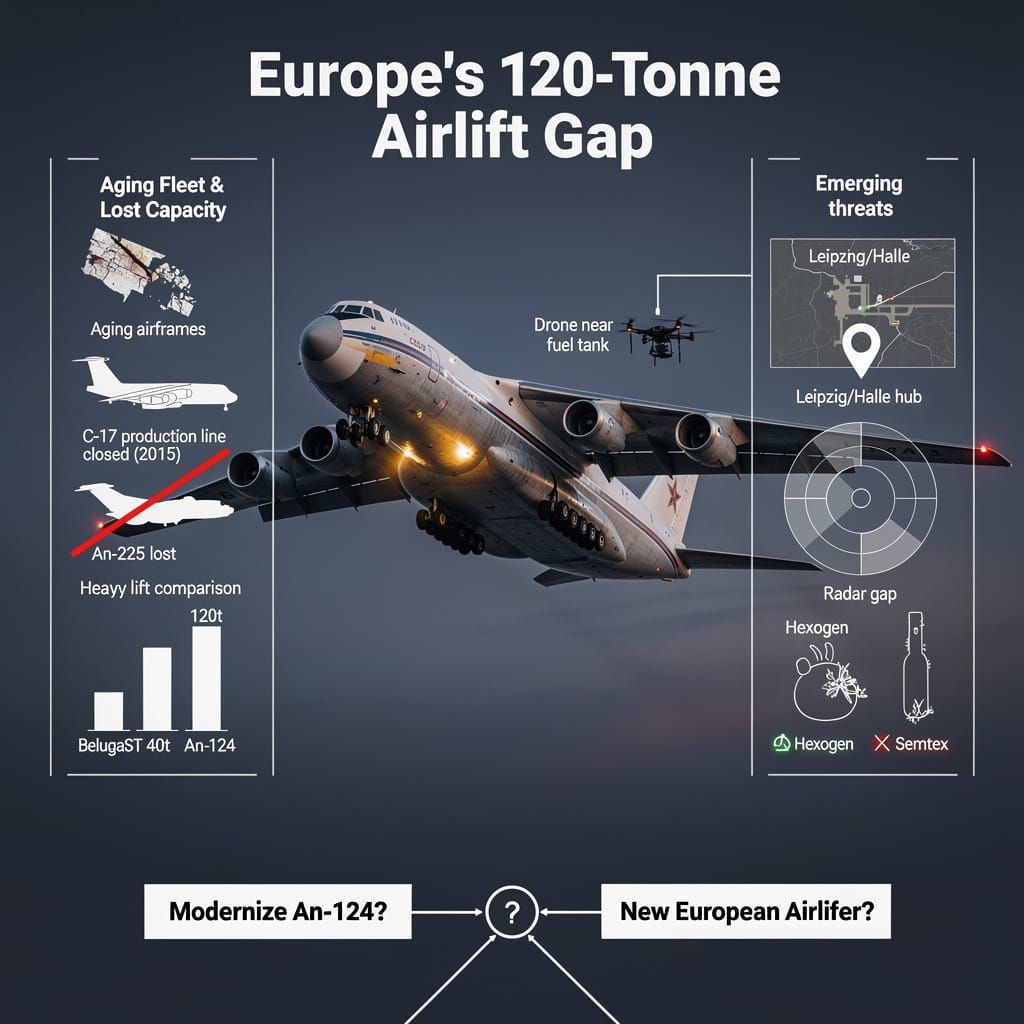
By the early 2030s, Europe's outsized cargo airlift shrinks to a handful of aging Soviet-era An-124s — roughly two dozen airframes, most chartered, carrying the tanks and radar modern armies move. ✈️ An EU study (ESOCA) offers only two costly choices: modernize the old fleet or build a new lifter. Neither is picked. The gap is no longer abstract. In August, a quadrotor slipped past defenses and struck an An-124 at Leipzig, exposing thin perimeter security at a key NATO hub. Remote-control one strategic airlifter — or risk an empty ramp when it matters?
The numbers are stark. Europe's belt for hauling the truly outsized cargo of modern warfare—the tanks, the radar installations, the heavy engineering—rests on roughly two dozen Soviet-era Antonov An-124 aircraft, most of them chartered, none of them young. By the early 2030s, that belt runs out. And the EU's own study, released in September, stops short of saying how it plans to close the hole.
The study in question is ESOCA—the European System for Outsized Cargo Airlift—an 18-month, €20-million project funded through the European Defence Fund and coordinated by Airbus Defence and Space. Its consortium of 14 organisations from eight countries (Finland, France, Germany, Greece, Italy, the Netherlands, Poland and Spain) delivered its conclusions on September 8. The findings landed as a binary: modernize the aging An-124-100 fleet, or build a new European strategic airlifter to replace the Boeing C-17 Globemaster III.
Neither option, the report concedes, is painless. And neither has been chosen.
The Old Guard Is Not Going to Last
The An-124s date from the Soviet era and are, in study language, "nearing end of service life." Modernization would mean deep structural and avionics work on airframes that are already decades old, plus continued dependence on Antonov's industrial base in Ukraine—a base the war has visibly degraded. The same fight that destroyed the unique An-225 Mriya in February 2022 has left the production and support chain for the smaller An-124 uncertain.
The alternative—a new European design—faces the harsher arithmetic. The C-17 production line closed in 2015 with no restart in sight; NATO's pooled fleet of twelve allied C-17s and the newly launched Airbus A400M pooling (July 7, 2026) both stop short of the An-124's 120-tonne payload. For comparison, the BelugaST, another proposed outsize freighter, carries 40 tonnes—one-third of the workhorse's capacity. Airbus shuttered Beluga Transport in January 2025 for lack of customers.
So Europe's strategic lift has, at the moment, no native answer to the An-124. The ESOCA report does not manufacture one.
A Vulnerability Made Visible
The urgency is not purely about fatigue. On the evening of August 4, 2026, a quadrotor carrying roughly four grams of Semtex struck a Ukrainian An-124 at Leipzig/Halle Airport, hitting the wing near the fuel tanks before bouncing off and falling inert; debris was recovered intact only after accidental ignition by a passenger. Investigators now say the device bore a semtex-PETN payload that went undetected for roughly four hours despite active defenses—a gap that speaks to how thin those defenses are. Forensic analysis projects the blast could compromise a three-millimeter aluminum skin, though it produced only minor fuselage dents on impact; the working theory centers on a possible GRU-style modification to evade perimeter sensors.
An FPV drone was detected near a second An-124 the following day, briefly disrupting traffic and drawing bomb-disposal teams for a controlled robotic detonation. Ten days later, investigators recovered a third drone and about 50 grams of hexogen from a field in Kabelsketal, west of the airport—material whose DNA profile, they say, links to the July 2024 DHL parcel-fire plot. A second drone was never located and is suspected of having been destroyed inside a DHL freighter's engines during a temporary closure.
The fleet is not only old. It is physically exposed: the first drone slipped past an unguarded outer fence and beyond radar coverage, with Moscow denying involvement. Reliability concerns and repeated airport shutdowns at a critical NATO logistics hub sharpened the point.
A Thin Base
Combined with reliance on the NATO SALIS program for access, Europe's outsized-cargo capability rests on a handful of aging airframes parked at a handful of known airfields. That is a thin base on which to rest a defense posture. The same week the drones grounded Leipzig staging, Airbus' own Spanish plants entered an indefinite strike from August 24–25 over wages and working conditions—workers confirmed the action with an 81% vote on September 1, rejecting a company ultimatum to suspend the stoppage—hardly a backdrop conducive to a speedy strategic-airlifter decision.
The ESOCA study presents the technical case. The political decision belongs to the member states, who convene October 21–22 in Brussels for Strategic Transport Days. Expect the familiar dynamics: countries with existing Airbus interests lean new-build; those wary of cost and timeline lean toward stretching the An-124; a compromise no one fully defends is the likeliest landing spot. The same calculus that starves Operation Aspides of warships—member states reluctant to add assets—governs expensive airlift decisions too.
The causal chain is simple. Aging aircraft, a closed production line, a damaged industrial base, and a demonstrated vulnerability add up to one conclusion: by the 2030s, Europe will lack a 100-tonne-class lifter it controls, unless it commits to one of two costly paths. The study names the gap. It does not close it.

Comments ()