Supreme Court declines stay on UPI fee above ₹2,000
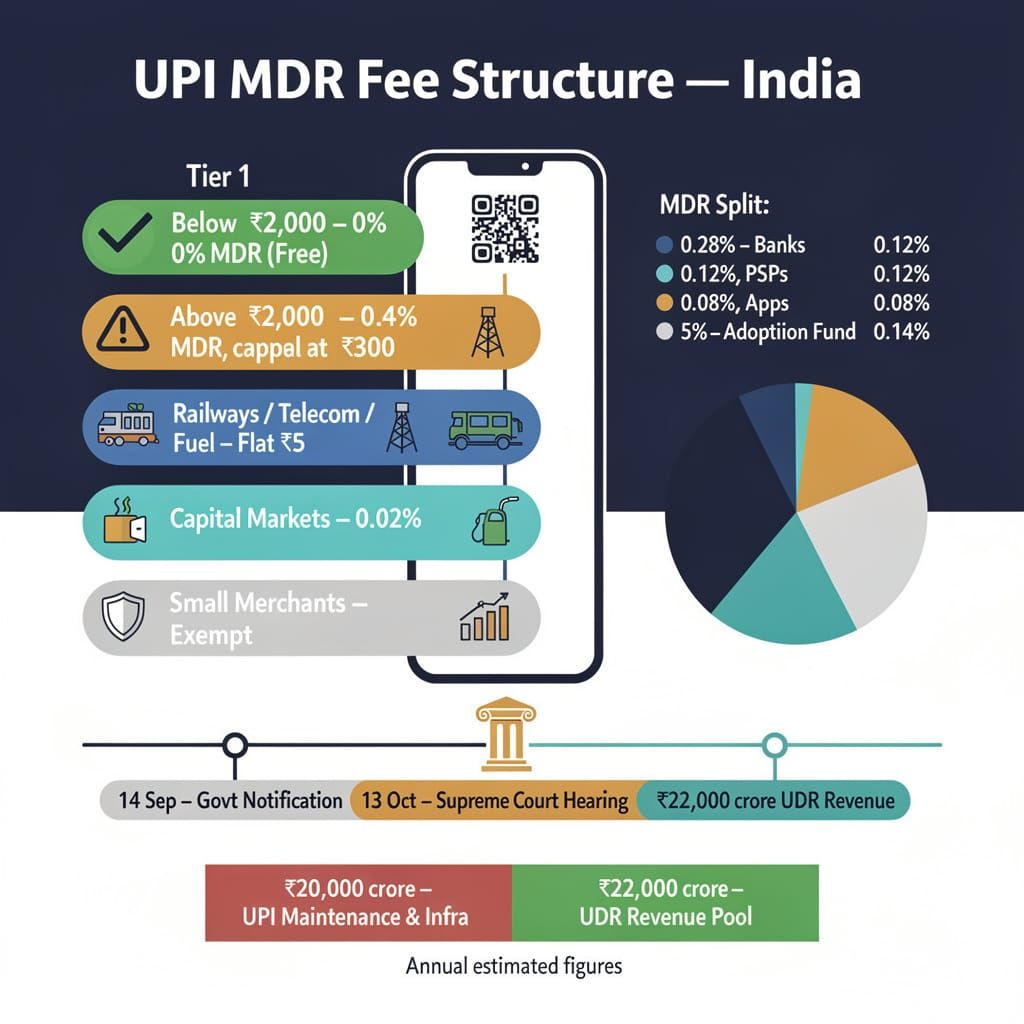
💳 India's free-UPI era is about to hit a ₹2,000 velvet rope. The Supreme Court declined to stay the 0.4% Merchant Discount Rate on UPI person-to-merchant transactions above ₹2,000, effective October 15 — telling the Centre, RBI, and NPCI to respond within four weeks. What's exempt: payments under ₹2,000 (NPCI data: 96% of merchant payouts), capital-market transfers, and small merchants (≤ ₹1 lakh/month via QR code). The 0.4% splits 0.28% to issuing banks, 0.12% to PSPs, 0.08% to apps. The cost is real for mid-large merchants, but capped at ₹300 and offsettable via input tax credit. Case resumes October 13 — two days before rollout. Watch for split-transaction behavior and first-cycle volume data.
Effective October 15, India's free-UPI party has a velvet rope.
Let's get the headline straight. The Supreme Court, sitting with Chief Justice Surya Kant and Justices Joymalya Bagchi and V. Mohana, has declined to stay the Centre's decision to impose a Merchant Discount Rate (MDR) on UPI person-to-merchant transactions above ₹2,000. A PIL from Advocate Anjan Datta — contesting the September 14 notification and September 15 framework — tried to halt the rollout; the bench instead told the Centre, RBI, and NPCI to file their responses within four weeks. The case resumes October 13 — two days before the charge takes effect.
Translation from legal to human: the framework is live-on-schedule unless something dramatic happens in a fortnight.
What Actually Charges (and What Doesn't)
The government's arithmetic, post-PSSA Amendment via the Taxation and Other Laws (Amendment) Bill, 2026 (passed September 16):
- Below ₹2,000: P2P and P2M payments stay MDR-free. NPCI and government data put over 96% of merchant payouts under this line.
- Above ₹2,000: 0.4% MDR, capped at ₹300 (you hit the ceiling at ₹75,000 per swipe).
- Railways, telecom, insurance, fuel: a flat ₹5 charge, regardless of size.
- Capital-market payments: 0.02%, capped at ₹300.
- Small merchants (≤ ₹1 lakh monthly via UPI QR code): fully exempt.
That last carve-out is doing heavy lifting. NPCI has also concluded there's no GST liability layered on top of the MDR itself — and even where an 18% GST might notionally attach, eligible merchants can offset it via input tax credit against their sales GST. So the "double tax" boogeyman, for now, stays in the closet. Separately, NPCI MD Dilip Asbe has said the 0.4% fee will not be passed to consumers — even as government sources concede roughly 10% of UPI transaction value might see merchants try to pass the charge along anyway. They'll be reminded of the fine print, presumably with a smile.
Where the Money Flows
The optics are a study in who-gains-who-loses. The Finance Ministry has been explicit that this is an independent decision, not a product of foreign pressure — a clarification aimed at the conspiratorial corners. The MDR splinters into 0.28% to the issuing bank, 0.12% to the PSP, and 0.08% to app providers; 5% of collections funnels into a UPI adoption fund for underserved Tier III/IV regions.
NPCI figures peg annual system maintenance at roughly ₹20,000 crore, while the estimated revenue pool runs to about ₹22,000 crore (₹14,000 crore of it to banks). The government projects first-year collections between ₹13,000 and ₹15,000 crore. Note the inheritance: that same MDR pot effectively replaces the government's ₹2,000-crore BHIM-UPI incentive scheme for low-value transactions, which now faces the axe — direct subsidies giving way to revenue-based promotion. For the merchant ecosystem, the squeeze is real but concentrated: the exempted small players largely dodge it, while mid-large merchants absorbing the 0.4% face a genuine cost line — tempered by that ₹300 cap and the ITC offset.
The realistic transmission path runs like this: larger merchants eat the fee, then either absorb it into margins or push it into consumer prices. The risk flagged by operators — transaction splitting to duck the threshold — is less a conspiracy than an inevitability, and the government knows it. Datta's petition isn't alone: political figures have piled on the "roll back UPI tax" bandwagon, though framing a settlement fee as a tax is doing some heavy rhetorical lifting.
The Constitutional Kickback
Datta's petition doesn't just quibble with the fee; it attacks the amended Section 10A of the PSSA on Articles 14 and 19(1)(g) grounds — equality and the right to practice any profession. The Centre's counter-position, previewed in filings: MDR is not a tax or a government levy, so constitutional tax-share arguments don't stick. It's a service charge inside the payments ecosystem — a point the Finance Ministry reinforces by insisting no penny flows into state coffers.
Open Questions, Observable Conditions
Three things worth watching between October 13 and the four-week response deadline:
- Does the Court let October 15 pass untouched? The bench's refusal of an immediate stay reads as "prove the harm," not "we endorse the design."
- Does merchant pushback get quantified? Watch for payment-volume dips or split-transaction behavior in the first reporting cycle post-launch.
- Does the ₹2,000 threshold itself survive review? That's the lever most likely to move if the data shows collateral damage to working-capital access.
As rulings go, this is a "not yet," not a "never." As a fees policy goes, it's the first bill India's digital-payments miracle — 24.5 billion transactions in August alone — has ever really had to face. The court has effectively said: go ahead, and bring receipts.
Comments ()