America.gov launches: 30,000 websites become one AI-run portal
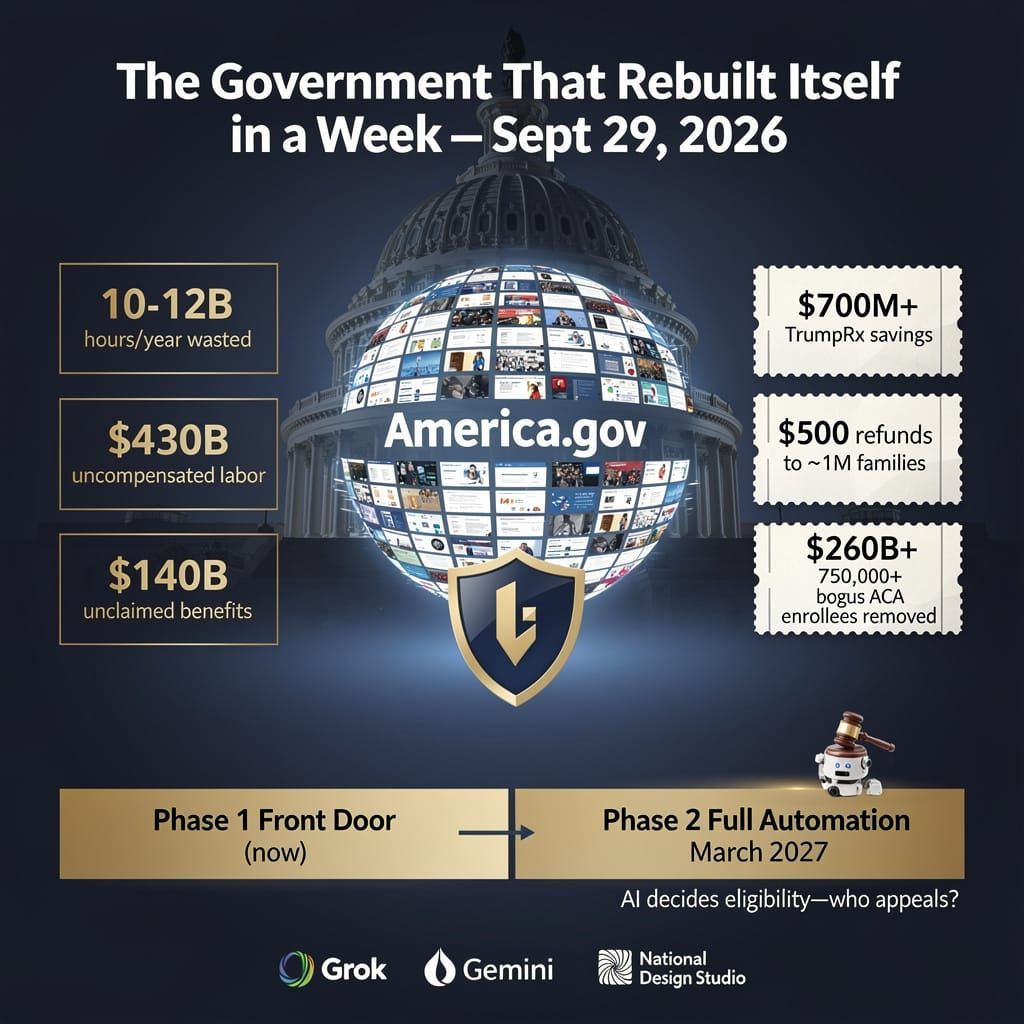
America.gov launched Sept 29, folding 30,000 federal websites into one AI portal run on Gemini and Grok. The pitch: buy back 10–12 billion paperwork hours (≈$430B in uncompensated labor) and $140B in unclaimed benefits for Americans. The rollout comes with traceable wins: $700M+ in TrumpRx savings, $500 refunds to ~950,000 families, and $260B+ in fraud surfaced by the Vance task force. The twist: Phase 2 plans full automation by March 2027, with identity-verification workflows still under legal review—and tax filing excluded by executive order. One open question: when the AI decides you don't qualify, who do you appeal to?
America.gov is here. Roughly 30,000 federal websites, folded into one AI-powered portal, launched by executive order on September 29, 2026. Donald Trump's administration—with a heavy assist from Elon Musk's Grok, Google's Gemini, and an outfit called the National Design Studio—has declared war on the form-fill. And for once, the headline numbers are genuinely hard to snark at.
Let's do the math, because the administration certainly did. Washington's own estimates put Americans somewhere between 10 and 12 billion hours a year wrestling with federal paperwork—the August 2026 figure even tabs that at a $430 billion value of uncompensated labor, plus $140 billion in unclaimed benefits annually. That's the equivalent of every person in the country and then some working a full-time job purely on bureaucratic overhead. The portal's whole pitch is buying that time back through a single Login.gov-authenticated front door covering more than 100,000 services. Fewer logins, fewer searches, less existential dread.
The receipts (and the refunds)
The rollout comes loaded with specific, traceable wins. TrumpRx has supposedly saved patients $700M+ on medicines—a number that dates all the way back to a July 24 White House report, back when the platform's big get was adding Praluent (the cholesterol drug) at 60% off. The Working Families Obamacare Refunds are cutting checks for $500 to nearly 1 million Americans—more than 950,000 people across 30 states, per the Treasury, starting September 30. And the Vance Task Force says it has flushed out $260B+ in fraud—money that, per the president, is heading back to the people.
That last figure is doing a lot of heavy lifting, and the track record cuts both ways. When VP JD Vance first stood up the Task Force to Eliminate Fraud back in July, the number was $230B, with $56B in illicit disbursements halted and 17 new anti-fraud actions announced. Then came September 22, when Vance announced the removal of 750,000+ fraudulently enrolled individuals from the ACA marketplace—with CMS Administrator Mehmet Oz slapping a six-month moratorium on new brokers after a ring of 40 agents funneled 50,000 people into the system. By late summer the figure had crept to $230B again. So the $260B headline is either the fraud multiplier working as intended, or a round-number game between press cycles. Cynical? Sure. But this is the same playbook that's been working all October—er, September. Moving on.
The part nobody's talking about
Here's where it gets interesting, and not in the way the press release hopes. The portal isn't just a nicer website. It's an AI-assisted first point of contact for how Americans interface with their government. Passports, Medicare, veterans benefits—the whole shebang gets rerouted through Gemini and Grok. Even the launch team is a tech-adjacent dream: former DOGE members led development, with Airbnb co-founder Joe Gebbia heading the crew and NVIDIA's Jensen Huang showing up to the launch party.
Phase 1 (now) is the front door. Phase 2, scheduled for full automation in March 2027, is the ominous part. And tucked away in the fine print: pending legal review of the identity verification workflows. Which is a polite Washington way of saying "the lawyers haven't signed off on a machine deciding who gets benefits yet." The internal compliance audit reportedly scored above threshold—but the tax filing is excluded per executive order, so even the administration knows there are limits to its own medicine.
What actually changes
- Admin burden: ~10–12B hours/year theoretically back to taxpayers.
- Service access: one login, one portal, instead of 30,000 stumps.
- Fraud: the $260B+ the Vance task force claims it surfaced, plus 750,000+ bogus ACA enrollees.
- Costs: $700M+ in TrumpRx savings; $500 refunds to ~1M families.
That's the whole pitch, quantified. Whether those savings survive contact with a federal procurement cycle that historically eats its young—your guess is as good as ours. Here's the twist nobody in the announcement addressed: the very task force credentialing this as an efficiency win also, in September, gutted the ACA rolls by three-quarters of a million people. Is that fraud-fighting or just fewer people to serve? The White House insists this is efficiency, not austerity. The GSA and OMB have signed off. Democrats like Elizabeth Warren have called TrumpRx a "scam" flat out, while Mark Cuban countered on pricing transparency. The National Design Studio is the creative engine under the hood.
The uncomfortable question
Launching a unified, AI-driven government portal is a genuinely big deal. Centralizing identity, authentication, and service delivery creates one very juicy target for anybody who wants it. And handing first-line citizen interactions to Grok and Gemini raises a question nobody in the announcement answered: when the AI gets it wrong, who do you appeal to?
Not the machine, presumably. But by March 2027, we might find out. Give the Vance task force credit for one thing: it's framed the fraud ledger as the accountability mechanism for all this money flow. Whether that ledger survives its own legal review—and whether a machine deciding eligibility counts as the "transparency" everyone keeps claiming—remains an open question. The administration frames this as the end of the paperwork era. It might also be the start of the "the AI told me I don't qualify" era. Either way, the forms are dead. Long live the forms.
Comments ()