Smilegate founder's record divorce ruling cracks a supermajority
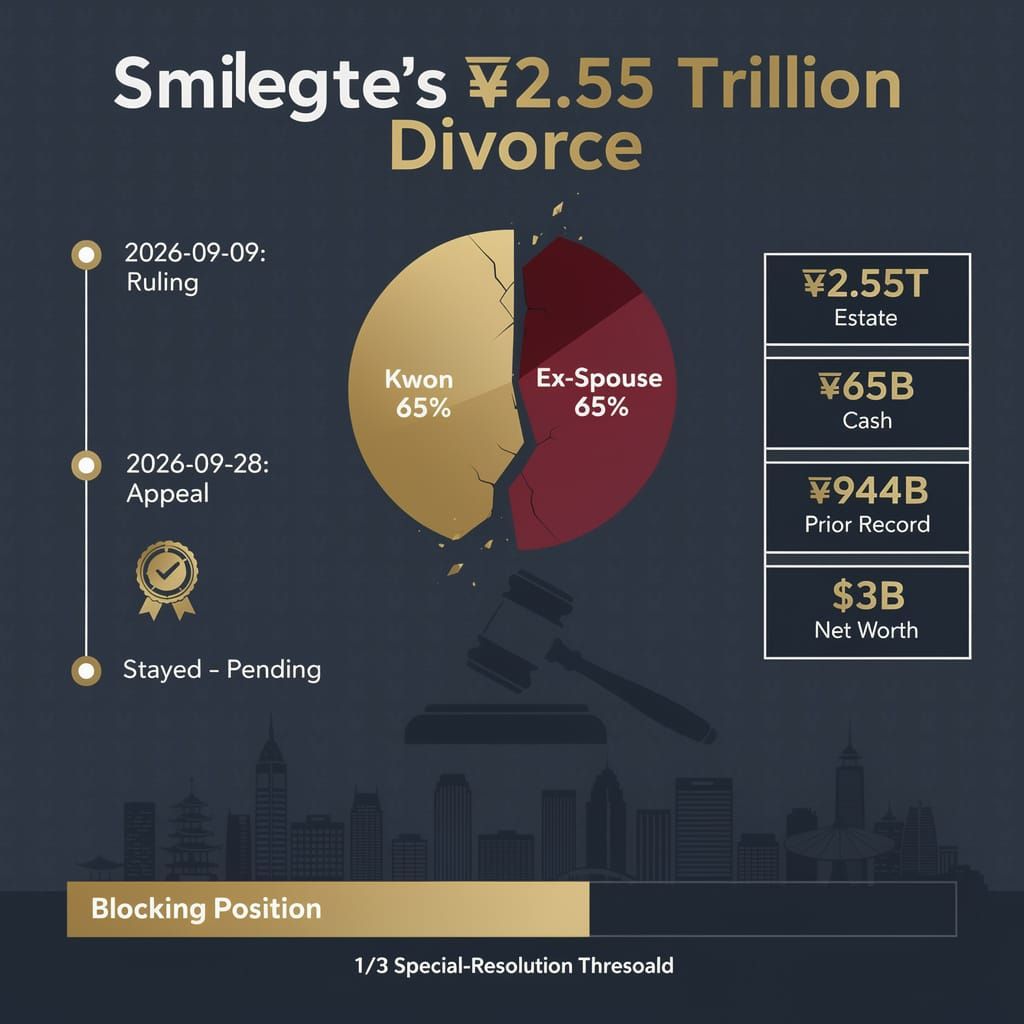
A Seoul Family Court handed down South Korea's largest divorce-asset split on Sept. 9, 2026: Smilegate founder Kwon Hyuk-bin gets 65% of the ₩2.55 trillion estate, his ex-spouse Maria Lee takes the rest. The catch: 35% is a rulebook blocking stake. Under Korean commercial law, charter changes, mergers, and director removals need two-thirds of attending shareholders—so Kwon's 65% can't act alone. The firm just went from founder-led to "pending marital litigation." Kwon appealed Sept. 28. Nothing transfers until then. For operators: watch whether Smilegate attempts any special-resolution vote in the next two quarters—that's the honest signal on whether the split is treated as live.
Here's a number that should make any founder queasy: ₩2.55 trillion. That's the marital estate at the center of Smilegate founder Kwon Hyuk-bin's divorce—and, per the ruling, the largest divorce-related asset division in South Korean history, blowing past Chey Tae-won's previous record of ₩944 billion (which itself was later struck down by the Supreme Court). A Seoul Family Court decided in early September that his ex-spouse gets 35% of the equity she says she helped build.
Let's be precise about the date, because reporting on this has been a mess. The Seoul Family Court handed down the first-instance ruling on Sept. 9, 2026, not the late-September date some headlines floated. Kwon—CVO of Smilegate and chairman of Hope Studio—filed his appeal Sept. 28.
The company itself isn't the defendant here; it's two private parties dividing a fortune. But the corporate governance ripple effects are real, and they're worth watching closely.
What actually happened (vs. what's still open):
- Sept 9, 2026: First-instance ruling allocated Kwon 65% and his ex-spouse Maria Lee (also referenced as Lee Hwa-jin) 35% of Smilegate equity—a stake Bloomberg values at roughly ₩2.5 trillion—plus ₩65 billion in cash. That's the finding, not the final word.
- Sept 28, 2026: Kwon filed his appeal. His legal team contests the asset division, arguing the spouse never contributed capital, had no workspace, and never worked at Smilegate.
- Status: The ruling is stayed pending appeal. Nothing transfers hands today.
How the math works:
Under Korean commercial law, a 35% stake is a powerful blocking position. Super-majority decisions—charter amendments, mergers, spin-offs, removal of directors and auditors—require a special resolution: two-thirds approval of attending shareholders' voting rights and one-third of total issued shares.
Here's the public math game: if those shares ultimately vest, Kwon's 65% can't unilaterally pass a special resolution. He'd need his ex's support—or a lot of other shareholders. Kwon goes from absolute control to needing a dinner date with his ex.
Worth noting: Kwon reportedly held 100% initially. That makes the court's valuation exercise unusually consequential—and, per some coverage, raises unresolved tax questions around transferring shares in a non-listed private company. The ₩2.55 trillion estate also happens to be a meaningful chunk of Kwon's roughly $3 billion net worth, per Bloomberg, which frames just how much capital is now in legal limbo.
The transmission path to operators:
This is the part with practical teeth. The appeal process means months (possibly years) of ownership uncertainty for a company that might otherwise want to run a merger, restructure, or raise capital. Kwon's appeal argues the court ignored his efforts to maintain the marriage and treated post-filing events as grounds for breakdown. Any board contemplating a major transaction now has an official asterisk in the room: pending marital-asset litigation.
For competitors and partners, the observable condition to track isn't the rhetoric—it's whether Smilegate attempts any special-resolution vote in the next two quarters. Attempting one signals confidence in resolving the dispute; avoiding one signals the 65/35 split is treated as live.
Settled vs. unsettled:
- Settled: First-instance allocation percentages. Not binding pending appeal.
- Open: (1) Whether the appellate court affirms, adjusts, or reverses the contribution-based reasoning. (2) Whether the ₩65 billion cash component stands or shifts. (3) How long either side strings out discovery. Notably, Lee's original petition sought 50% of Smilegate—so the 35% award is a starting point, not her ceiling.
Watch items:
- Any move by Kwon to buy back or dilute before the appeal concludes—legally risky, but observable.
- Whether Lee files counter-motions seeking interim dividends or court-supervised voting rights on the disputed stake, given she originally demanded a 50% share.
- The appellate court's calendar; Korean appeals in high-value family cases rarely move fast. The ₩944 billion Chey precedent took years—and traveled all the way to the Supreme Court.
None of this changes Smilegate's day-to-day operations today. But for a private company whose founder's grip on a supermajority is suddenly, legally in question, the divorce isn't a personal matter anymore—it's a governance event wearing a family-law costume.
As always, this is reporting and analysis, not advice—legal, financial, or otherwise. For that, you'd want lawyers. Preferably ones not in the middle of their own divorce.

Comments ()