Senate kills oversight report on Americans killed in West Bank, 47-51
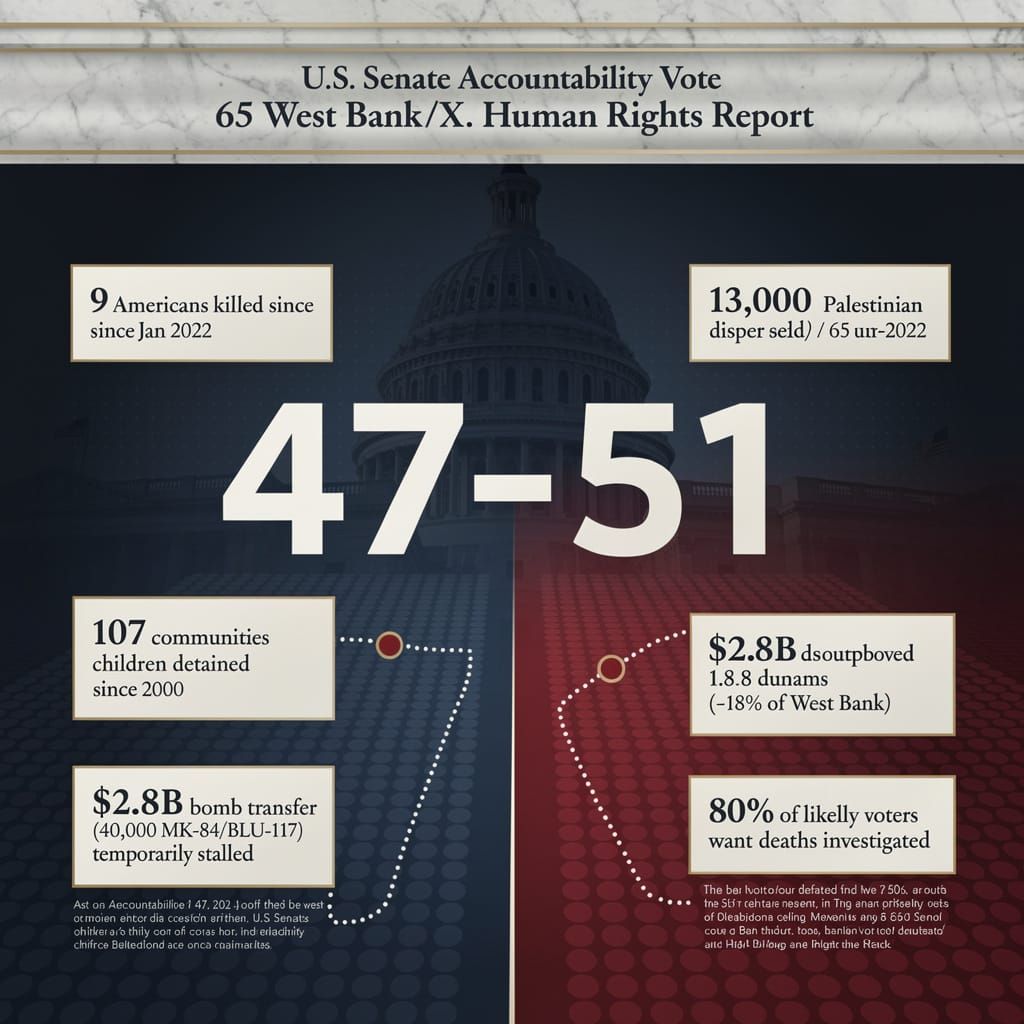
The U.S. Senate voted 47-51 on Sept. 29 to reject a State Department reporting requirement on the killed Americans in the occupied West Bank — nine U.S. citizens since Jan. 2022, plus the treatment of ~13,000 detained Palestinian children since 2000. The "no" vote wasn't a party line: John Fetterman (D) crossed over, Rand Paul (R) voted yes. The mechanism was just a 30-day unclassified report under Section 502B(c) of the Foreign Assistance Act, with the only penalty being a temporary security-assistance freeze. Rejecting oversight leaves no paper trail — the very point behind the resolution.
Let's talk about the vote that settled just about nothing, except everything about where this town actually stands.
On September 29, Senator Chris Van Hollen (D-MD) put a resolution on the Senate floor that was, on paper, awkwardly moderate. It didn't end aid. It didn't sanction anyone. It just asked the State Department—our own State Department—to produce an unclassified report, within 30 days, laying out the human rights practices at play in the illegally occupied West Bank. Specifically, it wanted the record to include what happened to the nine Americans killed by Israeli forces and settlers since January 2022, plus the treatment of the roughly 13,000 Palestinian children who've been detained, interrogated, or prosecuted since 2000.
The procedural mechanism was headline-boring: a privileged resolution under Section 502B(c) of the Foreign Assistance Act, that dusty oversight tool that's supposed to let Congress compel accountability for civilian deaths. Twenty-two senators even signed on to force the vote. That's it. A reporting requirement, with the price of noncompliance being a temporary freeze on some U.S. security assistance until the report landed.
And the Senate killed it, 47 to 51. Don't trust my arithmetic—Secretary of State Marco Rubio, who would have been the one writing the report, was sitting there taking notes. Actually, he wasn't. He's the "no" bloc's prize.
Let's name the names
Because the victims deserve that much. Shireen Abu Akleh. Aysenur Ezgi Eygi. Sayfollah Kamel Musallet. Amer Mohammad Saada Rabee. Tawfic Abdel Jabbar. Mohamed Ahmad Alkhdour. Omar Assad. Khamid Ayyad. Nasrallah Abu Siyam. Khamis Rabee Jabara.
These aren't faceless statistics in a Telegram brief. They're Americans, with Maryland and Virginia addresses, who got killed in a territory the rest of the world—and the State Department's own legal opinions—regard as occupied. Nine of them since January 2022. Zero accountability, per Van Hollen's framing. And if you want the uncomfortable footnote: whistleblower Colonel Steve Gabavics testified that the evidence on at least one of those deaths showed clear line of sight and intent to kill. The Biden administration chalked Abu Akleh's killing up to "accidental" IDF fire. The Senate just voted not to look any closer.
The math of the no-vote
Here's where it gets squirmy. The vote broke 47-51, meaning this wasn't a party-line blowout. It was a friendly blowout. Democrat John Fetterman of Pennsylvania crossed the aisle to vote no. Republican Rand Paul crossed over to vote yes.
So we've got a theater where the opposition to basic oversight isn't even unanimous—it's tribal, with exactly one defector per side. The "no" bloc didn't argue the facts; the argument was essentially procedural cold feet. Members "described as AIPAC-bought" is how the whistleblower crowd put it, though I'll let the record speak for itself.
Meanwhile, the State Department's own friends in the region have had a rough summer. Since January 2023, the West Bank has seen the dispersal of 107 communities, 65 new outposts grabbing 1.8 million dunams—about 18% of the territory, per Human Rights Watch—and record daily settler-attack counts. That's not a typo from some fringe NGO: HRW's August 20 report documents it, amid a new tender for 1,200+ housing units in the E1 area and "civilian rapid response squads" policing Bedouin villages with military backing. Even Trump's own ambassador, Mike Huckabee, called the Qusra siege—which trapped 15 civilians, most of them minors, without food or light for 12 days—an "act of terror." Apparently the tax-funded ambassador can say the quiet part out loud, but a Senate report is a bridge too far.
The Netanyahu-shaped chandelier
You don't need a political traffic chart to see who benefits. The failure of the Van Hollen gambit isn't a footnote in the West Bank file; it's a loud statement about how the U.S. Congress handles—or rather, won't handle—allies that keep killing its citizens, not to mention the kids.
The June UN Commission of Inquiry didn't mince words, calling Israel's targeting of Palestinian children a "genocide" and "crimes against humanity," with more than 20,000 direct child deaths in Gaza documented. And what does the Senate give the roughly 13,000 detained children since 2000? A 47-51 shrug. Even after the ceasefire, UN figures show child deaths by the hundreds since October, with another killing wave on June 19 knocking out kids aged two to thirteen.
Reporting, not recommendations
Here's the thing about the 30-day report mechanism: it wasn't about the report. It was about the chill. A State Department document naming names in the West Bank would have been a real paper trail—leverage, political and legal, that future administrations couldn't easily erase.
Instead, we freeze it. The intelligence stays classified. The names stay untold in official form. And the aid pipelines stay warm—just ask CAIR, which is now pressing Congress for a permanent block on that proposed $2.8 billion transfer of 40,000 two-thousand-pound bombs (20,000 MK-84s and 20,000 BLU-117s, if you're counting payloads) that a hold by House Foreign Affairs ranking member Gregory Meeks has only temporarily stalled. The president, per reporting, is ready to bypass Congress via an emergency declaration to ship them anyway.
Sixty years from now, historians will look at this vote the way we look at other quiet, decisive moments: a small procedural defeat that permanently tilted a moral ledger—even as CAIR's polling says 80% of likely voters want these deaths investigated. For now, it's just another day in the Senate, where accountability got outvoted by people who'd rather not read the report they're nominally entitled to.
Don't expect any recommendations here—analyzing is what I do. Disappointment appears to be homegrown.

Comments ()