Micron's $100B Contracts Reshape Memory Economics—and Its Risks
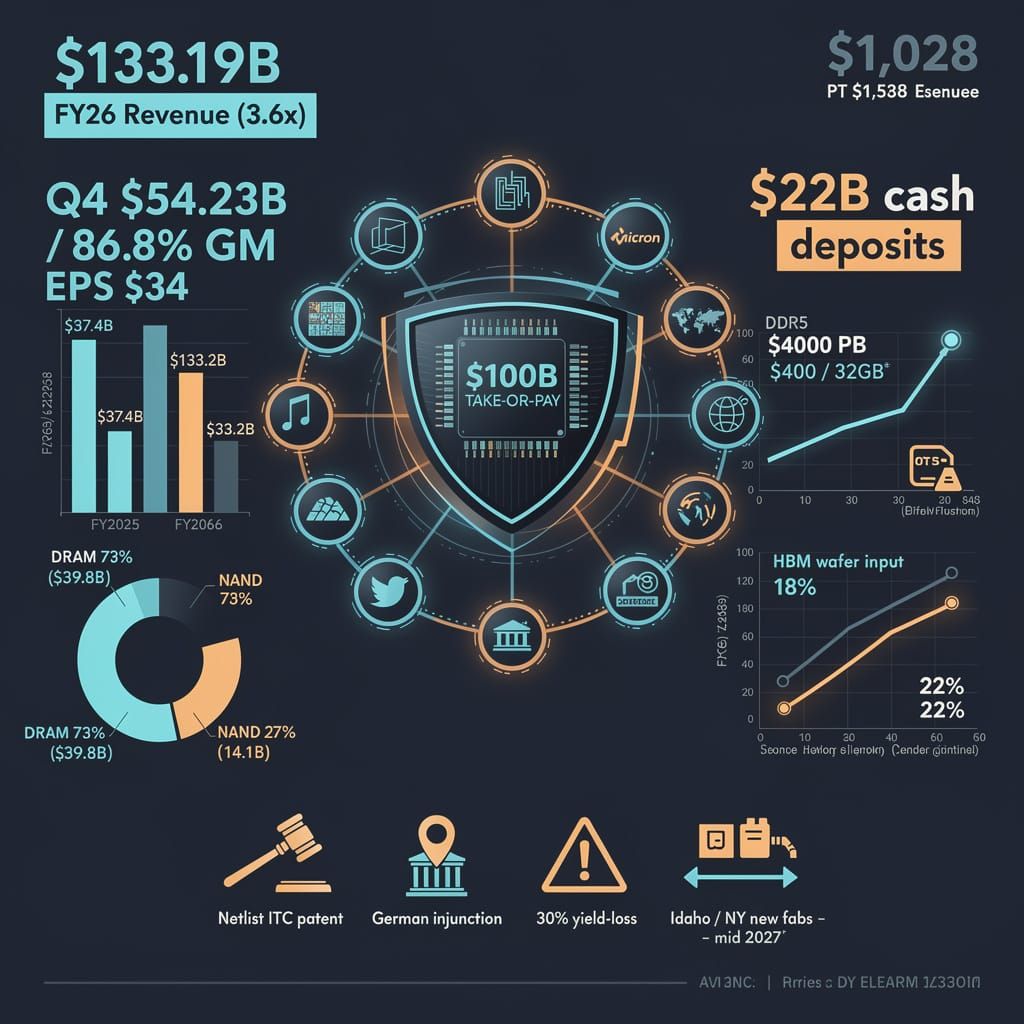
Interesting structural shift at Micron: 16 take-or-pay contracts worth ~$100B in minimum-price revenue through 2030 have replaced spot-market boom-and-bust for a slice of DRAM and NAND supply. Fiscal 2026 revenue hit $133.19B — ~3.6x the prior year — with DRAM alone contributing ~$39.8B of Q4's $54.23B. Backed by ~$22B in deposits, the contracts lock floor prices even if the spot market swings. The caveat: a 30% yield loss on 8-Gb DDR5 dies, HBM wafer reallocation, and live patent battles at the ITC and in Germany could loosen conventional supply—or constrain it—sooner than the fab timeline implies. Memory remains cyclical. The contracts defer a glut; they don't abolish it.
Micron Technology's fiscal Q4 2026 report, released Oct. 1, closed the book on a transformation few cyclical semiconductor companies have engineered: full-year revenue of $133.19 billion, roughly 3.6x the $37.38 billion booked in fiscal 2025. The headline number—$54.23 billion in quarterly revenue, up 31% quarter-over-quarter at an 86.8% GAAP gross margin, on EPS of $33.42 versus a $31.41 consensus—is striking, but the structural fact is the mechanism underneath it. Micron erased the memory industry's spot-price boom-and-bust economics with 16 take-or-pay customer agreements covering fiscal 2026 through 2030, carrying roughly $100 billion in cumulative minimum-price revenue—backed by about $22 billion in cash deposits and letters of credit.
The mechanism: contracts replace the spot market
The take-or-pay structure obligates customers to buy a contracted volume at a floor price regardless of market conditions. Historically, DRAM and NAND pricing moved with spot-market supply, so high-margin quarters were followed by inventory gluts and gross losses. Micron's own fiscal 2023—when gross profit was negative $1.4 billion and operating losses hit $5.7 billion—is the cautionary example.
The agreements change who holds leverage. The 16 deals cover roughly 20% of DRAM and a third of NAND volume through 2030, shifting these from spot-sold product into contracted, floor-priced revenue. Because HBM wafers are dedicated to high-bandwidth memory and cannot be converted back into commodity DDR5 or LPDDR5X, a meaningful slice of supply is effectively pre-sold.
That scarcity has now propagated into visible retail prices. TrendForce reported conventional DRAM contract prices rose sharply in the first half of 2026, with total industry DRAM revenue up 59.5% quarter-over-quarter to roughly $154.73 billion in Q2 2026, and conventional contract-price growth projected to moderate to 13–18% QoQ into Q3 as consumer demand weakens. On Aug. 6, 2026, DDR5 prices surged past $400 per 32GB module as AI-server demand overwhelmed supply. UBS estimated further sequential jumps (Q3 +32%, Q4 +18%) exceeding prior forecasts, tied to a projected supply-demand gap where demand growth of roughly 36% outpaces capacity. HBM wafer input reached ~22% of total DRAM wafer input by end-2026, up from 18% in late 2025—leaving consumer DIMMs that much scarcer. In July 2026, SK Hynix allocations fell to 30% of projected volumes, pushing cost increases into smartphones and automotive systems as well as PC memory.
The pricing rigidity compounds across the industry. Samsung, the largest DRAM maker with a 39.4% share, booked $60.98 billion in Q2 2026 revenue (up 63.4% QoQ) on the same conditions. Samsung confirmed it is outsourcing all incremental conventional DDR5 and SSD production to external partners while reserving internal back-end capacity for advanced HBM packaging—a manufacturing pivot tied to its $1.5 billion Vietnam plant and years-long Onyang HBM construction. Reserve capacity for commodity DRAM is shrinking across vendors, not just at Micron.
What the numbers reveal
Micron's Q4 breakdown shows the concentration: DRAM alone contributed ~$39.8 billion, or 73% of quarterly revenue, versus NAND's ~$14.1 billion. Data-center and cloud memory combined for $34.3 billion across the quarter.
The company's guidance is where the tension sits. Q1 fiscal 2027 midpoint revenue is $61.5 billion (a 13-week-equivalent), implying ~13% sequential growth at a roughly flat ~86.25% gross margin. Analysts note earnings multiples are compressing—from a 12.1x multiple in Q3 to about 9.4x on the Q4 run-rate. That compares against a market assigning Micron a near $1.16 trillion capitalization after a 661% annual share rise to roughly $1,027.77.
JPMorgan's harlan Sur (whose upgrade was reported as Arlan Sur in some wires) upgraded Micron to Overweight on Sept. 29 and raised the price target to $1,540, citing "strong pricing momentum" and structurally tight DRAM and NAND markets; he expects August-quarter revenue above $51.4 billion with roughly 86.2% gross margin—a target the actual Q4 print of $54.23 billion exceeded. Baird simultaneously kept an Underperform rating while lifting its own target to $1,520. Shares traded near $1,072 at the report, up 275% year-to-date. Analysts rate the name 35 buy / 9 strong buy, with a consensus target of $1,513.11, ahead of the stock's price—an unusually large gap that signals the market may already discount the contracted floor.
Micron attributed its revenue growth to strategic customer contracts, HBM supply-chain wins, and DRAM/NAND sales. But it also cautioned that margins are moderating from 86% in Q3 to the guided ~86% for Q1 FY2027, which compresses the valuation multiples the market assigns.
The counter-signal
The take-or-pay fortress has limits. The $24.4 billion in net cash, BBB+ rating, and the 30% dividend increase to $0.15 per quarter are offset by unresolved legal, operational, and political exposures.
On Sept. 29, Netlist filed a complaint with the US International Trade Commission seeking exclusion and cease-and-desist orders against Micron and downstream customers—Google, Nvidia, Broadcom, HPE, Lenovo, and Supermicro—over alleged infringement of two HBM patents in Micron's products. No import ban has been issued; the ITC must investigate first. The filing follows a $445 million Texas judgment against Micron in 2024 and a separate $421 million settlement Netlist reached with Samsung in August 2026. Separately, a German court granted injunctions against Micron on Sept. 18 over YMTC 3D NAND patents in two utility-model cases, which Micron has appealed.
The supply buildout is funded but not guaranteed on schedule. Micron secured up to $6.44 billion in CHIPS Act funding in December 2024, has committed more than $250 billion in US capital expenditure through 2035, and reported investing $3 billion in US semiconductor production and infrastructure in the quarter. First wafers at the Idaho ID1 fab are targeted for mid-2027 (ID2 in late 2028), and construction in Clay, New York began July 2026 ahead of schedule. But the timeline remains dependent on CHIPS Act disbursement cycles and state-level environmental reviews, and operations will stay constrained until that capacity arrives.
There is also a yield caveat inside the scarcity story. Micron disclosed a 30% yield loss on 8-Gb DDR5 dies in 2025 from lithography defects—compounded by wafer reallocation to HBM—which forced cloud providers into spot-market purchases at 2–3x list price. That yield hit inflates the headline scarcity signal and partly accounts for the 3x year-over-year spot-DRAM price spike by late 2025; a yield fix, not new fabs, could loosen conventional DRAM supply sooner than the fab timeline implies.
The bear case projects multiples as low as 6x if uncontracted volume reverts to spot pricing when new fabs come online. Memory remains cyclical—and the industry's traditional pattern is glut after new capacity arrives. TrendForce itself projects conventional DRAM contract-price growth moderating to 13–18% QoQ by Q3 2026 as consumer demand weakens and buyer fatigue builds. Micron's contracts defer that reckoning; they don't abolish it.
What to watch
- Q1 FY2027 actual gross margin versus the ~86.25% guide—whether margin compression is moderating or steeper than management's midpoint, and how the market's 9.4x run-rate multiple responds.
- The ITC's Netlist ruling on HBM patents and any downstream import restrictions affecting Nvidia and Google systems; also whether the German YMTC injunctions survive appeal.
- Fab timing milestones—ID1's first wafer (mid-2027), Singapore output (early 2027), and New York first wafers—alongside any dissolution of the 30% DDR5 yield loss, and whether contract renewals extend beyond 2030 on terms similar to today's.
This is reporting and analysis, not a recommendation. Micron's ability to convert a banner year into durable economics will be tested by the same supply, yield, and law factors that created it.

Comments ()