Federal loyalty essay ban hits a compliance gap: 6,000 postings stayed in limbo
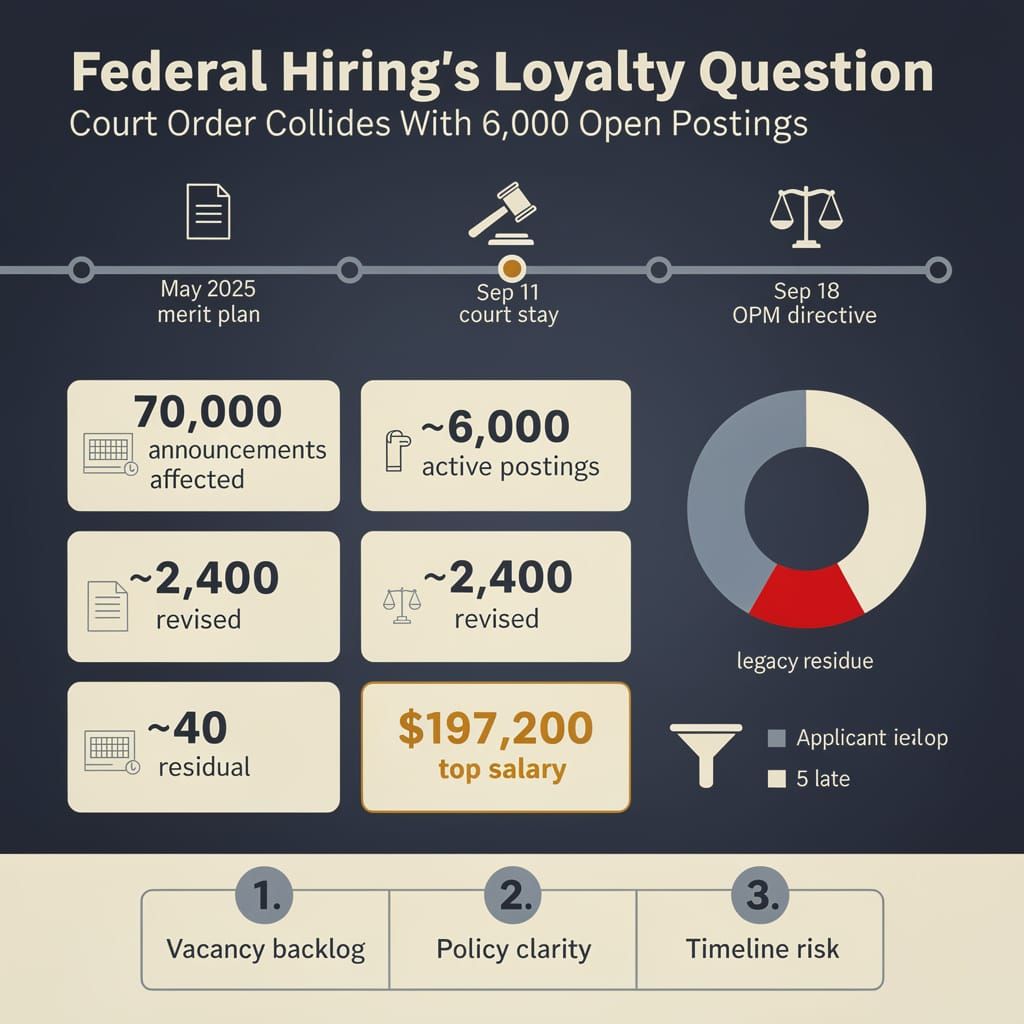
A federal court blocked the loyalty essay in federal hiring—yet ~40 postings (paying up to $197,200) still carried it in late September, and 5 new ones did after OPM's own directive. Why it matters: the cleanup exposed the real problem. Editing ~6,000 active postings individually pits career HR staff against automated requisition templates, so agencies triage—some slots updated, others left to age out. The replacement "Question 3" shifts from allegiance to execution, but its subjective grading invites the same scrutiny that killed the original. Watch three signals: surviving postings after Oct 7, grading variance, and applicant completion rates.
On September 18, the Office of Personnel Management issued a directive that reads, on its face, like a routine administrative correction: agencies must swap a contested essay prompt for a new, implementation-focused question. But the bulletin landed on top of a September 11 federal court stay, and together the two orders forced OPM and roughly 180 agencies into a month-long scramble with a very concrete operational cost.
What actually happened
The original prompt, introduced under the May 2025 merit-hiring plan, asked federal applicants to explain how they would "help advance" a set of listed executive priorities. U.S. District Judge George O'Toole ruled the question likely violated the First Amendment's protection against compelled affirmation, and enjoined its use on September 11. The ruling landed in AFL-CIO v. Kupor, the November 2025 lawsuit where four federal workers filed pseudonymous declarations detailing how the prompt politicized a nonpartisan procedure.
The scale of the mandate was bigger than the draft implied. Over 70,000 federal job announcements had carried the loyalty essay question since the merit hiring plan took hold—the Justice Department and agency records put the number far above the ~6,000 live postings at the moment of the stay. That larger denominator is why the cleanup is slow and uneven.
OPM's replacement—dubbed "the new Question 3"—shifts the burden from allegiance to execution: applicants must describe an example of implementing leadership direction on a strategy or policy decision, and a fifth essay asks them to pick among three named agency-wide priorities and outline how they'd advance one.
The ban is unambiguous. The cleanup is not.
The numbers that tell the story
- ~6,000 active postings still carried the old question as of the stay, per the Justice Department's count
- ~2,400 announcements had been revised by late September, per OPM
- ~40 postings—including roles paying up to $197,200—retained the loyalty question as of the final days of September
- 5 new postings still carried the original phrasing even after OPM's September 18 directive
The residual postings matter because they reveal the mechanism of the failure. Deleting ~6,000 announcements risks killing in-flight pipelines and applicant pools mid-selection. Editing them individually pits career HR staff against a fixed system of requisition templates that feed automated screens. The result is triage: silo by silo, some slots updated, others left to age out. The court's own order made the stakes explicit—it ordered OPM to notify every agency head that used the question and to halt its use, framing the continued screen as irreparable harm to applicants mid-application.
What the change signals to the workforce
Federal law requires nonpartisan, merit-based hiring, and civil servants read the loyalty question through that lens. The more consequential signal, though, is friction.
The new Question 3 is nominally optional, yet OPM pushed it onto every requisition closing on or after September 26. University of Maryland professor Don Kettl has argued its grading is subjective enough that claims of objectivity ring hollow—and that friction has a real cost: applicants who see a politics-adjacent screen on a federal form are measurably less likely to complete it. Quantified across a brochure that touched 70,000 announcements, even a modest yield drop compounds into a large recruitment shortfall. That's a recruitment yield problem, not a morale footnote.
The friction lands on a workforce already being pulled multiple ways at once. The same week the stay was issued, OPM finalized a performance overhaul capping GS, SES, and SP top ratings at 40% agency-wide, requiring at least 60% of bonus dollars to flow to levels 4 and 5, and making performance—not tenure—the primary factor in future reductions in force, with level 5 ratings worth 7 points and level 3 worth 3. Meanwhile OPM is consolidating roughly 119 HR IT systems into a single platform. Field offices now face a simultaneous deadline on the essay prompt, a forced-distribution regime effective July 2026, point-based RIF registers effective September 2, and an HR IT migration—an operator pulling all of those levers at once has limited bandwidth to rework requisitions under a judicial calendar.
Counterevidence is worth noting. OPM told reporters the test "may no longer sit upon any requisition following the ninth day," and the volume of updated postings suggests substantial compliance. Union and ethics challenges did not prevent the question from being written in the first place—enforcement, not drafting, is what moved the needle. That compliance gap is the durable pattern: the stay ordered OPM to police its own delegated field offices, and the residual postings indicate the directive reached headquarters faster than the periphery. Notably, union challenges to the broader forced-distribution system cite the same First Amendment and Civil Service Reform Act grounds, suggesting the loyalty-contamination fight did not end with the essay ban.
What to watch next
Three indicators will tell you whether this is a one-off correction or a durable shift:
- Legacy-posting residue. The ~40 lingering ads inevitably close by month's end. A count of any surviving postings after October 7—OPM's stated cutoff—is the cleanest test of whether the directive reached down to field offices with delegated hiring authority, mirroring the same compliance lag visible in the ~40 stragglers and 5 late postings.
- The new Question 3's grading. If subjective scoring produces demonstrable variance across agencies, expect renewed scrutiny of whether "execution-focused" language merely relabeled the loyalty test—the same pull the 40% rating cap and point-based RIF registers already introduce, where manager discretion over who lands in level 4 versus level 3 now determines not just scores but who survives a reduction in force.
- Applicant volume and self-assessment throughput. If completion rates on Question 3 postings diverge from pre-May 2025 baselines, friction becomes quantifiable. Watch the same signal on the performance side: DHS, whose portal downtime already delayed self-assessments toward a September 30 deadline, is running the forced-distribution system on infrastructure that struggled to stay up during implementation—a direct preview of how the hiring and performance overhauls interact.
The court ordered a consequence. Whether the system absorbed it without collateral damage to 6,000 job pipelines—and without the new rating and RIF rules importing the same loyalty friction by another door—is the part still being written.

Comments ()