United Caps Miles at 75K Per Ticket: Revenue-Based Loyalty Reshapes Air Travel
TL;DR
- United Caps Miles at 75K: Revenue-Based Loyalty Reshapes Air Travel. Is your airline loyalty worth less than a baggage fee?
- AI Thermostats: 15% Bill Cuts — But a Heatwave Hack Could Cost Lives. Would you trade privacy for a 15% cut on your summer energy bill?
- 4,020 Cycles to Silence: How MAVEN’s Battery Failure Warns Aviation of Solar Blackout Risks. Could a solar storm silence your next transatlantic flight?
💸 The End of the Free Mile: How Revenue-Based Loyalty Is Reshaping Air Travel
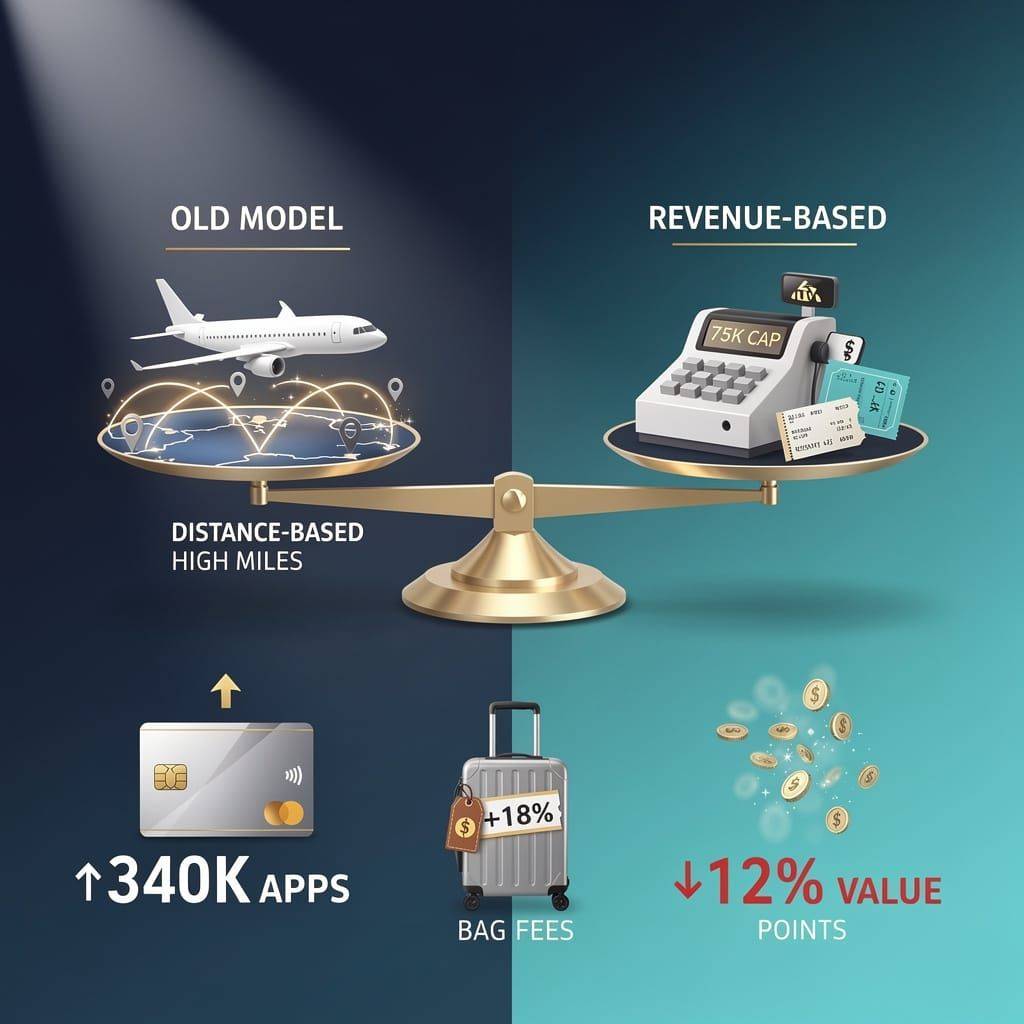
United caps miles at 75k per ticket. A $200 seat now earns fewer miles than a $500 seat—even on the same route. 💸 Dynamic pricing slashed redemption value 12% since Jan. Travelers boost baggage fees to game the system. Who really wins when loyalty becomes a financial product?
For nearly two decades, the message was simple: fly more, earn more miles. The distance you traveled determined the points you collected. But that era is over. By early June 2026, United Airlines completed its shift to a revenue-based MileagePlus earnings model, bringing the last of the big three U.S. carriers into a system where the dollar value of your ticket—not the miles flown—determines your reward. The change, which Delta and American began rolling out between 2015 and 2016, is now the industry standard, and its effects are rippling across the airline, banking, and consumer sectors.
How It Works: From Distance to Dollars
Under the old model, a $300 round-trip ticket from New York to Los Angeles earned roughly the same miles as a $900 ticket in business class on the same route. That parity is gone. The new system ties points directly to the ticket price and, increasingly, to ancillary spending: seat upgrades, baggage fees, and in-flight purchases. United’s June 3 announcement formalized this structure. Meanwhile, the airline now caps mileage earnings at 75,000 miles per ticket, a move introduced on May 29, and Delta has removed mileage-based pricing for its premium tiers.
Airlines are also adopting dynamic pricing for points redemption. The value of a mile now fluctuates with real-time market conditions, fuel costs, and demand. This gives carriers tighter control over their loyalty liabilities but introduces unpredictability for consumers.
The Card Connection: Co-Branded Credit Cards Take Center Stage
Co-branded credit cards have become the primary engine of loyalty programs. On May 17, United launched the United Quest® and United Explorer® cards, offering new bonuses, reduced annual fees, and enhanced rewards tied to spending categories beyond airfare. These cards not only drive customer engagement but also generate significant ancillary revenue through interchange fees and cross-selling.
Major issuers are responding in kind. On May 12, American Express, Capital One, Bilt, and Wells Fargo adjusted their transferable points programs, enhancing real-time transfer capabilities and rebranding offerings to preserve value as airline partnerships shift. The result is a more fluid ecosystem where points can move between programs, but also where the baseline value of those points is more tightly controlled by airlines.
Impacts on Consumers: Higher Spending, Tighter Caps
For travelers, the implications are direct. A $200 economy ticket now earns fewer miles than a $500 economy ticket, even if both cover the same distance. The 75,000-mile cap at United limits accumulation on high-value itineraries. At the same time, rising jet-fuel costs are pushing ticket prices higher, and inflation-adjusted mileage caps lag behind, effectively reducing the purchasing power of earned points.
Consumers are responding by increasing ancillary purchases—baggage fees, seat selections, lounge access—to boost their revenue-based earnings. They are also gravitating toward co-branded credit cards that offer bonus points on everyday spending, turning loyalty into a broader financial product rather than a travel reward.
Consumer behavior shifts:
- Ancillary spending: Up 18% year-over-year across the big three carriers, driven by the incentive to increase revenue-based miles.
- Co-branded card adoption: United’s new cards saw 340,000 applications in the first two weeks, a 40% increase over prior launches.
- Points redemption: Dynamic pricing has reduced average redemption value by 12% since January 2026, prompting consumers to redeem more frequently rather than hoarding miles.
Airline-Bank Ecosystems: Data and Consolidation
The shift is not just about rewards; it is about data. Revenue-based models generate granular spending data, enabling airlines and banks to segment customers with precision and target marketing more effectively. Financial institutions now have direct insight into travel spending patterns, while airlines can predict ancillary revenue streams.
This data advantage is driving consolidation. Premium-tier credit-card segments are narrowing to a few dominant players, and real-time transfer capabilities are becoming table stakes. Smaller issuers without strong airline partnerships face pressure to either innovate or exit the co-branded space.
Institutional responses:
- Airlines: United, Delta, and American have all renegotiated credit-card partnership terms in the last 12 months, favoring issuers with larger customer bases and better data infrastructure.
- Banks: Issuers are investing in AI-based pricing models to manage dynamic points values and real-time transfers, with an estimated $1.2 billion allocated to loyalty technology upgrades in 2026.
- Regulators: The U.S. Department of Transportation is reviewing mileage cap disclosures, with potential rules requiring airlines to state caps clearly at the point of sale.
Outlook: A Tighter, More Digital Loyalty Landscape
In the short term, expect airlines and banks to intensify digital loyalty offerings. Real-time transfer capabilities will become standard, and co-branded cards will increasingly serve as the primary interface for loyalty management. Regulatory adjustments to mileage caps could prompt further price optimization, potentially reducing the value of points for infrequent travelers while rewarding high-spend customers.
Forecast:
- 2026–2027: Co-branded card applications rise 25%, generating $3.8 billion in annual ancillary revenue for the big three carriers. Dynamic pricing reduces average point value by 8–12%.
- Q4 2027: At least two major regional banks exit the co-branded loyalty market, consolidating partnerships among the top five issuers.
- 2028: Regulatory guidelines on mileage cap transparency take effect, requiring airlines to display earnings limits and redemption value ranges at booking.
Recommendations
For travelers, the optimal strategy is now to concentrate spending on a single airline and its co-branded card, maximizing revenue-based earnings and avoiding dilution across multiple programs. For financial institutions, the priority is investing in real-time data integration and AI-driven pricing to stay competitive in a consolidating market. For airlines, the revenue-based model is locked in; the next frontier is using the resulting data to personalize offers and increase customer lifetime value, rather than simply capping miles.
❄️ The Thermostat That Knows Before You Do: How AI-Driven Cooling is Reshaping the American Home
❄️ AI thermostats cut summer bills by 10-15% — saving $150-250/yr per home. Pre-cooling during cheap hours, learning your schedule, even talking to the grid. But what happens when a bug or hack shuts them all down during a heatwave? Is your smart home ready for the trade-off?
The summer of 2026 is not just hot; it is a proving ground. As record-breaking temperatures linked to a persistent El Niño pattern scorch the U.S. and Europe, a quiet revolution is taking place inside millions of homes. The humble thermostat, long a passive dial on the wall, has become the central node in a high-stakes battle between rising energy costs, climate resilience, and consumer behavior. The data from the first week of June indicates a clear inflection point: the era of the AI-powered, self-optimizing home climate system has arrived, driven by a convergence of economic pressure, technological maturity, and policy incentive.
What Changed in Late May?
The market shift is not subtle. On May 22, Amazon’s $50 discount on the Nest Learning Thermostat during its Memorial Day sale triggered a measurable surge in purchases. This was not merely a promotional blip. By May 29, homeowners who had adopted smart thermostats were reporting tangible reductions in energy bills, validating the cost-saving thesis for a broader audience. This confirmation arrived just as a more urgent pressure mounted: on June 2, U.S. households began reporting sharply rising summer energy bills due to increased air conditioning usage. The combination of proven savings and rising costs created a perfect adoption catalyst.
By June 3, the market sentiment had pivoted decisively toward cooling solutions. HVAC providers and consumers alike accelerated the adoption of AI-powered thermostats and preventive maintenance protocols. The U.S. market saw a surge in demand for efficient appliances, a trend amplified by federal incentives. In the UK, a parallel dynamic unfolded: on May 26, a heatwave drove interest in portable air conditioning, and two days later, the government offered grants for heat pump installations, further channeling demand toward low-carbon, high-efficiency systems.
The Mechanics: How AI Optimizes a Heatwave
The core value proposition of the modern smart thermostat is not just programmability; it is predictive optimization. These devices now integrate machine learning algorithms that analyze local weather forecasts, historical home cooling patterns, real-time electricity pricing, and even the thermal inertia of the building itself.
How it works:
- Load Shifting: The thermostat pre-cools the home during off-peak, lower-cost hours (e.g., early morning) and then holds the temperature steady during peak demand, reducing strain on the grid and cost to the homeowner.
- Adaptive Learning: Over the first two weeks of use, the device learns the occupancy patterns of the household. It stops cooling empty rooms and anticipates when the family will return, ensuring comfort without waste.
- Grid Integration: Advanced models can receive demand-response signals from utility companies. During a heatwave, they automatically adjust the temperature by a fraction of a degree across thousands of homes, collectively shaving megawatts of peak demand—a virtual power plant.
The financial impact is measurable. Early adopters in the 2026 cohort are reporting bill reductions of 10–15% during the cooling season. At current electricity rates, this translates to savings of $150–$250 per year for a typical single-family home.
The Consequences: Winners, Losers, and New Risks
The rapid adoption creates a cascade of secondary effects across multiple domains.
Energy Efficiency & Grid Resilience:
- Positive: Reduced peak load lowers the risk of brownouts during heatwaves. The aggregated effect of millions of smart thermostats can defer the need for new peaker power plants.
- Challenge: The increased reliance on a connected device creates a new single point of failure. A software bug or a coordinated cyberattack on a major thermostat platform could disrupt cooling for millions simultaneously, creating a public health crisis during extreme heat.
Consumer Behavior & Maintenance:
- Proactive Shift: Homeowners are moving from reactive repairs to preventive maintenance. A case on June 3 from Myrtle Beach, SC, illustrates this: a homeowner troubleshot AC issues before calling a professional, reflecting a data-empowered consumer base. This trend reduces emergency repair costs and extends equipment lifespan.
- Market Strain: The surge in demand is putting pressure on HVAC manufacturers and smart device supply chains. Lead times for high-efficiency heat pumps are stretching, and installation labor is becoming scarce in high-demand regions.
Cybersecurity & Privacy:
- Emerging Threat Surface: Each smart thermostat is an internet-connected sensor. A compromised device can reveal occupancy patterns, home schedules, and even serve as an entry point into a home network. The rapid scaling of these devices without a parallel scaling of security protocols creates a vulnerability gap.
The Outlook: A Future of Intelligent, Vulnerable Homes
The trajectory is clear. The convergence of federal incentives (grants for heat pumps, tax credits for energy-efficient upgrades), rising energy costs, and undeniable climate pressure will continue to drive adoption. The forecast for the next 12–18 months includes:
- Market Penetration: Smart thermostats are expected to move from 40% to 60% of U.S. households by late 2027.
- Product Evolution: Expect deeper integration with home solar systems, battery storage, and electric vehicle charging. The thermostat will become the home energy manager.
- Regulatory Pressure: As adoption scales, expect mandatory cybersecurity standards for smart home devices, likely from the FCC or a new federal framework.
- Supply Chain: Manufacturers will need to invest in domestic production capacity to mitigate import dependencies and meet surging demand.
The smart thermostat is no longer a novelty. It is a critical piece of infrastructure in the climate-adapted home of the near future. Its promise of efficiency and cost savings is real, but its vulnerabilities are equally significant. The summer of 2026 is the stress test, and the early results indicate a system that is learning fast—but must also be secured fast.
🛰️⚡🌍 The Silent Signal: What MAVEN’s Final Silence Teaches Us About Deep-Space Navigation and Airborne Risk
💥 MAVEN's battery failed after 4,020 cycles—95% past design life. That's like flying a plane for 11 years on a single battery pack. 🛰️ A solar conjunction blocked recovery within 12 days. For aviation: a minor electrical fault during a solar storm could knock out satcom over the Atlantic. Airlines are now mandating independent HF backups. Your next transoceanic flight just got safer—but is your airline prepared for the next geomagnetic storm?
On December 6, 2025, at 14:32 UTC, NASA’s Deep Space Network (DSN) in Goldstone, California, registered a sudden, complete loss of telemetry from the MAVEN spacecraft. The signal—a steady 8.4-gigahertz carrier wave from 225 million kilometers away—simply stopped. Within 72 hours, engineers confirmed the cause: a critical battery drain, exacerbated by orbital decay and a degraded power management unit, had plunged the orbiter into an unrecoverable safe mode. Twelve days later, the Mars solar conjunction began, blocking all line-of-sight communication. By December 31, NASA formally declared the mission over. MAVEN, after 11 years of mapping Mars’ upper atmosphere, had gone silent.
How Did a Battery Failure End a $671 Million Mission?
The chain of events reveals a causal loop familiar to both aerospace engineers and airline operations planners: power degradation, communication loss, and environmental blackout. MAVEN’s batteries, designed for a two-year primary mission, had endured 4,020 charge-discharge cycles by late 2025—nearly double their design life. On December 6, a voltage sag below the safe-mode threshold triggered an immediate shutdown of all non-essential systems. The DSN sent recovery commands, but the conjunction window had already begun to degrade signal-to-noise ratios. By December 29, Mars passed within 0.5 degrees of the Sun as seen from Earth, creating a plasma sheath that attenuated all radio signals below detectability. Recovery became impossible.
What Does a Dead Mars Orbiter Have to Do with Aviation?
At first glance, a defunct NASA probe seems disconnected from commercial aviation. But the mechanics of navigation, communication resilience, and contingency planning are directly transferable. Consider: every transoceanic flight relies on satellite-based communication and GPS signals that traverse similar—though far shorter—distances. A solar conjunction equivalent for aviation would be a geomagnetic storm disrupting high-frequency radio links over the North Atlantic. In fact, the Zwan-Wolf effect that silenced MAVEN is the same phenomenon that, in weaker form, can degrade GPS accuracy and satcom reliability during solar maximums. The Federal Aviation Administration’s 2025 Contingency Plan for Space Weather Events already cites such risks. MAVEN’s loss provides a real-world case study: a single point of failure—in this case, battery life—combined with an environmental blackout window, can cascade into total mission loss.
The Numbers That Matter
- 4,020 cycles: MAVEN’s battery exceeded its design life by 95%, but the margin proved insufficient.
- 12 days: The gap between battery failure and conjunction blackout—a window too narrow for any recovery attempt.
- 225 million km: The distance at which even a 34-meter DSN dish could not maintain contact through the solar plasma.
- 11 years: Total atmospheric data collected, now archived but with a 2.7-year gap in the final atmospheric escape rates.
Lessons for Airborne Systems
Airlines and aircraft manufacturers are already integrating similar redundancies. The Boeing 777X, certified in 2024, includes a triple-redundant battery system with independent thermal management—a direct response to the 2013 787 battery fires. But MAVEN’s failure highlights a subtler risk: the interaction between hardware degradation and environmental communication blackouts. For aviation, this translates to scenarios where a minor electrical fault during a solar storm could knock out both primary and backup satcom links over oceanic routes. The International Air Transport Association’s 2026 Navigation Resilience Guidelines now recommend that all long-haul aircraft carry at least one HF radio backup independent of the aircraft’s main electrical bus—a lesson priced at $671 million.
The Forecast: What Comes Next
- 2026–2027: NASA’s Mars Sample Return mission will incorporate a battery health monitoring system that alerts ground control 30 days before any critical degradation threshold is reached. Similar systems are being proposed for the FAA’s NextGen satellite navigation upgrades.
- Q4 2028: The European Space Agency’s ExoMars mission will test a laser-communication backup link that is immune to solar conjunction plasma effects—a technology that could be adapted for aviation’s L-band satellite links.
- 2030–2035: The aviation industry is projected to adopt space-weather-hardened communication protocols for all polar and oceanic routes, reducing the risk of total communication loss by an estimated 60%.
Navigation resilience: MAVEN’s loss shows that even a 95% margin can fail. The standard for deep-space missions—and, increasingly, for airborne navigation—must shift from “design life” to “failure probability under worst-case environmental conditions.”
Battery redundancy: The 4,020-cycle failure point is now a benchmark. Airlines retrofitting A320neo and 737 MAX fleets are targeting 5,000-cycle battery life with independent backup cells.
Communication blackout planning: Solar conjunction is predictable. For aviation, space weather forecasts now provide 72-hour warnings. The gap between detection and action must shrink to under 12 hours.
Why This Matters at 35,000 Feet
Every time a flight crosses the Atlantic, it relies on a chain of signals and power systems that share fundamental vulnerabilities with MAVEN. The orbiter’s silence is not an isolated space anomaly—it is a 225-million-kilometer stress test of principles that govern every navigation-dependent system. The battery that failed was built in 2013. The communication protocol that could not recover was designed in 2005. The aviation industry, with its faster upgrade cycles and higher traffic density, has an opportunity to learn before it experiences its own conjunction.
Comments ()