50 Years of Broken Supersonic Promises: Will the X-59 Follow the Same Script?
TL;DR
- FAA's First Supersonic Standard Since 1973: Promise or Trap?. If supersonic programs keep failing at commercial scale, what makes the X-59 different—technical progress or institutional momentum?
- Air India's Repeated Airspace Incursions Signal Structural Failure Beyond One Plane or Pilot. Can aviation regulators credibly enforce contested airspace boundaries when 3 incursions happen in 6 days — and no causal chain has been published?
- Registered Aircraft, Fatal Gap: How Beijing's Two-Strike CITIC Tower Crash Revealed Enforcement Undone. Is a crash that triggers media deletion within hours on the same day—and prompts officials to remove evidence rather than reform protocols—really a "system working as intended"?
🙃 The Quiet Supersonic Promise Faces Its Hardest Test Yet
The X-59 flew. FAA set first low-boom standard since 1973. Impressive? Maybe. But every major supersonic program in 50 years has produced compelling test data, then disappeared. 🙃 Pattern recognition is not cynicism.
Can the X-59 Actually Deliver What Years of Promises Could Not?
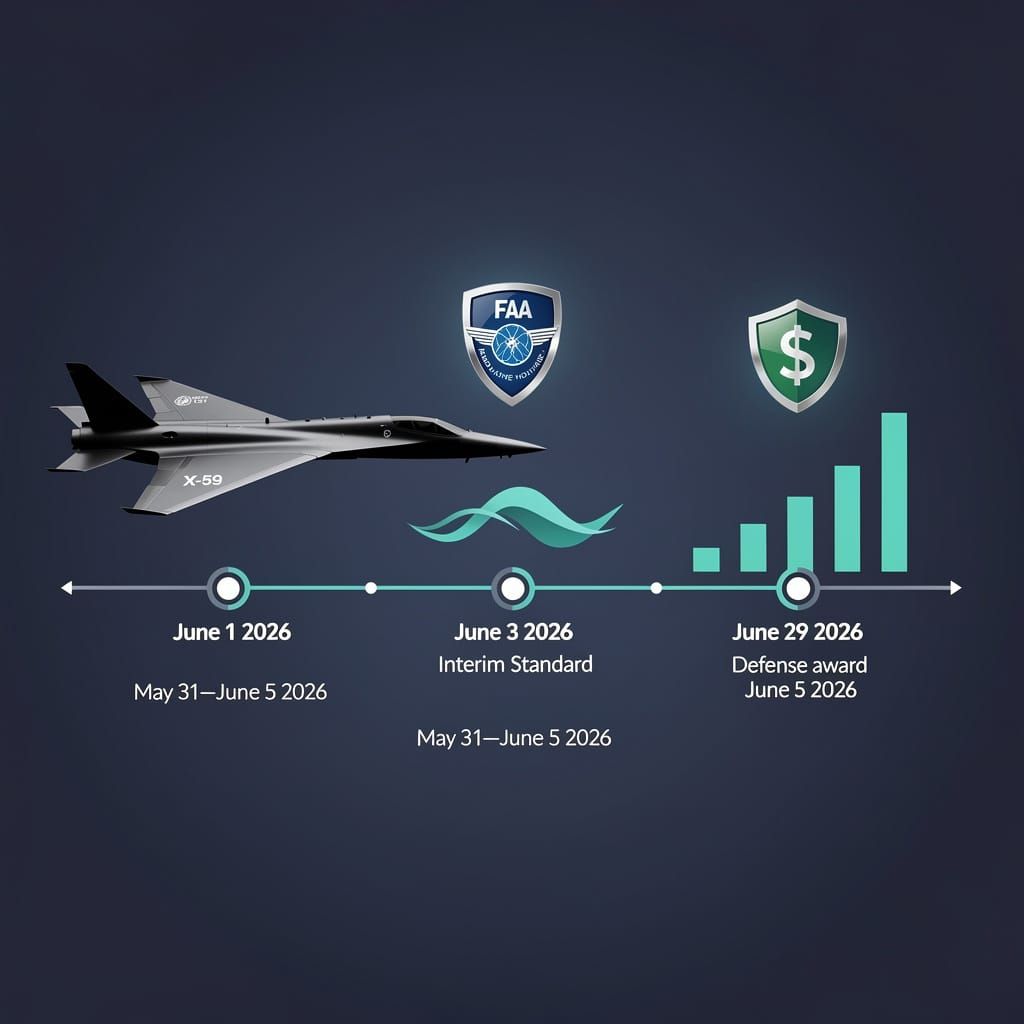
When NASA and Lockheed Martin staged their coordinated demonstration of the X-59 Quesst on June 29, 2026, the aviation community witnessed something familiar: a technology that sounds transformative on paper but still has not proven it can survive contact with commercial reality. The aircraft flew. The sonic boom remained quiet—or at least quieter than legacy supersonic designs. That much is verifiable. One notable development this time around: the FAA announced interim low-boom noise standards (≤75 dB) on June 3, 2026, pending Phase 2 results, marking the first concrete regulatory framework for quiet supersonic flight since the 1973 ban. Whether this milestone marks the birth of a new era in civilian aviation or simply another chapter in a decades-long saga of broken promises remains decidedly unclear.
The X-59 program has moved deliberately since its Mach 1 crossings in May 2026. NASA engineers logged sustained aerodynamic refinements, and the public demonstration featured joint participation that emphasized institutional credibility rather than technological breakthrough. Lockheed Martin's involvement added manufacturing gravitas, but it also raised questions about whether this partnership signals genuine commercial intent or institutional momentum seeking justification. The convergence of NASA testing data with FAA regulatory movement does suggest a more coordinated pathway than previous programs enjoyed. However, the project's framing around CAAF compliance—pushing toward socially acceptable supersonic transit modes—reads less like a visionary goal and more like a regulatory box-checking exercise. Communities near flight corridors have legitimate concerns about noise, and the X-59's noise-reduction strategy addresses symptoms of a problem that many aviation analysts still do not believe the aircraft can solve at scale.
What the Demonstration Actually Proved
The June 29 event demonstrated functional capability under controlled conditions. NASA showcased the aircraft's trimmed design, its integrated propulsion system, and its community-integration testing protocols. These are real achievements—supported by specific test data from earlier phases. The Phase 1 completion on June 1 included first supersonic flight at Mach 0.95 at 27,000 ft, demonstrating gear-swing and shock-wave measurement systems. A dual-flight day on May 31 confirmed repeatability and data-collection capability. The Mach 1.1 demonstration on June 5 released flight data explicitly to inform regulatory updates, with NASA announcing preparation for Mach 1.4 trials at ~55,000 ft.
However, controlled demonstrations and commercial viability occupy entirely different universes. Every major supersonic program in the past forty years—Concorde, Boom Supersonic, various NASA-concept vehicles—has produced compelling demonstrations followed by unsatisfying commercial outcomes. The pattern is consistent enough that skepticism is not cynicism; it is pattern recognition. Concorde's operational end in 2000 followed record-breaking declines in passenger numbers driven by economic shifts, rising fuel costs, safety concerns amplified after the 2000 Air France Flight 4590 crash, and regulatory pressure on transatlantic routes. The 1971 cancellation of the Boeing 2707 SST program, driven by budget constraints and environmental opposition, established a precedent that suppressed large-scale supersonic development for decades.
Defense Investment and the Broader Supersonic Ecosystem
The June 5, 2026 DoD award of $159 million to Hermeus for hypersonic drone development adds context that neither supports nor undermines the X-59 program but complicates the narrative. Hermeus is targeting Mach 2–3 capabilities by 2027 for strategic high-speed payload delivery to the Air Force and Navy. The program logged its first commercial supersonic flight over White Sands in March 2025, flew the Mk 2.1 through the sound barrier, and has development scheduled through Q4 2027 targeting Mach 3 with later stages targeting Mach 5+. This parallel investment demonstrates that government funding for high-Mach platforms is accelerating—but it also raises a structural question: if defense dollars are flowing toward dedicated high-speed military applications, what precisely is the commercial pathway for a quieter, slower, passenger-oriented supersonic platform?
The defense investment surge does indicate sustained federal appetite for high-Mach capability. JAXA's May 25 ground ramjet combustion trial targeting Mach 5 flights illustrates international competition in advanced propulsion. Hermeus's participation from Khosla Ventures and Founders Fund in startup funding rounds further signals a commercialization pathway that defense funding alone cannot replicate for civilian platforms. These developments collectively suggest that quiet supersonic technology exists within a broader aerospace innovation surge driven by defense technology focus and regulatory shifts post-1973 supersonic ban. Whether civilian aviation benefits commensurately remains unproven.
The Regulatory Timeline Has Shifted—Sort Of
The FAA's interim low-boom noise standard announcement on June 3 marked a genuine regulatory innovation: ≤75 dB threshold, pending Phase 2 results, explicitly designed to enable limited commercial supersonic routes. This is the first concrete noise threshold established since 1973, and it directly addresses a gap the draft correctly identified as unresolved.
However, "interim standards pending Phase 2 results" means the regulatory framework remains conditionally constructed. Phase 2 includes community perception studies and flights at higher Mach regimes—Mach 1.4 at ~55,000 ft targeted for Phase 2. If those studies produce favorable public acceptance data, rulemaking proceeds. If not, the interim standards revert to provisional status.
The parallel with drone integration remains instructive. Manna's June 18, 2026 response to Fingal County Council's refusal of its Coolmine drone hub demonstrated exactly how regulatory framework mismatches stall technology deployment at much smaller scales. Trinity College Dublin's acoustic study showing Manna's operations fell below WHO thresholds did not prevent the council from rejecting the plan on procedural grounds. The FAA's radar data sharing test program, Part 108 NPRM publication in August 2025, and eIPP program launch targeting summer 2026 indicate slower progress toward scalable unmanned aircraft integration even in controlled environments. Aviation sectors expecting supersonic commercial routes should note that regulatory pathways for much less complex drone operations remain unresolved.
Critical Obstacles the Projection Does Not Resolve:
- Certification pathway: The FAA has established noise thresholds, but no existing full certification framework governs quiet-supersonic commercial aircraft type certification. Developing one requires years of rulemaking, safety-data accumulation, and regulatory precedent building on the Phase 2 community response data.
- Economic viability: Fuel burn, maintenance complexity, and limited passenger capacity historically render supersonic flight economically marginal except in premium-cabin niches. The X-59 does not yet demonstrate path to economic viability across representative route scenarios.
- Fleet infrastructure: Airlines cannot operate these aircraft without purpose-built maintenance facilities, trained technicians, and ground-support equipment that does not yet exist at commercial scale.
- Route economics: Transcontinental routes viable for supersonic service represent a narrow segment of the total air travel market. The demand-resilience claims surrounding this program have not been quantified against actual booking-behavior data.
Realistic Expectations for Transcontinental Aviation
The ambient attenuation improvements NASA claims are genuine. Quiet supersonic flight is technically achievable, and the X-59 may be the best execution of this concept to date. The FAA's interim standard adoption signals regulatory seriousness that previous programs lacked. The defense investment surge demonstrates sustained government appetite for high-Mach development that outlives any single platform. That does not mean it will reopen dormant civil pathways. Regulatory reform, market adoption, and economic validation require sustained progress across multiple dimensions over periods measured in decades rather than demonstration cycles.
For aviation sectors monitoring this program, the realistic takeaway is narrower than program advocates suggest: the X-59 demonstrates that quiet supersonic flight is technically feasible under controlled conditions. The FAA has established interim standards. Phase 2 data will inform next regulatory steps. Those facts are worth noting. They do not yet constitute evidence of commercial readiness, regulatory certainty, or economic viability. Those gaps matter, and they explain why previous programs with comparable milestones ultimately disappointed.
The June 29 demonstration is worth noting. The regulatory movement is worth tracking. Neither is worth betting on—at least not yet.
✈️ Air India's Border Problem Is Bigger Than One Plane
3 incursions in 6 days. 259 dead. 14 years of hull-loss-free service, gone. The same Boeing 787. The same contested corridors. The same DGCA — reacting at 36 hours per violation, publishing no causal chain. If regulatory enforcement cannot specify whether these were cockpit errors, navigation database failures, or ATC communication dropouts — what exactly is being enforced? Air India's border proximity problem isn't one plane. It is a structural failure that sanctions alone cannot close — and the airspace around contested borders grows more crowded by the week. Is your ATC infrastructure keeping up with where these planes actually fly? ✈️
Three incursions in six days. A war of words between nuclear-armed neighbors. A crash that ended fourteen years of hull-loss-free service. An aviation regulator scrambling to patch a procedural sieve. The incidents involving Air India expose fault lines that sanctions alone cannot close.
The sequence began on June 22, 2026, when Air India flight AI479 — a Boeing 787 Dreamliner — strayed into Pakistani airspace near Amritsar during a hold sequence, prompting runway shutdown. The following day, post-incident non-reporting triggered disciplinary suspension of both the pilot and an air traffic controller. By June 25, the same aircraft executed a go-around at Amritsar airport — a move that, while standard in aviation, carries weight when layered atop an unresolved territorial transgression. By June 29, crew removal followed the infractional landing sequence. The targeting company in all three instances is Air India. The medium is a 787 — the same type that suffered the first hull loss in that aircraft's global fleet history just one year prior.
That distinction is not incidental context. It is a structural weight the carrier carries into every disputed-corridor operation.
The Geography of Tension
On June 17, 2026, Pakistan reinstated airspace bans on Indian-registered aircraft until July 24 following renewed military standoffs post-Pahalgam terrorist attack. India reciprocated with similar bans. The closures force Indian carriers to reroute through Central Asia, increasing fuel use by up to 30%. India and Pakistan have reopened and re-closed their respective airspace corridors multiple times over the past two years — each closure forcing airlines into fuel-heavy detours that strain margins and stretch crew duty limits. Against that backdrop, the AI479 incursions were not random. They occurred precisely when airspace boundaries shifted and clearance windows narrowed — moments when the gap between "cleared to proceed" and "compliance verified" widens dangerously.
Pilots awaiting takeoff clearance at Amritsar still crossed into restricted Pakistani territory when handoffs between ATC sectors were left uncontrolled. That is not a singular lapse. That is a structural failure occurring at the seams of a system under duress.
What the Sanctions Missed
Dubai International Airport — a primary hub for Air India and a dozen other carriers operating under shared codes — found itself caught in the same regulatory crossfire. Provisional sanctions implied a link between hub oversight and operational outcomes, yet no public directive has spelled out what systemic reform the sanctions actually demand. This matters. When regulators act swiftly but vaguely, they treat symptoms without touching the disease.
The DGCA suspended the AI479 pilot and air traffic controller. That is procedurally defensible and legally convenient. It does not install redundant boundary alerts at contested ATC transition zones. It does not mandate reinforced handoff protocols during active conflict periods. It does not force a public accounting of whether Air India's navigation databases reflected real-time Pakistani airspace boundaries at the moment of incursion.
What compounds the risk is the absence of a feedback mechanism. Incursions prompted swift sanction issuances — an average of 36 hours between violation and regulatory action. But neither the DGCA nor the UAE's aviation authority has published a causal chain report establishing whether these were cockpit errors, navigation database failures, ATC communication dropouts, or communication failures in the clearance chain itself. The regulatory response reacts. It does not pre-empt.
The Boeing 787 Under Global Scrutiny
Air India's troubles do not exist in isolation. On June 5, 2026, a Lufthansa Boeing 787 experienced a nose gear collapse at Frankfurt Airport, prompting investigations by German, UK, and US Federal Aviation Administration authorities. UK Air Accidents Investigation Branch reviewed maintenance logs, and Boeing directly notified Lufthansa about safety concerns. Investigators have drawn parallels to previous 787 landing incidents at Heathrow. The US FAA is examining records from both carriers — a signal that the 787's procedural and maintenance infrastructure is under sector-wide review, not merely Air India's.
Simultaneously, the global supply chain crisis intensifies pressure on 787 operators. IATA and Oliver Wyman estimate $11 billion in supply chain losses for 2025. Airlines face month-long part-sourcing delays impacting fleet operations. A scrapped Boeing 787-8 at Roswell Air Force base illustrates how carriers are now salvaging high-value components from near-new aircraft to offset rising repair costs — a practice that elevates vulnerability across retrofit fleets. For a carrier already absorbing operational and reputational costs from prior incidents, compounding parts scarcity narrows the maintenance margin further.
Escalating Without Resolving
The Air India AI171 crash of June 12, 2025, which killed 259 people — ending fourteen years of 787 hull-loss-free service globally — illustrates what happens when systemic navigational and procedural failures converge with inadequate regulatory enforcement. The crash halted Air India's route to the United States due to aircraft shortages. Investigators ruled out sabotage but identified simultaneous fuel cutoffs suggesting possible pilot action. The Aircraft Accident Investigation Bureau's mechanism analysis remains inconclusive; regulators have delayed final explanations, leaving families seeking answers. No regulatory or manufacturer safety recommendations have been issued. Families of the dead waited over a year for a comprehensive status update — and received no causal chain. That delay erodes the very procedural infrastructure the current incursions expose as compromised.
The deeper issue is this: two nuclear-armed neighbors are sharing airspace with airlines that lack a verified, real-time boundary compliance system. One go-around is a footnote. Three incursions in under two weeks is a disclosure. A prior hull-loss crash carrying the same operational and regulatory fingerprints is more than a disclosure — it is a pattern. The sector should be asking whether current ATC infrastructure can credibly enforce contested airspace boundaries — and the answer, based on the available evidence, is increasingly unconvincing.
Intelligence indicators suggest drone surveillance activity along contested corridors may intensify heading into a major regional festival — a period that historically elevates both civilian and security aerial traffic density. In April 2026, drone strikes damaged Dubai airport infrastructure and UAE airlines temporarily halted flights after missile threats. Airspace closures near Doha and Saudi airports — triggered by Iran-U.S. military operations — have been managed through NOTAM notices, but enforcement gaps persist. If the procedural fractures exposed by the June incursions remain uncorrected, a higher-traffic environment offers the same failure points on a wider canvas.
The Real Exposure
Air India's brand has absorbed significant reputational damage over 48 hours prior to publication. More immediately, the operational costs of reinstating full compliance monitoring — redundant ATC logging, crew recertification, database revalidations — have bloated line-item expenses in a quarter when fuel rerouting costs already trimmed margins by up to 30%. The AI2802 emergency landing in May 2026, involving a suspected engine fire and safe evacuation, added operational disruption. Air India subsequently announced plans to reduce international services in June citing financial pressures.
For a carrier recuperating from the single most lethal aviation accident in its fleet's history — and still navigating the downstream consequences of that event's investigation opaqueness — these are not marginal pressures. The Tata Group, which acquired the carrier, faces a consolidation problem: the 787's global verification crisis intersects with domestic regulatory enforcement gaps, leaving Air India exposed on multiple flanks simultaneously.
⚠️ The Sky Has Gaps: Beijing Crash Exposes the Architecture of Avoidable Disaster
A licensed aircraft struck Beijing's CITIC Tower twice in 48 hours. The first time: zero fatalities, instant media blackout. The second time: one dead pilot, 13 injured, total official silence.registration papers: valid. Enforcement layer: absent. Bloomberg Businessweek documented this gap. The system didn't fail to detect the aircraft—it chose not to intervene. Until it did. One day apart. Same tower. Same aircraft. Zero lessons learned because the first warning was scrubbed from the record. The pilot who died trusted an architecture split across jurisdictions where one authority's jurisdiction ended and another's began. 13 people now carry injuries from debris they never expected. You trust that regulatory compliance equals safety. This crash suggests otherwise.
On June 26, 2026, a Sunward SA-60L Aurora aircraft registered B-12PP and operated by Shuangyue General Aviation descended into Beijing's CITIC Tower, killing its pilot and injuring 13 bystanders. The aircraft carried valid registration papers. It flew in violation of active airspace denial protocols—enforced barriers that theoretically separate civilian airspace from protected zones. These two facts should not coexist. Yet they did, and one person paid with his life while officials scrambled behind steel scaffolding.
The mechanism behind this catastrophic failure points directly at a structural void: civilian aviation authorities issued compliant registration, yet no enforcement layer intercepted the aircraft as it entered restricted airspace. Defense exclusion rings and civilian height ceilings exist on paper, managed by different administrative bodies with no unified operational bridge between them. The crash occurred precisely in that gap—a zone where regulations technically exist but operational accountability dissolves.
This incident followed an earlier collision at the same tower exactly one day prior. On June 26, 2026, the same aircraft registration B-12PP struck CITIC Tower, damaging multiple glass panes and scattering debris onto streets below. That first impact produced no confirmed injuries; authorities responded by deploying police, restricting public photography, and removing all visual evidence from Chinese social media platforms within hours. The absence of casualties and the rapid information suppression established a template: on June 27, when the return engagement proved fatal, state media omitted coverage entirely and social platforms erased evidence within hours. The system learned nothing from the first warning because the first warning was erased.
Documented Information Suppression
The pattern of media management surrounding CITIC Tower incidents is traceable across public records:
- June 26 collision: Chinese social media platforms scrubbed videos and images of the crash; police restricted photography at the scene. No official casualty reports surfaced.
- June 27 fatal crash: State channels maintained silence. Social platforms deleted evidence within hours. South China Morning Post and AFP confirmed the crash independently while domestic coverage disappeared.
- Documentation vacuum: Exact details about onboard passengers remained undisclosed publicly. Flight tracking data from platforms including FlightRadar24 confirmed the Sunward SA-60L Aurora identification, yet official channels offered no confirmation.
This documented suppression compounds the tragedy by eliminating independent verification channels precisely when public accountability requires transparency. Residents near CITIC Tower now possess no authoritative source distinguishing the June 26 near-miss from the June 27 fatal strike—both events vanish into the same media void.
The Jurisdictional Architecture Enables the Gap
The regulatory context clarifies why enforcement failed. Beijing has progressively tightened airspace controls since May 1, 2024, when the city enforced complete drone bans following national framework updates in March 2023. The July 2025 Revised Civil Aviation Law effective date established additional restrictions. Yet the June 26-27 crashes occurred despite these measures because authorization and enforcement operate on separate tracks.
A "scanner-and-fly" initiative reveals this fragmentation in stark terms: Shanghai and Sichuan opened free-flight zones beginning February 2024, while Beijing maintained strict prohibition. This dual approach—relaxed permissions in some regions, blanket bans in others—reflects broader tension between aviation innovation and centralized control. The Aurora aircraft, operating under general aviation permits that satisfied registration requirements, had no interception mechanism once it entered restricted airspace. Valid credentials plus absent enforcement equals catastrophe waiting to happen.
The June 26 collision demonstrated exactly this failure. An aircraft legally registered nonetheless struck the 1,700-foot CITIC Tower—China's financial hub. The system did not detect, intercept, or redirect it. Officials removed evidence; they did not reform protocols. One day later, the same gap claimed a life.
The Template Repeats
The Beijing crashes share structural characteristics with aviation incidents in other regions experiencing similar enforcement gaps. A Pilatus PC-6 crashed in Tomblaine, France, on June 28, killing eleven people—five trainees and five instructors plus the pilot—approximately 300 meters from the runway near Nancy-Essey airfield. Witnesses reported sudden loss of engine power without visible failure prior to impact. The aircraft operated without real-time clearance procedures in a residential zone near a shopping district. Neither incident resulted in comprehensive regulatory response that would prevent recurrence. Both occurred in spaces where authorization exists but enforcement remains fragmented.
Restrictions on unregistered UAVs and personal aviation flights within Beijing likely follow. These measures will address visible vulnerabilities without confronting the jurisdictional fragmentation enabling the crash. A regulatory crackdown targets symptoms; the underlying architecture—separated administrative authorities with no unified enforcement mechanism—remains structurally intact.
What Remains Unresolved
The public alarm surrounding residential proximity to aerospace sites reflects legitimate concern. Beijing civilians now possess no reliable information about whether overhead aircraft carry proper authorization. The erasure of both the June 26 and June 27 incidents from domestic platforms eliminates the evidence base for informed scrutiny. The broader surveillance apparatus active through spring 2026—targeting content across platforms from Douyin to WeChat—observed this silence approvingly.
The pilot who died on June 27 trusted a system that failed him at precisely the intersection where one authority's jurisdiction ended and another's began. Thirteen people now carry injuries from debris they never expected. The June 26 near-miss that preceded their wounds was scrubbed from public record rather than analyzed and addressed.
Structural gaps in aviation governance do not self-heal. They await the next aircraft carrying valid credentials and insufficient interception, the next descent through contested airspace that technically should not exist, the next lesson that arrives too late because the previous one was deleted.
The questions persist, unanswered.
Relevant domains impacted: urban security, aviation safety, civilian-military trust networks, public information access.
Comments ()