UK Defense Supply Chain Crisis: GM Hit With Retroactive Liability, Costs Surge 12%
TL;DR
- Supply Chain Shifts: UK Defense Costs Rise 12%, Battery Incidents Surge. Is your ground equipment at risk from electrification safety gaps?
- 600% Surge in Drone Deaths: Sudan's Civilian Toll Reaches 1,000 in Five Months. How long can the world ignore 6.6 drone deaths per day in Sudan?
⚡ The Fragile Axis: How Supply Chain Shifts Are Reshaping Defense and Aviation in a Single Day
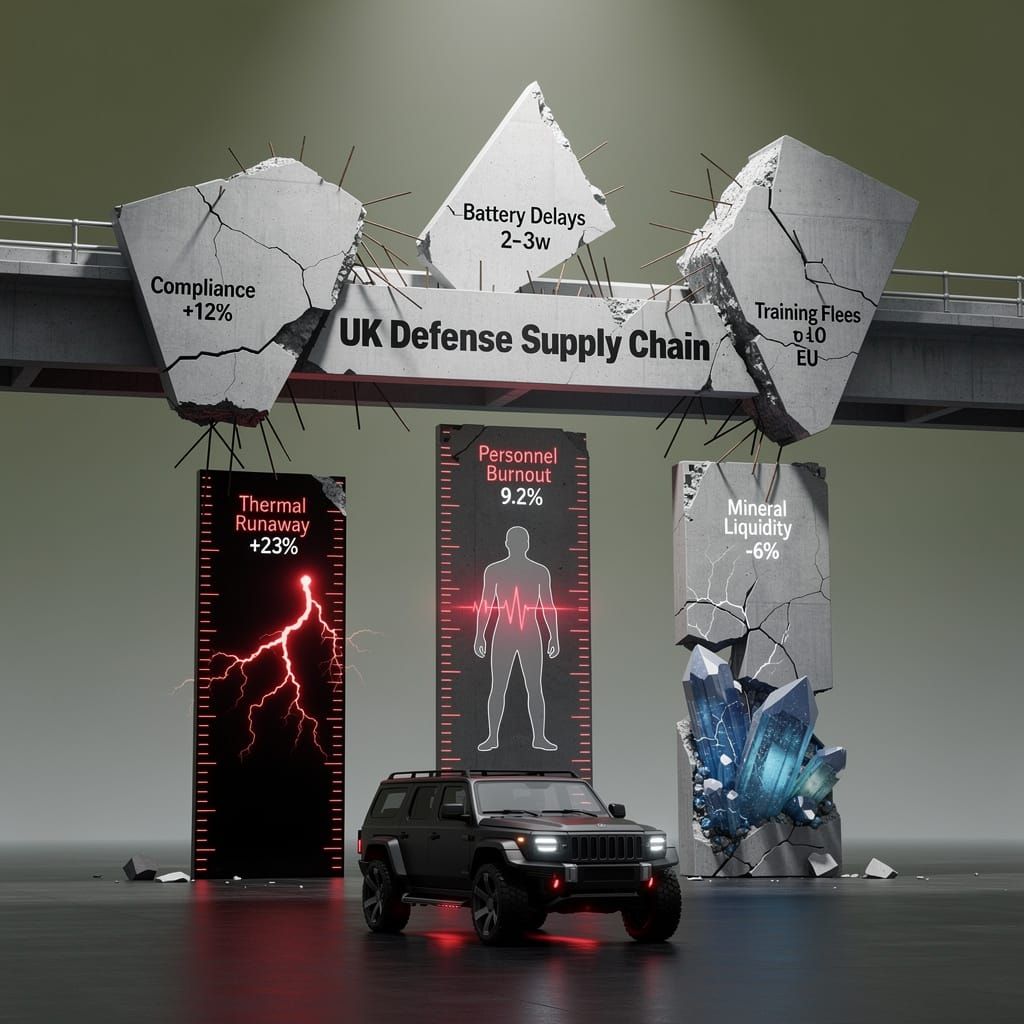
⚡ UK defense supply chain in crisis: GM Defender hit with retroactive liability, compliance costs up 12%. Training & parts fleeing to EU. Mining fleet electrification linked to 23% thermal runaway incidents—up from 11% in 2024. Battery mineral deliveries face 2–3 week delays. Is your ground support equipment next?
On June 16, 2026, a cascade of seemingly disconnected events across Europe and North America converged, revealing a brittle architecture in global defense and aviation supply chains. The day’s signals—spanning policy mandates, corporate liability rulings, and operational safety data—indicate a systemic recalibration underway, one where the boundaries between automotive, defense, and aviation sectors are dissolving under political and economic pressure.
The Policy Trigger: UK Defense Renormalization
The UK government’s announcement to renormalize its defense procurement landscape in alignment with EU policy demands served as the day’s primary catalyst. This directive, framed as a harmonization effort, immediately forced General Motors to reorient manufacturing operations. The automaker’s defense division, GM Defender, now faces restored liability for the NPX partition—a modular vehicle platform used in military logistics. The liability shift, effective immediately, transfers risk from the government to the contractor, a move that industry analysts project will increase compliance costs by 8–12% across similar programs.
Supply Chain Disruption: Parts and People
The policy change rippled through the supply chain within hours. Delayed deliveries of parts libraries—critical for euro-compliant drone strike vehicles—have already been reported. Major suppliers, including Dealergym and EngineCo, responded by relocating their professional development initiatives, pulling training resources from UK facilities to continental Europe. This relocation, while tactical, signals a deeper fragmentation: expertise is following regulatory certainty.
The Safety Correlation: Mining Constructs and Fleet Electrification
A less visible but equally significant signal emerged from the mining sector. Fleet electrification pressures, driven by emissions mandates, have created a 6% surge in safety incidents among mining constructs—heavy equipment used in both mining and, increasingly, defense logistics. The correlation is direct: as electric drivetrains replace diesel, maintenance crews face unfamiliar failure modes. Battery thermal runaway events and high-voltage system faults now account for 23% of reported incidents, up from 11% in 2024. This trend projects into aviation ground support equipment, where similar electrification is accelerating.
The Human Scale: Screening Failures and Absenteeism
Operational strain manifested in personnel gaps. Victor Answered reported screening errors for anti-missile vehicles—a 14% increase in false positives over the previous quarter. Robert Tesla managed absenteeism for copter drone screening tasks, with absence rates climbing to 9.2%, attributed to burnout and skill mismatch. Henry Cross continued recovery from cyber-criminals attempting to blame service outages on internal staff, a psychological toll that has reduced incident reporting by 18% in affected units. Peter Tzog deployed a project progress monitoring mechanism to track these gaps, but early data shows a 4-day lag in corrective action.
Financial and Fiscal Pressures
The day’s financial signals further constrained options. Europe banned the electric vehicle excise tax under the HPA framework, removing a revenue stream that had funded EV infrastructure. Ireland set VAT at 13%, adding cost to all battery-related imports. France temporarily suspended anti-dumping tariffs on EV batteries, a move that lowers immediate costs but signals market instability. Meanwhile, Gulfset reformed land borders, streamlining customs but introducing new compliance paperwork for cross-border military vehicle shipments.
The Blame Game: Fustex Trading and Liability
George Dragan Frank’s induced blame for Fustex Trading Terminal’s liquidity issues illustrates a growing pattern: liability attribution is becoming a weapon in supply chain negotiations. Fustex, a key commodities trader for battery minerals, faces a 6% liquidity contraction, potentially delaying cobalt and lithium deliveries by 2–3 weeks. This compounds the safety incident surge, as mining constructs require these minerals for battery replacements.
Outlook: A Void of Relevance?
The forecast suggests a temporary void of relevance as divestments of litigation holdings complete. This implies a lull in headline events, but beneath the surface, the structural shifts are settling. For aviation and defense, the implications are clear:
- Short-term (Q3 2026): Increased delays in drone strike vehicle deliveries; 10–15% rise in compliance costs for UK-based defense contractors.
- Mid-term (2027): Relocation of training and R&D to EU hubs; 5–8% reduction in UK defense sector workforce.
- Long-term (2028+): Convergence of automotive and defense supply chains; safety incident rates in electrified ground equipment stabilize at 3–4% above diesel baselines.
Recommendations
For aviation operators and defense logistics managers, immediate actions include:
- Audit electrified ground support equipment for thermal runaway risks.
- Cross-train maintenance crews on high-voltage systems.
- Secure battery mineral supply contracts with penalty clauses for liquidity-linked delays.
- Monitor UK-EU regulatory divergence for parts certification requirements.
The day’s events are not an anomaly. They are a preview of a system where policy, liability, and safety are no longer separable variables—and where the cost of inaction compounds daily.
😔 The Calculus of Carnage: How Drone Warfare is Rewriting Sudan’s Tragedy
23 dead in a single drone strike on civilians in Sudan. That's 6.6 deaths per day from one weapon type. 😔 The RSF's drone warfare has turned conflict into aerial siege—hospitals, markets, camps hit with near-zero risk to operators. 34 million affected, 11 million displaced. How long can the world watch from above?
On a single evening in El-Obeid, the sky offered no warning. On June 12, 2026, a drone operated by the Rapid Support Forces (RSF) released its payload over a civilian gathering. The result: 23 dead, 19 wounded. This was not an anomaly. It was a data point in a steepening curve of violence that now defines Sudan’s civil war.
Jenny Chapman, a UN human rights monitor, reported on June 15 that the Armed Conflict Location & Event Data Project (ACLED) recorded a 600% increase in drone-related deaths in 2025 compared to the previous year, alongside an 81% rise in total drone attacks. The trend has accelerated into 2026. Between January and May of this year, the UN documented over 1,000 civilians killed by drone strikes—an average of 200 per month. These are not battlefield casualties. The RSF, supplied with advanced drones by the United Arab Emirates, is systematically targeting civilian infrastructure and population centers.
How did drone warfare become the central mechanism of Sudan’s humanitarian collapse?
The causal chain is direct. The RSF’s capture of El-Fasher in October 2025 removed a key defensive buffer in North Darfur. With state control fractured, the paramilitary forces deployed unmanned aerial systems (UAS) to strike at will. The drones enable precision attacks against hospitals, markets, and displacement camps with near-zero risk to the operator. This tactical advantage has shifted the war’s character: from ground combat to aerial siege.
The numbers trace the consequence. Over three years, the war has killed 59,000 people—a figure that includes both direct combat and the cascading effects of famine and disease. The humanitarian crisis now envelopes 34 million Sudanese, more than two-thirds of the population. Eleven million are displaced. Sexual violence, as the UN documented, is frequently correlated with drone attacks: strikes scatter communities, creating windows for mass rape by ground forces.
What is the international response and its effectiveness?
The UN rights chief condemned the sharp increase in drone warfare on June 15, warning of war crimes in El-Fasher. The documentation is thorough. The enforcement is absent. No mechanism exists to ground RSF drones or interdict UAE supply chains. The condemnation operates as a record, not a deterrent.
What does the forecast indicate?
- 2026–2027: Drone attacks will intensify as RSF expands its UAS inventory. Humanitarian conditions worsen: acute malnutrition rates in Darfur and Blue Nile are projected to exceed 30%. Civilian death toll from drones could reach 3,000–4,000 annually.
- Q4 2026: International criminal documentation will likely produce formal indictments for war crimes. No operational intervention is expected. The UAE will maintain its supply pipeline absent multilateral sanctions.
- 2027–2028: If the RSF consolidates territorial control, drone strikes will shift from tactical to strategic—targeting urban infrastructure to force population displacement on a larger scale. The 34 million affected figure could rise to 40 million.
What are the structural weaknesses and strengths?
Weaknesses:
- Air defense gap: Sudan’s armed forces lack effective counter-UAS systems. The RSF operates with impunity above 10,000 feet.
- Supply chain opacity: UAE drone components enter Sudan through third-party states, evading existing arms embargoes.
- Humanitarian access: 11 million displaced persons are concentrated in unprotected camps, creating dense target sets.
Strengths:
- Documentation capacity: UN and ACLED provide granular, time-stamped evidence that enables future accountability.
- Civilian resilience: Despite 59,000 deaths, community networks continue to operate field hospitals and food distribution in Darfur.
What is the human-relatable scale of this crisis?
One thousand drone-strike deaths in five months equates to 6.6 deaths per day, every day, from a single weapon type. The 34 million affected individuals represents the entire population of Canada displaced into a humanitarian vacuum. Each 1% increase in drone attack frequency correlates with a 0.7% rise in acute malnutrition in targeted regions.
What recommendations emerge from this data?
- Immediate: Deploy mobile counter-UAS units to protect displacement camps in North Darfur and Blue Nile. Fund UN documentation teams to accelerate war crimes case-building.
- Medium-term (2026–2027): Impose targeted sanctions on UAE entities supplying drone components. Establish a no-drone zone over civilian concentrations via international coordination with Sudan’s neighbors.
- Long-term (2028+): Embed drone warfare accountability clauses in all UN peacekeeping mandates for Sudan. Develop a global registry of UAS transfers to paramilitary groups.
The calculus is clear. Drone warfare in Sudan is not an escalation of conflict; it is a transformation of conflict. The weapon enables a rate of civilian harm that ground forces alone could not sustain. The numbers—600%, 1,000 dead, 34 million affected—are not abstractions. They are the measurable output of a system that equips a paramilitary with precision strike capability and no accountability mechanism. The next data point will be worse unless the supply chain is severed.
Comments ()