Turkey's Fund Liquidation Crisis Drags 400K Retail Investors Into BIST 100 Freeze
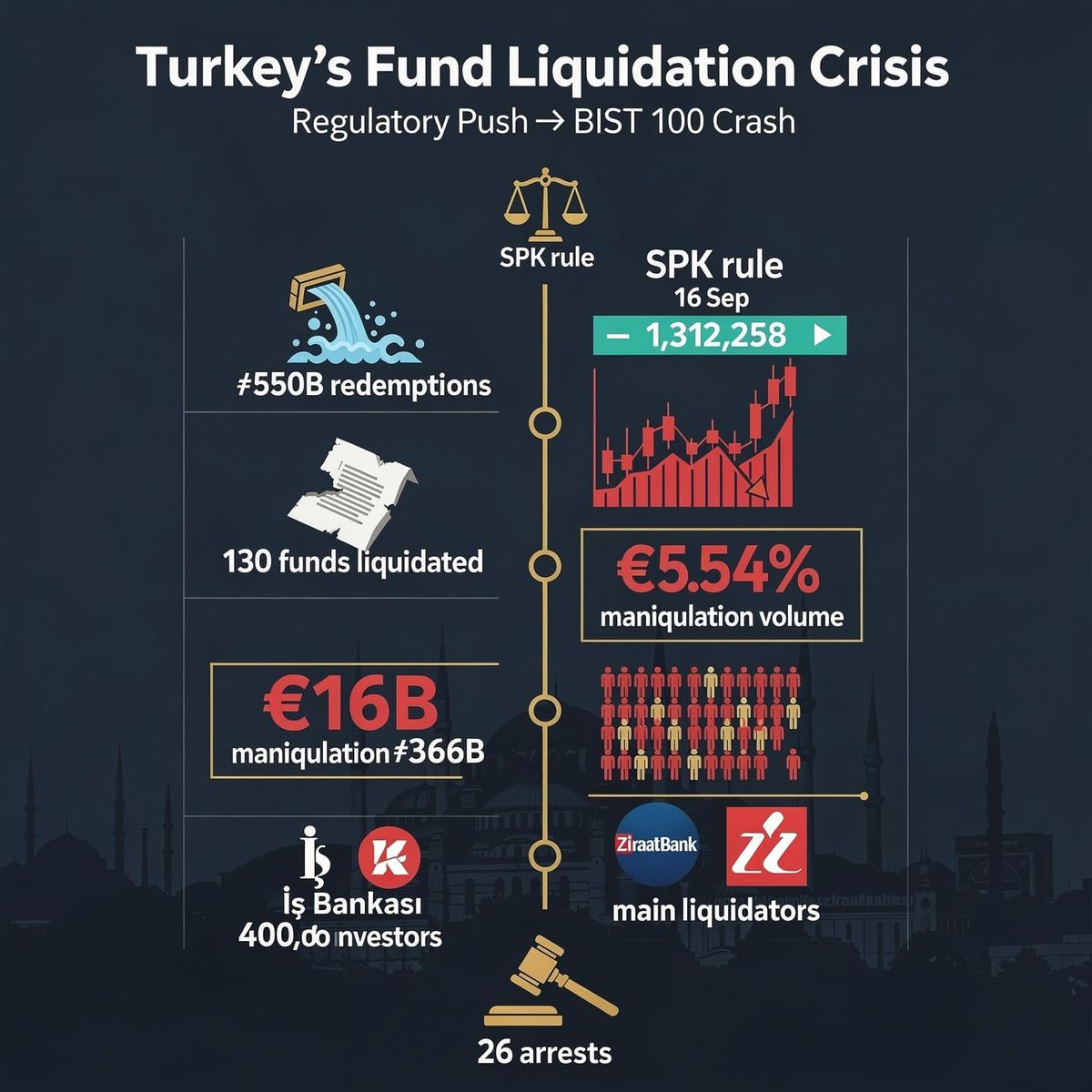
Turkey's regulatory push on concentrated fund positions backfired into one of its worst capital-markets dislocations in years. On Sept 16, SPK tightened single-stock and daily weight caps. Within 24 hours, ~₺550bn ($11bn) in redemptions poured out. The BIST 100 fell 5.54% on Sept 17, and 130 funds ordered into liquidation with trading suspended in seven companies. Tera and Pusula defaulted on redemptions—Tera alone ~₺366bn ($7.5bn)—freezing claims for 400,000+ retail investors. The incident traces to a June MSCI warning on potential collusion and, per Şimşek, manipulation authorities knew about by Nov 2025.
Thesis: What began in mid-September as a regulatory tightening on concentrated stock positions has cascaded into one of Turkey's most severe capital-markets dislocations in years—one that demonstrates how a rule aimed at market discipline can rapidly transmit liquidity risk from fund managers to retail investors and, ultimately, to the country's financial-stability architecture.
The Mechanism: From Compliance Rule to Redemption Run
On September 16, the Capital Markets Board (SPK) imposed stricter allocation limits on fund managers, requiring daily weight caps and curbing single-stock exposure in illiquid, low free-float names. The rule was framed as a transparency measure—global index providers had flagged concentrated holdings as inconsistent with disclosure standards. That framing traced directly to a June warning from MSCI about potential collusive behavior between funds and listed companies in Turkish markets, alongside coordinated trading risks.
But the incentive structure changed fast. With SPK requiring markdowns on illiquid positions, fund unit values began repricing. The reaction came within 24 hours: roughly ₺550 billion (~US$11 billion) in investor redemptions poured out of mutual funds. On September 17, the BIST 100 fell 5.54% to close at 1,312,258, adding to an 8% two-day slide that began September 15. The board ordered the liquidation of 130 investment funds while suspending trading in seven companies—including Tera, Pusula, Hedef, Atlas, A1, Pardus, and Bulls.
The second-order effect was the mechanism itself failing. Two of the largest asset managers—Pusula Portföy and Tera Portföy—defaulted on redemption requests. Tera alone defaulted on approximately ₺366 billion (US$7.5 billion) in redemptions, according to board statements. The SPK and exchange suspension on September 17 cited unmet redemptions exceeding US$1 billion in a single day. A redemption default is not a market move; it is a liquidity event that converts investor expectations into frozen claims.
The Fragility Behind the Defaults
The concentration problems were not new, and the scale of the underlying manipulation only became public later. On September 25, Turkish authorities confirmed a major manipulation scandal involving the 131 funds at the center of this freeze: investment firms had illegally colluded to drive individual stock prices artificially high, with aggregate trading volume across the affected funds approximating €16 billion. Funds managed by Tera Portföy had reported returns above 17,000% since early 2025. Treasury Minister Mehmet Şimşek confirmed on November 4, 2025, that authorities knew manipulation was occurring, yet valuation-rule changes did not arrive until July 2026 and broader fund rules until August 28, 2026. The delay allowed risk to compound before reforms landed.
Who Controls the Leverage
The stress concentrated where ownership was most concentrated. Funds holding large low free-float positions had no liquid market into which to sell without collapsing prices further—so liquidation orders became self-reinforcing. Deposits and fund claims became effectively illiquid; over 400,000 individual investors—disproportionately small-scale participants—have been directly affected, per SPK disclosures and financial-press reporting.
The SPK appointed Türkiye İş Bankası and Ziraat Bank to liquidate the investment funds, with the process ordered to complete within six months. That delegation underscores how a fund-management problem travels to banking-system balance sheets. Four fund managers were arrested the day the freeze took effect, bringing total arrests to 26 by late September, according to authorities. Total fund value has eroded by approximately ₺128.7 billion since late August, per reported data.
The Political Dimension
President Recep Tayyip Erdoğan and Vice President Cevdet Yılmaz have publicly addressed the crisis, with an emergency committee convening on September 17. Opposition lawmaker Deniz Yavuzyılmaz has alleged that investors were defrauded by receiving advance warning of the September 17 freeze and withdrawing before it took effect. How the state chooses between compensating investors, imposing losses, and restoring market functioning will determine both economic and political outcomes.
Unresolved Uncertainty
A critical open question is whether the loss estimates are final. Analysts estimate losses of 525 billion lira (~$10.8 billion) on delayed regulatory action, but liquidation proceeds remain contingent on how illiquid positions clear over the six-month window. A second uncertainty: the SPK's response straddles two opposing signals. Şimşek has publicly dismissed systemic risk—he called such contagion fears unwarranted—even as experts warn the scandal will deter foreign investment. Compounding this, authorities must weigh whether the concentration rules survive intact or are relaxed under political pressure, which will signal whether this crisis changes market structure or reverts to the prior model.
Monitoring Indicators
- Redemption default resolution: whether Tera and Pusula resume honoring redemptions in cash versus in-kind or deferred tranches within the six-month liquidation window.
- BIST 100 free-float and volume recovery: sustained volume in previously illiquid names rather than price alone.
- Regulatory-rule durability: whether SPK concentration caps are amended or enforced as written, and the pace of the 131-fund liquidation process.
These are reporting benchmarks, not investment guidance; the trajectory of this crisis turns on whether liquidity returns faster than regulatory or political intervention can be calibrated.
Comments ()