S&P Global launches Vault Risk Assessment for the roughly $10 billion crypto lending vault market
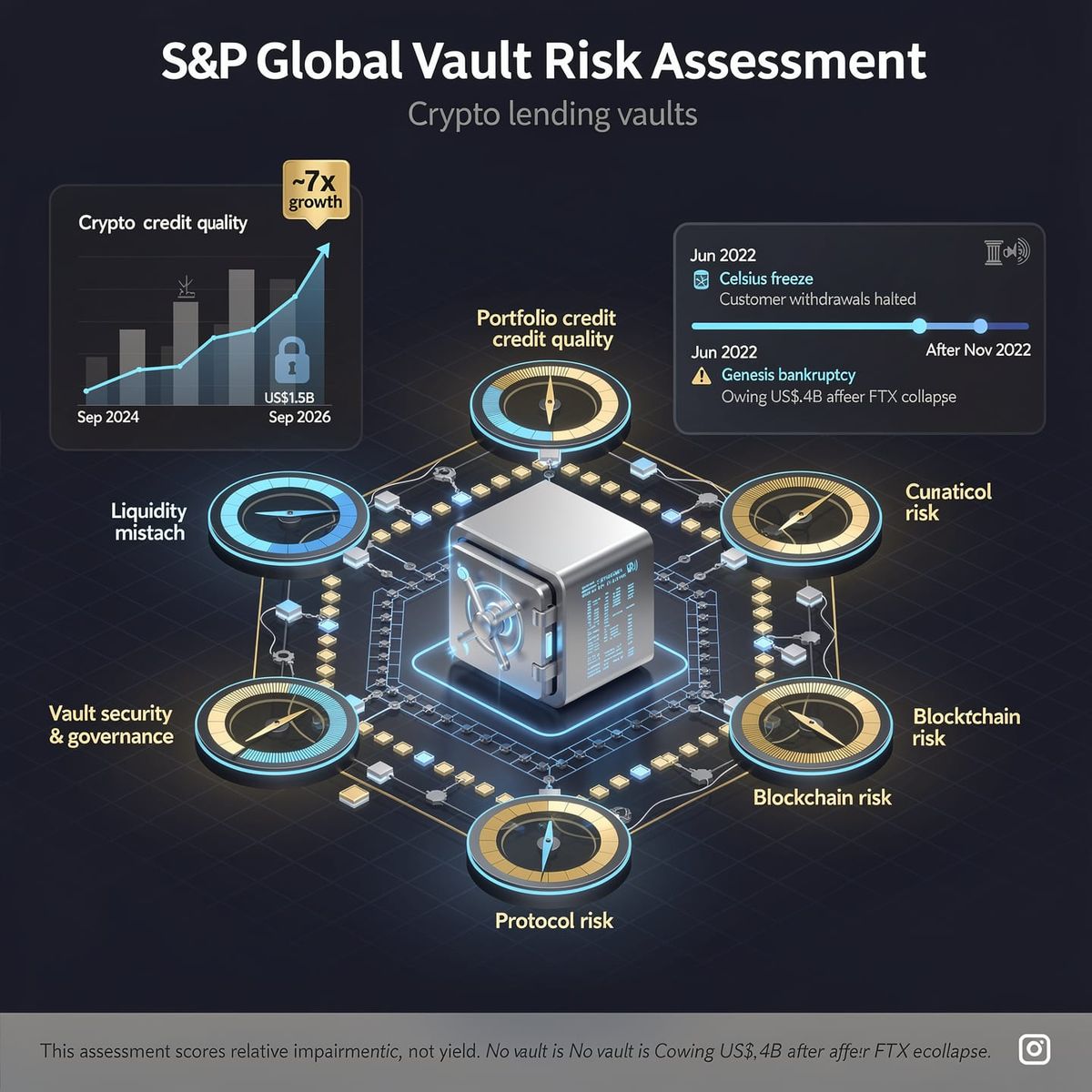
S&P Global Ratings on October 5 introduced a Vault Risk Assessment (VRA) framework for blockchain-based lending vaults, a segment whose deposits grew from $1.5 billion in September 2024 to roughly $10 billion in September 2026, per S&P's figures. The tool scores six risk domains — portfolio credit quality, liquidity mismatch, curator risk, blockchain risk, protocol risk, and vault security/governance — with the first individual assessments to be released in future announcements. No vault has been graded at launch.
The framework targets a specific corner of crypto lending: "vaults" that pool digital-asset loans under a curator's management but run on blockchain protocols rather than a single bank balance sheet. What S&P is grading, in effect, is the system between a depositor's assets and the borrower's repayment — the credit quality of the loans in the pool, how easily those can be sold if lenders withdraw, who picks the loans and with what discretion, and the code and custody underneath it all.
The liquidity-mismatch and curator-risk components map onto the collapse mechanisms documented in this sector's history. Celsius froze withdrawals in June 2022 before filing for Chapter 11, and Genesis froze redemptions after the FTX collapse and entered bankruptcy owing $3.4 billion to top creditors — both controlled opaque pools where depositor assets were redeployed beyond simple loan origination. The failures were tied to gaps in custody and asset management, which is the layer the VRA's curator and governance scores address. Neither element is priced into a simple yield figure, which is the gap S&P is targeting for institutions that want a third-party score before parking money in these pools.
S&P is explicit about the tool's limits. The VRA measures relative impairment risk, not yield attractiveness or conventional creditworthiness — it does not comment on yield levels. Direct exposure to tokenized bonds or funds may fall outside the framework's scope.
The $10 billion figure is the market's scale, not a loss or a funding shortfall — no specific vault has been flagged as distressed in this rollout, and the scorecards are being introduced before any public assessments surface.
What the framework confirms is that the fastest-growing segment of digital-asset lending has outgrown informal screening. Deposits have risen roughly sevenfold in two years, and that money increasingly needs a common yardstick for risks that conventional banks have standardized for decades. The decisive unknown is whether scoring those six domains can predict defaults and liquidity squeezes in a market whose track record on both is short and uneven — a question only the first full set of VRA assessments, not the framework launch, can answer.
Comments ()