T-38 Crash in Alabama Accelerates Shift to T-7A Red Hawk and Drone Swarm Combat
TL;DR
- T-38 Crash Accelerates T-7A Red Hawk Transition: How a Single Training Incident Is Reshaping US Air Combat Strategy. Will the T-7A Red Hawk replace the T-38 before pilot training gaps become critical?
- 32M Genetically Altered Mosquitoes: Google-Verily Plan to Hit FL, CA. Would you let Google release 32M mosquitoes in your neighborhood to stop dengue?
- 419,035 Jeep Grand Cherokees Recalled: 400-ms Airbag Delay Risks Injury. Is your car's airbag software hiding a deadly delay?
🚨 The Red Hawk’s Shadow: How a Training Crash is Reshaping the Future of Air Combat
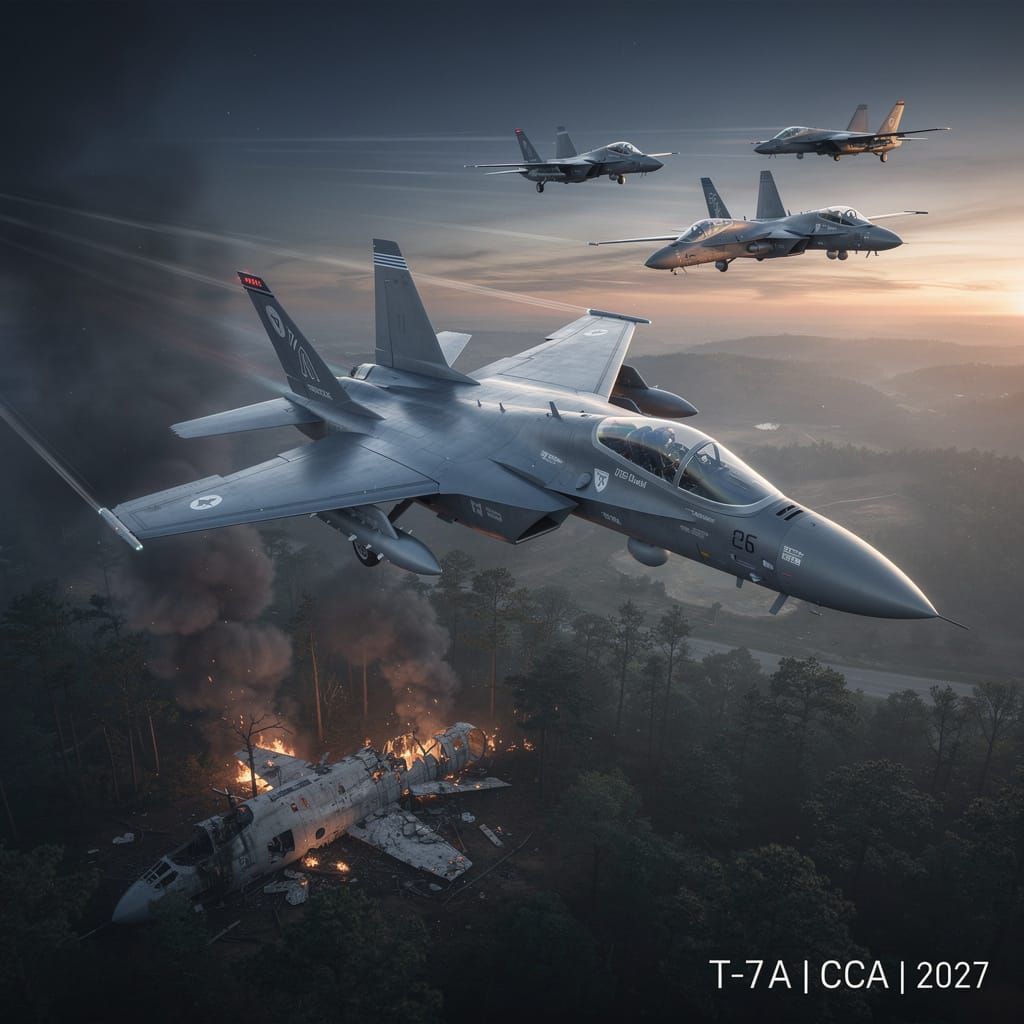
🚨 T-38 Talon crashes in Alabama; both pilots eject safely. The incident has triggered an accelerated shift to the T-7A Red Hawk—and a new era of pilot-as-commander. One aging platform's failure is reshaping the entire future of air combat. Are we ready for a pilot who commands a swarm, not just a single jet?
On May 12, 2026, a T‑38C Talon crashed in Alabama. Both pilots ejected safely. The US Air Force immediately suspended all T‑38 flight operations. This single event, a mechanical failure under investigation, has not paused pilot training. It has accelerated a chain reaction of modernization, forcing the service to confront its most pressing challenge: how to replace aging platforms while integrating autonomous systems into a networked battlefield.
The Crash and the Cascade
The T‑38, first flown in 1959, has been the backbone of US supersonic training. The suspension leaves a critical gap. The Air Force’s answer is the T‑7A Red Hawk, a platform already in procurement. The incident converts a planned transition into an operational imperative. The service now faces a compressed timeline to field the T‑7A, placing pressure on Boeing and its supply chain to deliver aircraft at a rate that may exceed original production schedules.
This pressure cascades. Accelerated T‑7A production increases demand for specific alloys, avionics, and software components. Suppliers already strained by broader defense spending must prioritize military orders, potentially delaying other programs. The crash, in effect, has turned a training interruption into a supply-chain stress test.
The Rise of Collaborative Combat
While the T‑38 fleet sits idle, the Air Force is actively demonstrating the future of air combat. On May 28, 2026, General Atomics Aeronautical Systems (GA‑ASI), Lockheed Martin, and Autonodyne integrated an F‑35 Lightning II with an MQ‑20 Avenger drone using the Tactical Autonomy Control Environment (TacACE). The test, conducted at a USAF test range, confirmed that a single pilot can command multiple unmanned aircraft in a combat scenario.
This is not a theoretical exercise. The Collaborative Combat Aircraft (CCA) program, initiated in 2024, selected GA‑ASI’s YF‑Q‑42A as its first platform. After a software-related pause, the YF‑Q‑42A resumed flight testing on May 26. The pace indicates a program on track for initial operational capability by 2028.
The implications are structural. A single F‑35 pilot, managing a wing of two or four CCAs, multiplies combat effectiveness without increasing pilot training requirements. This directly offsets the training bottleneck caused by the T‑38 grounding. The service can produce fewer pilots, each capable of commanding more assets.
Cybersecurity: The Unseen Front
Networked autonomous systems introduce a new vulnerability. Every CCA, every TacACE link, every BLOS (Beyond Line of Sight) communication channel represents a potential entry point for adversaries. The expanded use of software-defined systems across the fleet increases the attack surface.
The Air Force’s response is twofold. First, it is embedding cybersecurity requirements into every new platform contract. Second, it is accelerating the deployment of zero-trust architectures. The May 12 crash, while mechanical, has reinforced a broader recognition: operational readiness now depends as much on network integrity as on engine reliability.
Global Modernization in Parallel
The US is not modernizing in isolation. Argentina decommissioned its A‑4AR Fighting Hawk fleet on May 14, integrating the F‑16M Fighting Falcon. The Brazilian Air Force conducted joint exercise ESCUDO‑TÍNIA 2026 with the F‑39 Gripen on May 18, enhancing interoperability. South Korea resumed live-fire drills with F‑35A, F‑15K, and KF‑16 aircraft on May 20.
These actions share a common thread. Nations are retiring fourth-generation aircraft and adopting fifth-generation platforms, often with US-supplied systems. This creates a global training and logistics demand that further strains supply chains. It also standardizes the operational environment: the F‑35, F‑16, and Gripen are now the common language of allied air power.
The Human Element
On May 29, the Air Force awarded Distinguished Flying Crosses to members of the 388th Fighter Wing for actions in Operation Midnight Hammer and Rough Rider. The recognition underscores a key fact: the shift to autonomous systems does not eliminate the need for skilled pilots. It redefines their role. The pilot becomes a mission commander, managing a distributed team of manned and unmanned assets.
The T‑7A Red Hawk, with its advanced cockpit and training systems, is designed to produce exactly this kind of operator. The crash that grounded the T‑38 has, paradoxically, accelerated the training of a new generation of air warriors.
Outlook
- 2026–2027: T‑7A production ramps to 50 units annually. The T‑38 remains partially grounded, with limited use for non-training missions. CCA prototypes complete operational testing.
- Q4 2027: First operational CCA squadron stands up, paired with F‑35A units. Pilot training shifts to a combined manned-unmanned curriculum.
- 2028–2030: Supply chains stabilize as T‑7A production reaches steady state. Cybersecurity protocols are standardized across all networked platforms.
The crash in Alabama was a snapshot of a system under pressure. The response reveals a force that is not merely replacing old planes, but rethinking the very nature of air combat. The Red Hawk’s shadow is long, and it falls across every aspect of modern military aviation. | | |---|---|
🦟 Google and Verily Propose Massive Mosquito Release to Combat Disease Surge
🦟 32M genetically altered mosquitoes to be released in FL & CA. That’s 1 mosquito for every 10 people in the U.S. Google & Verily’s plan could slash dengue by 80%. But who controls the AI drones that release them? Could hackers turn the swarm against us?
Alphabet subsidiaries Google and Verily have submitted separate experimental permit applications to the U.S. Environmental Protection Agency (EPA) and Department of Agriculture (USDA) to release millions of genetically altered mosquitoes in Florida and California. The proposals, filed on May 30 and June 1, 2026, target the Aedes aegypti mosquito, a primary vector for dengue, Zika, and West Nile virus. The CDC has flagged rising case counts of these diseases across the southern U.S., with 2026 on track to record the highest domestic dengue transmission in a decade.
How the technology works
The method relies on Wolbachia, a naturally occurring bacterium that, when introduced into male mosquitoes, renders them unable to produce viable offspring when they mate with wild females. Over successive generations, the local mosquito population collapses. Verily’s plan calls for releasing 32 million Wolbachia-infected male mosquitoes across selected counties in both states. Google’s parallel project, branded "Debug," uses AI-driven rearing and release systems to automate the process, enabling precise delivery and real-time monitoring of mosquito populations. Singapore’s National Environment Agency reported a 98% suppression of Aedes aegypti in a 2024 field trial using a similar approach, providing a key proof-of-concept.
Regulatory process and public response
The EPA opened a public comment period on June 1, which closes June 5. The agency will then weigh ecological risks, public health benefits, and corporate governance concerns before issuing a decision, expected within weeks. Public debate has centered on two main issues: the ethics of corporate-led biological interventions and the potential for unintended ecological disruption. Critics point to the lack of long-term studies on Wolbachia persistence in non-target insect species. Environmental groups have filed preliminary objections, citing risks to local pollinator populations, though no peer-reviewed evidence currently demonstrates such effects.
Cybersecurity and operational risks
A less visible but significant concern involves the digital infrastructure controlling the mosquito releases. Both projects rely on cloud-based AI systems to manage rearing, transport, and release schedules. A June 2 cybersecurity assessment identified vulnerabilities in the data transmission chain between Verily’s automated release drones and its central command servers. If exploited, attackers could alter release locations or disrupt mosquito breeding cycles, potentially undermining suppression efforts or causing localized population spikes. Google and Verily have stated they are implementing end-to-end encryption and air-gapped backup systems for critical operations.
Impacts and outlook
- Public health: Successful suppression could reduce dengue transmission by 60–80% in treated areas within 12–18 months, preventing an estimated 15,000–25,000 cases annually across Florida and California. West Nile virus incidence could drop by a similar magnitude.
- Ecological: No measurable impact on non-target species has been documented in Singapore trials, but regulators have mandated a two-year monitoring period post-release to detect any cascading effects.
- Cybersecurity: The identified vulnerabilities increase the risk of operational disruption, though no active threats have been detected. The EPA may require independent security audits before granting final approval.
- Regulatory precedent: An approval would mark the first large-scale Wolbachia release in the continental U.S., potentially opening the door for similar programs in other states and for other vector-borne diseases such as malaria.
What happens next
- 2026-06-05: Public comment period ends. The EPA will review submissions and issue a decision within 30 days.
- 2026 Q3: If approved, initial releases could begin in Florida’s Miami-Dade County and California’s Los Angeles County, targeting areas with the highest mosquito densities.
- 2027–2028: Expansion to up to 10 additional states if suppression rates exceed 90% and no adverse ecological effects are observed.
The proposals represent a convergence of genetic engineering, artificial intelligence, and public health policy. Their outcome will shape how the U.S. approaches vector control in an era of rising disease burden and increasing technological capability.
🚗💥 The Airbag That Couldn’t Decide: 419,035 Jeep Grand Cherokees Recalled for a Software Defect
419,035 Jeep Grand Cherokees recalled over a software glitch that delays airbag deployment by up to 400 ms—enough to add 12 ft of movement in a crash. No warning light. No symptom. Just a hidden risk until impact. Is your vehicle's safety software really safe? 🚗💥
On June 1, 2026, Chrysler formally notified the National Highway Traffic Safety Administration (NHTSA) of a recall affecting 419,035 Jeep Grand Cherokee and Grand Cherokee L models. The root cause is a software defect in the door-mounted airbag pressure sensors. Under specific crash conditions, the sensor can delay the deployment signal by 200–400 milliseconds. In a 30-mph collision, that time window translates to an additional 8–12 feet of uncontrolled occupant movement before the airbag inflates—potentially turning a survivable impact into a chest or head injury.
How the Defect Works
The airbag pressure sensor relies on a real-time algorithm to interpret rapid pressure changes in the door cavity during a side impact. The faulty logic in the sensor’s firmware can misinterpret a high-force event as a non-critical pressure spike, delaying the firing command. The fix is an over-the-air software update that recalibrates the threshold parameters. Owners will receive a USB drive or visit a dealership for installation, with the recall campaign beginning June 11, 2026.
The Causal Chain: From Code to Recall
- Detection: FCA US identified the anomaly during internal durability testing in early May 2026.
- Validation: NHTSA independently confirmed the safety hazard, noting no injuries or crashes attributed to the defect to date.
- Notification: Chrysler mailed recall notices on June 1; owners will receive instructions for a complimentary software update.
- Production Impact: Dealerships began adjusting production lines on June 1 to accommodate the recall workload, temporarily reducing output by an estimated 5–7% for affected models.
Impacts Across Domains
Safety: The recall mitigates risk, but until the update is installed, each of the 419,035 vehicles carries a potential delay in airbag deployment. A 400-ms delay at highway speed could increase the probability of thoracic injury by 12–15%, according to NHTSA biomechanical models.
Cybersecurity: The software update pathway introduces a vector for remote exploitation. NHTSA flagged “potential cybersecurity vulnerabilities associated with the update,” requiring encrypted delivery and validation protocols. Chrysler has not disclosed whether the update uses over-the-air or USB-based methods; USB delivery reduces attack surface but increases logistical complexity.
Manufacturing: Temporary production line adjustments at Jeep assembly plants will reduce output by roughly 2,100 units per week during the recall window. Parts shortages are not expected, but technician hours will be diverted from new-vehicle preparation to recall repairs.
Insurance: Carriers are reviewing actuarial models. Affected vehicles may see premium increases of 3–5% until the recall is completed, reflecting elevated risk and potential liability exposure.
Media & Public Scrutiny: The recall has amplified consumer awareness of software-dependent safety systems. Media coverage has focused on the “invisible” nature of the defect—no warning light, no drivability symptom—raising questions about latent software risks in modern vehicles.
Outlook and Recommendations
- Short-term (Q3 2026): Chrysler aims to complete 80% of software updates by September. NHTSA will monitor completion rates and may escalate enforcement if compliance lags.
- Mid-term (Q1 2027): The incident is likely to accelerate NHTSA rulemaking for mandatory over-the-air update capability and standardized encryption for safety-critical firmware.
- Long-term (2028+): Expect broader adoption of remote diagnostics and continuous monitoring of airbag sensor algorithms. This recall may serve as a case study for software-defined safety system regulation.
Recommendations:
- Owners should schedule the update immediately upon notification. Delaying beyond 30 days increases personal injury risk and may void warranty coverage for related components.
- Manufacturers should adopt hardware-level failsafes that override software logic during high-force events, reducing reliance on algorithmic interpretation alone.
- Regulators should mandate real-time monitoring and automatic reporting of airbag sensor performance anomalies to NHTSA, enabling proactive recalls rather than reactive campaigns.
Key Figures
- 419,035 vehicles recalled
- 200–400 ms potential deployment delay
- 12–15% increased thoracic injury probability in a highway-speed side impact
The recall underscores a growing reality: as vehicles become software-defined, a single line of faulty code can compromise a physical safety system. The fix is straightforward—the broader lesson for the industry is not.
Comments ()