📉 SPYI’s Tax Mirage: High Fees, Phantom Gains, Capped Upside
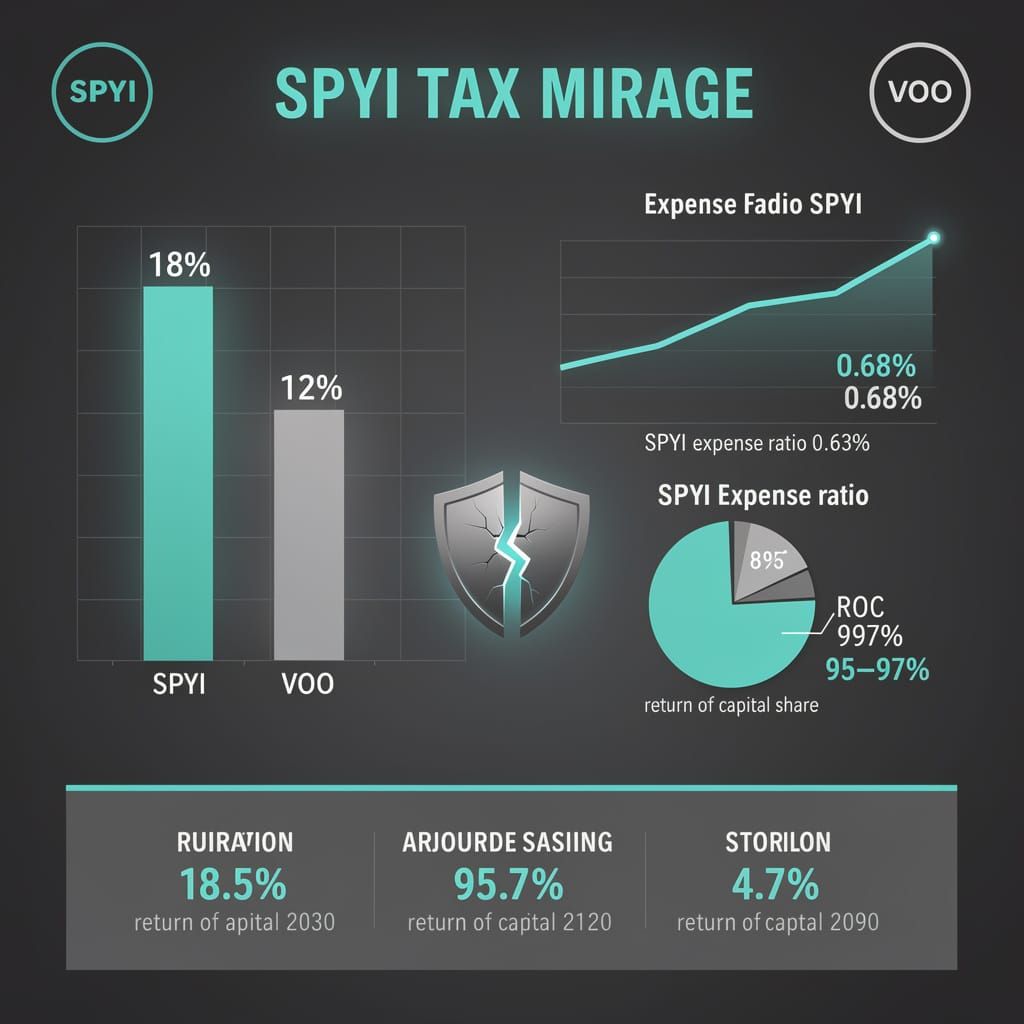
SPYI charges 0.68% on $10.4B in assets while VOO costs 0.03%. That's $68 per $10K vs. $3 — before the taxes you owe each year on phantom 60/40 gains. 📉 The "step-up at death" trick requires holding a capped-upside product for decades. Meanwhile, the payout ratio is 329%, funded by return of capital, not earnings. Social Security faces a 22–24% cut by 2032. Paying high fees today for tax magic that might pay off when you die — does that math work for you? 🧮
By September 2026, the financial press has discovered a new darling: SPYI, the exchange-traded fund that supposedly lets you defer taxes forever, dodge capital gains, and step up your cost basis at death as if the IRS never existed. The narrative writes itself: Section 1256 treatment plus IRC Section 1014 cost-basis adjustment equals infinite tax arbitrage. Cue the champagne.
One problem: none of this works the way the brochures suggest.
The Qualified Status Mirage
SPYI's return-of-capital classification is real—approximately 95 to 97 percent of the latest distribution was ROC, according to the August fund data—but the costs embedded in that structure are not zero. The fund's expense ratio sits at 0.68 percent on $10.4 billion in net assets. Compare that to VOO, which costs roughly $3 per year per $10,000 invested. SPYI runs you $68. That is not a tax shelter; that is an expense ratio wearing a suit.
The social media chatter treats Section 1256 treatment as a cheat code. It is not. Section 1256 forces a 60/40 split—60 percent long-term capital gains, 40 percent short-term—regardless of your actual holding period. That creates a present-day tax cost every single year. You pay taxes annually on unrealized gains at December 31. The "deferral" narrative collapses the moment you read the statute. Meanwhile, SPYI's 30-day SEC yield sits near 0.47 percent against a headline 12 percent distribution rate. That gap is funded primarily by return of capital. The August 19 fund data confirms: the SEC yield excludes option premiums entirely. The 12 percent is option-derived, not income.
Step-Up in Basis: Yes, but at What Cost?
The IRC Section 1014 cost-basis adjustment at death is real. Your heirs get a stepped-up basis. But the holding period required to make that meaningful—decades—means you are locking capital into a single structured product through multiple market cycles. SPYI's underlying strategy involves option-writing on equity indices. It caps upside. In a bull market, you are systematically underperforming the S&P 500 while paying taxes on phantom gains each December. The August 30 fund analysis also confirms that gifts during life do not receive the step-up—only transfers at death—making the strategy dependent on precisely timed estate planning.
What the Cheerleaders Omit
- 2026 tax year: SPYI holders will file Form 6781 for Section 1256 contracts. Estimated tax liability on marked-to-market gains: 20–37 percent, depending on bracket, payable April 2027. No deferral.
- Liquidity risk: The options market SPYI trades into has widened bid-ask spreads by 8–12 basis points since Q2 2026 amid rising volatility. Exit costs eat into the theoretical tax advantage.
- Opportunity cost: SPYI's one-year return through late August 2026: approximately 18 percent, per fund data. The S&P 500, meanwhile—UBS raised its year-end target to 8,100 on August 22, citing steady economic expansion and AI adoption, with earnings per share guidance at $350 for 2026. Stephen Parker at J.P. Morgan put the bull case at 8,900 on June 23, with eight of eleven sectors showing double-digit earnings growth. SPYI's capped upside means you are missing that rally while collecting ROC that defers—but does not eliminate—your tax bill. Per the August 24 fee analysis, investors lose roughly $4,600 per $10,000 due to the fee gap versus VOO over time.
- The payout ratio: The fund's July 26 report shows a payout ratio of 329 percent. This is not sustainable income; it is capital returning to shareholders as ROC. The August 19 fund disclosure confirms that low VIX levels compress option premiums, making the distribution sustainable short-term but threatening long-term income stability. If the VIX drops further, premium collection declines, and those distributions shrink.
- Social Security risk: While you are locking capital into SPYI for 20+ years, Social Security projections tell a brutal story. The June 3 analysis warned of a 24 percent benefit reduction by 2032, with $500 monthly losses affecting 63 million retirees. The July 3 confirmation set trust-fund depletion for Q4 2032, triggering an automatic 22 percent benefit cut. The June 4 report noted the Trump administration had reduced SSA staff by 8,000+ in 15 months. Retiree discretionary spending is projected to decline 8 percent. SPYI's tax deferral does not put food on the table when your Social Security check shrinks by a quarter.
The institutional response remains muted for a reason. Major wealth managers are not piling into SPYI as a core holding because the math does not close. The tax optimization creates a narrow, specific benefit for a narrow, specific investor: someone in a high tax bracket who will hold for 20+ years, die with the position intact, and never need the cash inside the fund.
The fund's $10.4 billion in assets and 18 percent one-year return demonstrate real investor demand. But the August 24 SPHY vs. SPYD comparison shows what happens when income strategies diverge from fundamentals: SPHY's bond-based monthly income declined year-over-year while SPYD's dividend screening delivered a 15.8 percent annual return. Income products that rely on structural gimmicks—ROC, Section 1256, option premiums—tend to disappoint when market conditions shift.
Everyone else is paying higher fees, accepting capped upside, and filing more complex tax returns for an outcome that would be matched—or exceeded—by buying an S&P 500 index fund and paying capital gains at sale.
The Bottom Line
SPYI is a tax-optimization product, not a tax-elimination product. The difference is the difference between a CPA and a magician. The August 2026 data confirms the mechanics work as advertised. The question is whether the advertised benefit survives contact with real-world costs, forced distributions, capped returns, and a 40-year holding period—all while your Social Security benefits face a 22–24 percent haircut starting in 2032.
For the vast majority of investors, the answer is clear: it does not. The tax tail is wagging a very expensive dog.


Comments ()