🇯🇵💸 Japan’s ¥27.1 Trillion Yen Intervention: Eight-Yen Gain, $80B Gone
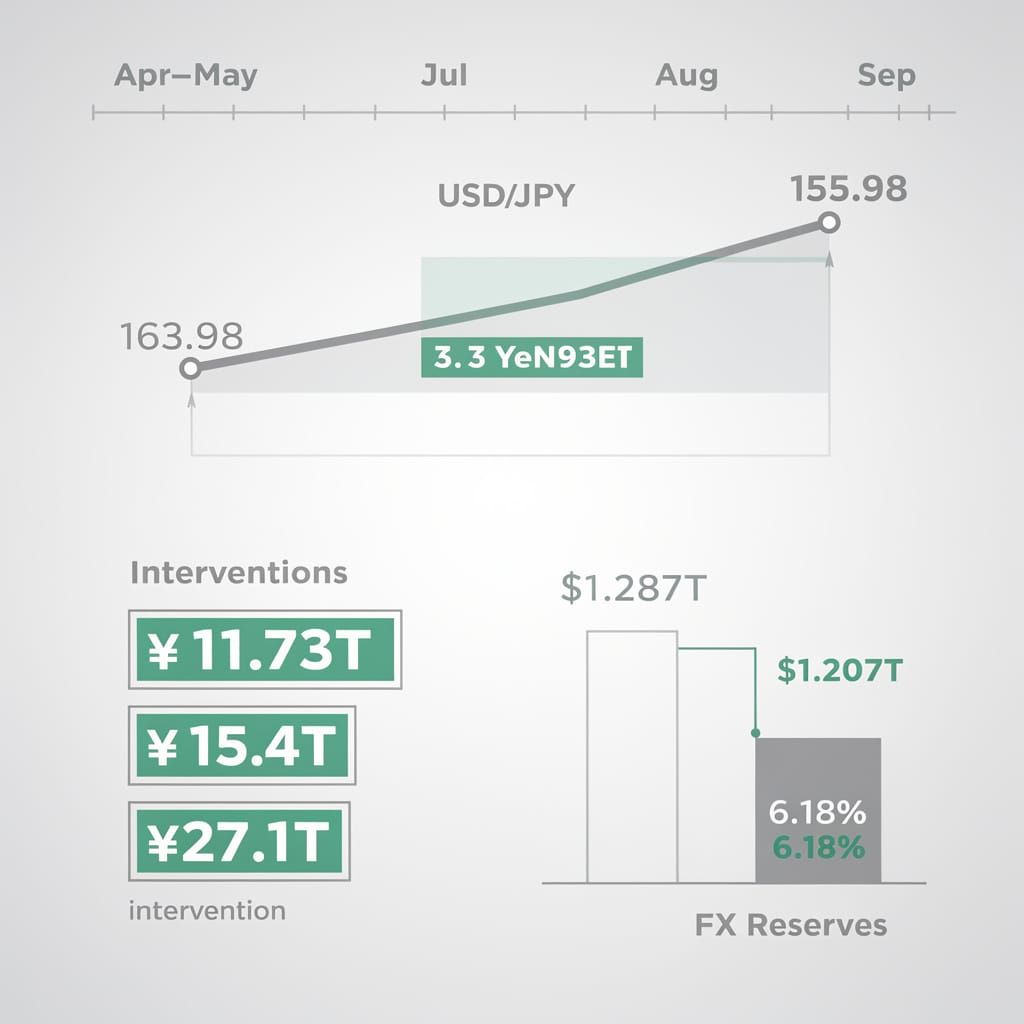
Japan spent ¥27.1 trillion ($173B) on yen interventions since April. The yen gained 8 whole yen. 🇯🇵💸 Foreign reserves cratered $80B in four months. The intervention didn't fix yield disparity — it just kept the U.S. deficit machine running. Carry trade incentive? Unchanged. Who's still betting this ends differently?
The markets love a good intervention story. Early August delivered one: coordinated yen-purchase operations between Washington and Tokyo, announced with the usual gravity, briefly shoving USD/JPY back into the 155–157 range. Problem solved? Hardly. By August's close, reserves data told the real story.
What Actually Happened
- April–May 2026: Japan spends ~¥11.73 trillion ($75.26 billion) on FX intervention.
- July 2026: Another ¥15.4 trillion injected after the yen hits a 40-year low of 163.98 on July 23.
- August 2026: Joint U.S.-Japan intervention announced August 2. Yen stabilizes briefly at 155–157.
- By September 7: Reserves reported at $1.207 trillion—down 6.18% from July's $1.287 trillion. Cumulative intervention spending reaches ¥27.1 trillion, the largest annual total ever recorded. The yen? Trading at 155.98 per dollar. Net gain since July's panic low: about eight yen. Cost: ¥27.1 trillion.
The mechanics were textbook, the outcome predictable. Japan's Finance Ministry now confirms foreign reserves fell at the fastest pace since records began in 2000, marking the fourth consecutive monthly contraction. State Street strategist Masahiko Loo attributes the decline to "dollar-selling, yen-buying FX interventions"—policy action, not financial distress, officials insist. But when you burn through ¥27.1 trillion across four months for an eight-yen improvement, the distinction between "policy" and "distress" gets fuzzy.
The Numbers Tell the Story
| Metric | July 23 Peak | September 7 | Verdict |
|---|---|---|---|
| USD/JPY | 163.98 (40-year low) | 155.98 | ~¥8 gain; cost: ¥27.1T |
| Foreign reserves | $1.287T | $1.207T | -$80B in four months |
| Cumulative intervention | — | ¥27.1T | Largest annual spend ever |
| Carry trade incentive | Strong | Strong | Unchanged |
The intervention reduced principal assistance amounts but generated significant secondary losses—portfolio rebalancing that punished Japanese bond holders as global bond yields climbed to multiyear highs in Germany, the UK, and US Treasuries. The intervention itself became a sell signal.
Behind the Curtain
The stated reasoning—restoring "favourable" exchange rates—remains laughable. 155–159 is still a far cry from pre-Plaza Accord levels. The real objective was preserving short-run dollar funding stability, as Capital Economics noted. The U.S. Treasury needed to keep the dollar bid without triggering a funding crisis in Tokyo. This wasn't about the yen. It was about keeping the U.S. deficit machine running.
External shocks compound the farce. Houthi threats to enforce a naval blockade of the Bab el‑Mandeb Strait—estimated to threaten ~7.4 million barrels per day, roughly 7% of global crude supply—directly raised Japan's oil import costs. Japan imports over 90% of its crude from the Middle East. Kpler estimates the flow cut at 7.4 million bpd. Brent crude pushed above $88/bbl in August, with forecasts testing €100/bbl if the blockade persists. On July 22, four oil tankers rerouted away from Bab al-Mandeb. Every rerouted barrel costs more. Every cost increase worsens Japan's structural trade deficit. And every intervention dollar spent to offset that deficit is another dollar gone forever.
The Structural Absurdity
Japan runs huge external balances. The U.S. builds net deficits. These are deep fiscal mismatches that no amount of FX market tinkering resolves. The BOJ holds at zero because Japan's debt-to-GDP ratio leaves no room for hikes. The Fed stays positive because inflation expectations haven't anchored. The result: persistent yield disparities that guarantee carry trade flows in one direction.
Even the Australian Retirement Trust, the country's second-largest super fund, saw the obvious: it took its largest yen overweight position in years, betting that BOJ hawkishness eventually trumps Fed dovishness. But that's a bet on structural change, not the outcome of yet another intervention. The RBA held at 4.35% on August 11, and the ASX200 rallied, the Aussie dollar hitting 70.52 US cents. Capital wasn't returning to Japan—it was fleeing to Australia.
Outlook: More of the Same
If current patterns continue—and there is zero indication either central bank will change course—intermittent FX interventions will persist. They will remain necessary to prevent dollar funding shocks in the short run. They will remain ineffective at solving underlying yield disparities.
The U.S. 10-year Treasury yield remains the gravitational center. The BOJ's zero-rate policy is the foil. Between them, the yen will oscillate, central bankers will posture, and markets will collect the spread. Japan spent ¥27.1 trillion, and the yen sits at 155.98. The definition of insanity, updated for 2026.
Bottom line: The August intervention was a Band-Aid on a compound fracture. One more cycle of the same failing strategy, dressed up as policy coordination—now with a ¥27.1 trillion price tag.


Comments ()