🤖 SpaceX Slashes Grok Bot Price 93% After $60B Anysphere Deal
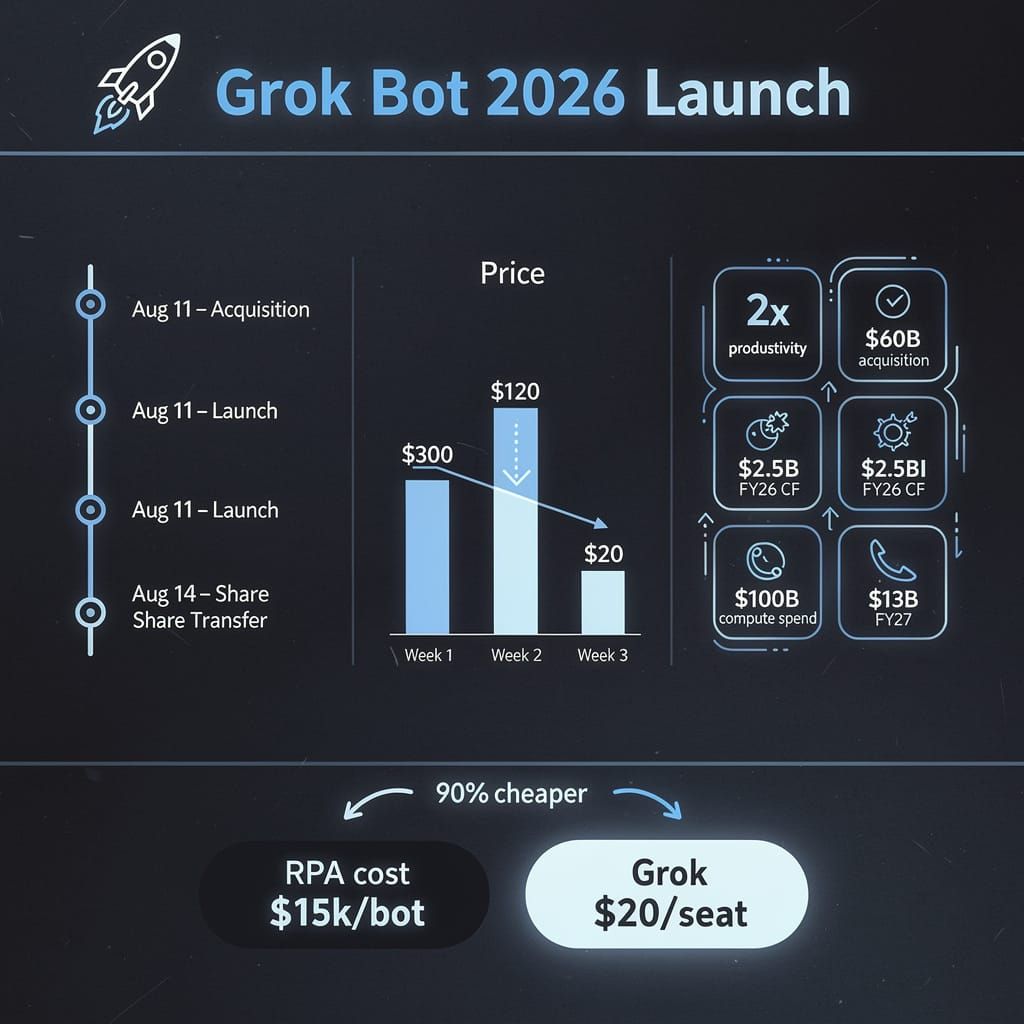
$60B satellite company swallows a coding startup, then slashes its AI bot price from $300 to $20/month in three weeks. That's a 93% price drop on Grok Bot—roughly three Netflix subs for automated data entry, scheduling, and invoice drafting that runs even with your laptop closed. Companies that adopt this will cut admin headcount. Shared login creates a unified vulnerability. No breach containment docs exist. Is the tradeoff worth it for your team? 🤖💸
What happens when a $60 billion satellite company swallows an AI coding startup and points the whole thing at boring office work? Grok Bot launched August 11 in beta, and the pricing story got weird fast.
The Acquisition That Made It Possible
On August 11, 2026, SpaceX completed a $60 billion all-stock takeover of Anysphere—the company behind Cursor, an AI coding platform. The deal closed by August 14, transferring roughly 391 million SpaceX shares to Anysphere holders and immediately funneling Cursor's user workflows onto SpaceXAI's GPU clusters and xAI Supercomputer. Morgan Stanley forecasts the acquisition adds $2.5 billion in extra cash flow for FY2026 and $13 billion by FY2027, supporting xAI's projected US$100 billion annualized compute spend by year-end. That's the financial engine running Grok Bot in the background.
How It Works
You don't need specialized hardware. Persistent cloud compute runs the bot; your phone, tablet, or laptop handles the front end. The bot works offline, coordinates multiple agents via threaded communication, and handles non-API sites without external dependencies.
Early user reports indicate a 2x productivity gain from automated execution—data entry, scheduling, invoice drafting, and ticket routing running continuously even with the device closed. One early adopter installed the bot on a Friday night, spent Saturday building their yarn stash app with AI-powered bulk imports, server migration from Heroku to FastAPI Cloud, domain setup, documentation updates, and database backup fixes. That's one user, one weekend, what used to be a week's work.
What You Get (and Give Up)
Grok Bot automates repetitive admin functions. Pricing launched at $120+ per seat per month for Cursor Premium Teams. Then things got weird. By September 4, SpaceXAI had slashed pricing to $20 per month while offering free two-week enterprise trials across iPad and Android. That's a 93% price drop in under a month—roughly three Netflix subscriptions or one really nice dinner, depending on who you ask.
But usage caps remain undefined in the documentation. Overage costs are ambiguous.
The Catch
Shared login creates a unified profile vulnerability. One compromised credential exposes your entire Grok Bot instance. Persistent cloud access with no published breach containment protocols—that's a security gap without a patch date.
Reduced human labor burden means fewer humans needed for admin roles. The 2x productivity boost enables headcount reduction. Companies that adopt aggressively will cut or redeploy staff.
Pricing whiplash. Dropping from $300 to $120 to $20 across different plans within weeks suggests SpaceXAI is testing price sensitivity in real time.
Competition Analysis
Vs. robotic process automation (RPA): Tools like UiPath cost enterprise licensing at roughly $15,000+ annually per bot. At $20–$120 per seat, Grok Bot undercuts that by approximately 90% at the per-seat level. The gap is wide enough that procurement teams will notice.
Vs. in-house solutions: Building your own automation agent requires AI talent commanding $200,000+ salaries. For small teams, the math works.
Vs. other AI assistants: OpenAI, Google, and Microsoft will likely replicate agent collaboration features within months, per industry analysts. Grok Bot's current advantage—persistent multi-agent execution—may become a feature of existing platforms before long.
Weak Points
Vendor lock-in: Persistent cloud compute ties you to SpaceXAI's infrastructure. Migration tools don't exist.
Security: Single-sign-on vulnerability with no containment documentation published.
Pricing opacity: The rapid descent from $300 to $20 indicates the company is testing price sensitivity in real time.
Reliability unverified: No independent tests published as of September 2026.
What Comes Next
The bet is that cheap automation at scale shifts how companies staff administrative functions. If Grok Bot hits meaningful enterprise adoption, expect a restructuring wave: fewer assistants, more bot subscriptions, and a lot of open questions about data privacy. OpenAI, Google, and Microsoft are watching. Their countermoves will define whether Grok Bot survives as a standalone product or becomes another feature absorbed into an existing suite.


Comments ()