South Korea's Four Port Authorities Reject Proposed Merger
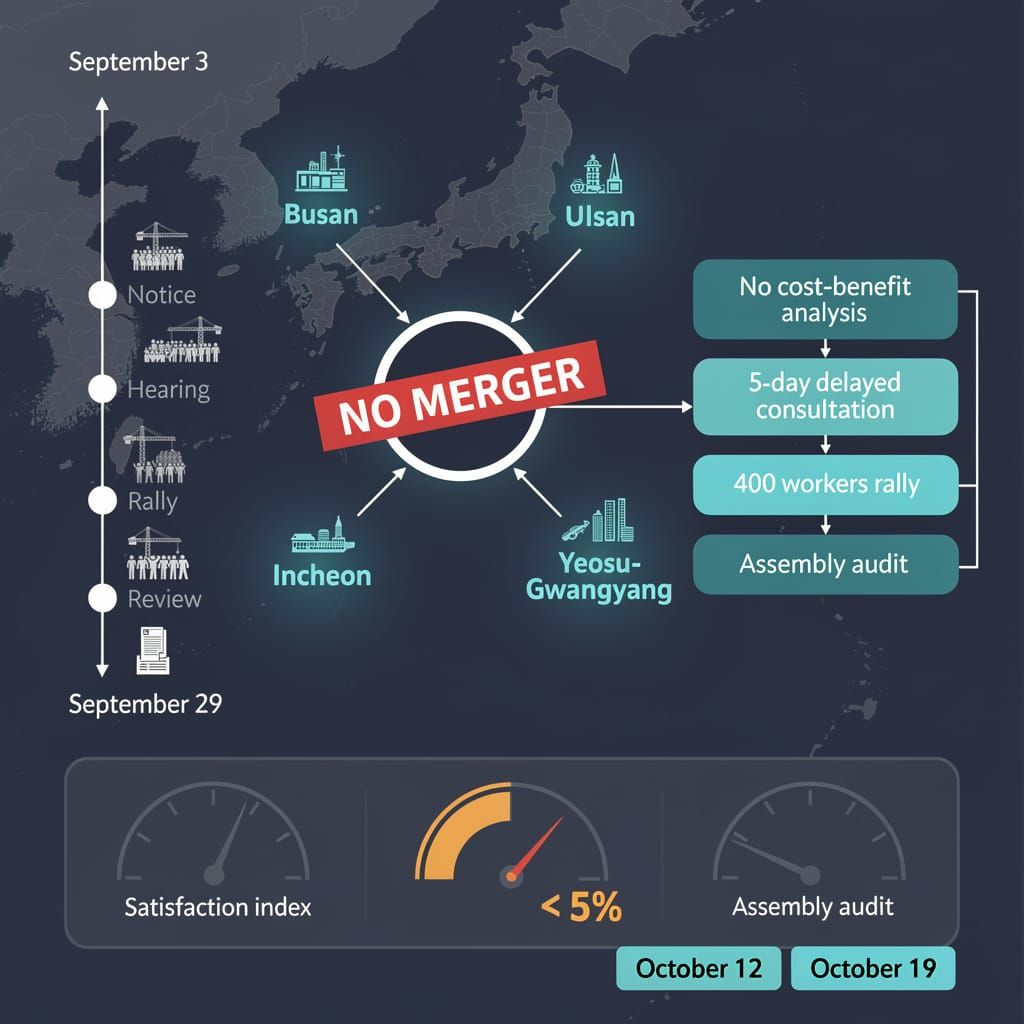
South Korea's four port authorities—Busan, Incheon, Ulsan, and Yeosu-Gwangyang—are pushing back against a Ministry of Oceans and Fisheries plan to merge them into one centralized corporation. The proposal landed Sept. 3 with no cost-benefit analysis, and unions now call it "integrate-first, verify-later." Roughly 400 workers rallied at the Blue House, arguing each port runs its own accounting and cargo profile—so promised efficiency gains have no numbers backing them. Two audits land Oct. 12 and 19. Will ministry verification stretch, or will the unified front fracture if Incheon's "evidence-based" faction negotiates separately?
In late September, roughly 400 unionized workers from South Korea's four port public enterprises—Busan, Incheon, Ulsan, and Yeosu-Gwangyang—gathered at the Blue House in Seoul for a joint rally they called a "general mobilization." The target wasn't wages or hours. It was a Ministry of Oceans and Fisheries plan to merge the four independently chartered port authorities into a single corporation, converting the regional bodies into branch offices under a centralized headquarters.
The protest followed a specific sequence. On September 17, provincial authorities in South Jeolla convened labor representatives to discuss the plan. On September 28, the unions staged their joint rally. The next day, the National Assembly initiated an audit protocol. By September 29, a formal institutional inquiry had been launched—within ten days of the ministerial proposal, which was announced September 3.
The causal chain behind the walkout
The timing matters because the plan itself was never verified before it was announced. The ministry introduced the merger on September 3 without a cost-benefit analysis, even though its stated rationale was enhanced international competitiveness and improved efficiency. According to the reporting, only one interagency consultation occurred, back in March, and direct meetings with the presidents of the four port authorities were delayed until September 8—five days after the public announcement. Major financial stakeholders, including the Korea Development Bank and the Export-Import Bank of Korea, were excluded from the consultations entirely.
The unions' stated objection centers on what they call an "integrate-first, verify-later" (선통합·후검증) approach. They argue that a one-size-fits-all structure ignores the distinct cargo profiles, port traffic, and local governance arrangements across the four regions. Because each port operates its own independent accounting system with no shared ledger, any claim that central consolidation would deliver net fiscal savings fails on its face; absent verified cost data, the announced efficiency gains have no numbers behind them.
The effect on workforce behavior is measurable. Union leadership framed the rally as a demand for "proportional oversight measures" and "regional decision-making rights," using language that treats the merger as an authority and information-flow problem, not just an employment one. That framing appears to have landed: the stakeholder satisfaction index for the affected workforce has dropped below the 5% threshold, per the reporting—a number the ministry has not disputed.
There is counterevidence worth tracking. Not every port enterprise is equally mobilized. Incheon's union—led publicly by Lee Young-ho—has pushed for an "evidence-based approach" to integration and "effective integration," language that leaves room for a negotiated outcome. That splits the collective stance between those demanding outright reversal and those seeking a renegotiated design.
What the October calendar changes
The audit is now scheduled in two steps: October 12 and October 19, when the National Assembly's audit committee is set to examine the plan. The unions have proposed a twelve-point resolution for the October follow-up. The Ministry of Oceans and Fisheries is simultaneously preparing its integration roadmap, and the government has flagged possible legislative adjustments following the October meeting.
Separately, leadership turnover is compounding the uncertainty. Incheon Port Authority installed a new chief executive, Kim Kang, and operations head Jeong Seong on October 1, following predecessor Park In-seo. New management arriving mid-dispute rarely expands the information unions accept; it typically resets relationships by forcing workers to re-establish context and re-test whether the new office holds the ministry's line or its own.
It is worth noting that this dispute unfolds against a broader labor moment in South Korea. Hyundai Motor and the Korean Metal Workers' Union reached a tentative deal in late August after a one-day strike by roughly 40,000 employees, settling on a 100,000-won monthly increase and a four-month bonus. That settlement shows that organized action in this period produces negotiated outcomes—which gives the port unions a recent precedent to point at if the October timeline holds firm.
Indicators to watch
Three observable signals will tell us whether this is a negotiation or a revolt:
- Does the October 12 audit produce a revised timeline? If the ministry stretches its verification phase beyond the current compressed window—acknowledging that no cost-benefit analysis preceded the September 3 announcement—the "integrate-first" premise collapses and unions gain negotiating room. If the timeline holds, the rally is likely to escalate toward further organized action.
- Do the four port unions issue a coordinated escalation? The unified rally succeeded because all four held together. If Incheon's "evidence-based" faction breaks to negotiate separately, the unified front fractures and policy momentum shifts; if they hold, centralization faces a single, larger bargaining block.
- How does new IPA leadership signal in the first 60 days? Kim Kang's early statements on the merger—whether he aligns with the ministry's roadmap or publicly questions its sequencing—will set whether the in-house workforce treats the integration as a change to absorb or a decision to contest.
The immediate test is whether the October 12 audit produces a timeline shift or a scaled-up strike. The reporting so far shows a workforce that treats the integration as a unilateral centralization of authority, a plan introduced without prior consultation or analysis, and a ministry that has not yet demonstrated the proportionality those workers say is missing.
Comments ()