Seven Adani entities settle SEBI cases, but capital markets tell the sharper story
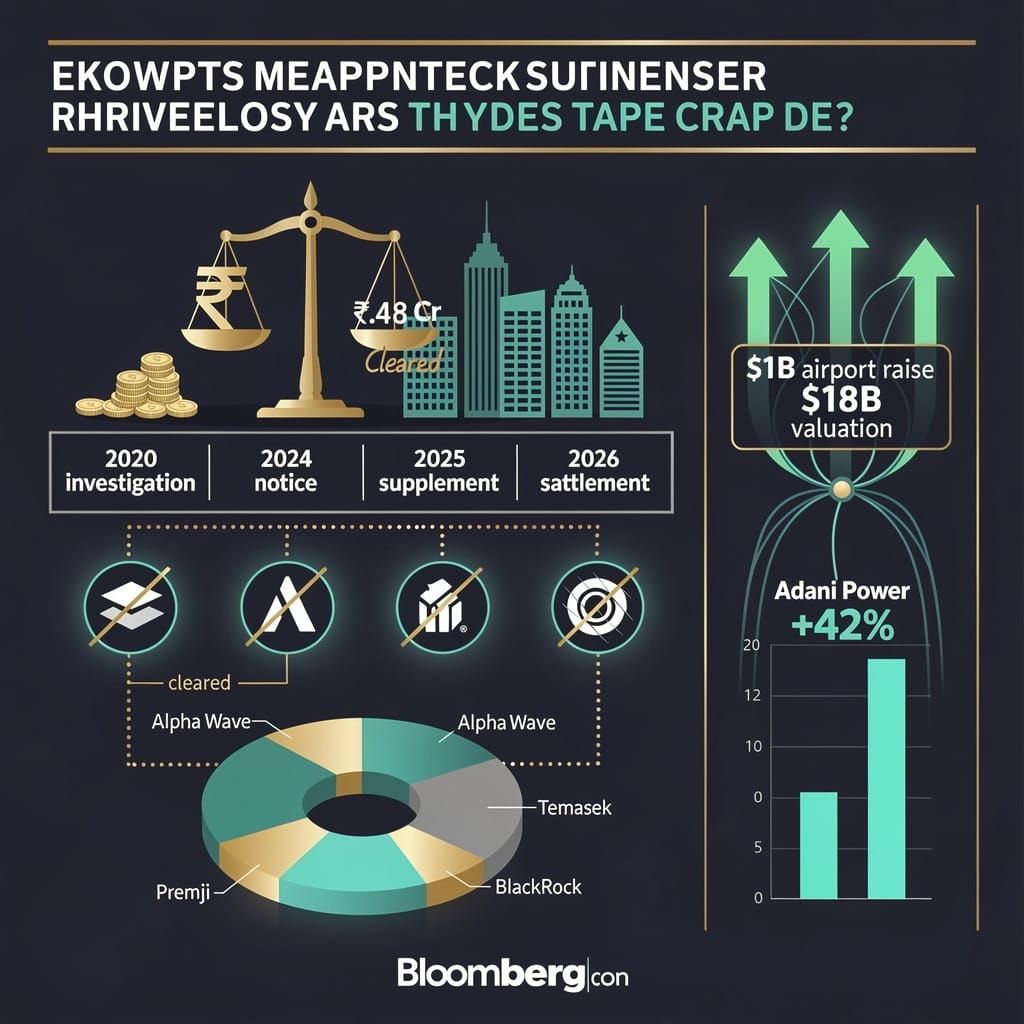
Seven Adani entities have bought procedural closure from SEBI — first via a Rs 1.48 crore MPS settlement, then a ₹1.508 crore related-party and audit-certification settlement in September that also cleared Vinod Adani. The crucial distinction: these resolve listing-rule and process breaches, not the fund-funneling scheme Hindenburg documented. Under the consent mechanism, underlying facts remain neither proven nor disproven. SEBI retained enforcement rights. The sharper signal is capital markets: Adani Enterprises' airport unit pulled a $1 billion raise at an $18B valuation from Temasek, BlackRock, Premji, and Alpha Wave; Adani Power's profit jumped 42%. Settlements and equity subscriptions are analytically distinct — one is procedural, the other a priced, contractual vote.
On Monday, Gautam Adani and four group entities formally closed a securities regulator case with a combined settlement payment of Rs 1.48 crore, ending a six-year investigation into minimum public shareholding (MPS) violations. Adani Enterprises Ltd, Adani Power Ltd, Adani Ports and Special Economic Zone Ltd, and Adani Transmission Ltd (now Adani Energy Solutions Ltd) bought procedural closure from the Securities and Exchange Board of India (SEBI), which also levied Rs 20 lakh fines each on two non-executive independent board members — Nasser Ali Shaban Ahli and Chang Chung-Ling.
The settlement resolves a specific, narrow charge: these companies fell short of the 25% minimum public float mandated under the Securities Contracts (Regulation) Rules and Listing Agreement, and SEBI found compliance lapses under the LODR framework. The mechanism was procedural — an investigation that began on October 23, 2020, a show-cause notice on September 27, 2024, a supplementary notice on March 3, 2025, and a settlement that withdraws the proceedings without a conviction or admission.
The Figures, Scaled
The Rs 1.48 crore headline is, by any measure, minuscule against the market capitalizations of these four listed entities — a scale gap that underscores how this settlement is structurally minor in monetary terms. But a fuller accounting shows the settlement extends beyond the four named entities.
On September 22, 2026, SEBI Adjudicating Officer Jai Sebastian passed a settlement order approving a combined ₹1.508 crore payment from five Adani Group companies — Adani Enterprises, Adani Total Gas, AWL Agri Business, Adani Green Energy, and Adani Energy Solutions — for unresolved adjudication proceedings. That round addressed undisclosed related-party transactions and the signing of audit and limited-review reports without valid Peer Review Certificates, violations of the SEBI (Listing Obligations and Disclosure Requirements) Regulations, 2015. The companies paid via email on September 5, 2026, after accepting the High Powered Advisory Committee's recommendations from June 29, 2026, with SEBI's Panel of Whole Time Members approving the settlement on August 13, 2026. SEBI disposed of the proceedings but explicitly retained enforcement rights — meaning it can reopen action if any representation proves false.
Combined with the earlier MPS resolutions for Adani Ports and Adani Power, a total of seven Adani entities named in the Hindenburg report have now been cleared through settlement.
Crucially, that September order also cleared Vinod Adani of MPS and PFUTP violations. The regulator's investigation into two offshore funds (Emerging India Focus Fund and Emerging Market Fund) and Opal Investments found no evidence that Vinod Adani directly controlled their investment decisions; an advisory role proved insufficient to establish de facto control over FPIs including Excel Investment and GMAML. That finding runs counter to the notion of an unwind as systemic.
Where the Penalty Distribution Lands
Independent directors paid penalties, not the promoters. The Rs 20 lakh fines on Ahli and Chung-Ling — rather than on the Adani holding entities themselves — shift the compliance burden onto individual stewards. That distribution signals where SEBI located the governance failure: in board-level oversight of public float reporting, not in the financing mechanics that Hindenburg alleged.
The key distinction: this settlement addresses a listing-rule breach (shareholding structure), not the alleged fund-funneling scheme Hindenburg documented through offshore and onshore intermediaries. The September order, similarly, resolves a certification procedural lapse. A settlement under the regulator's consent mechanism permits closure without adjudication, meaning the underlying facts about related-party fund flows remain neither proven nor disproven.
The Capital-Market Counter-Signal
The most persuasive counterweight to a "systemic fraud" reading is the behavior of the group's own capital-raising channels, which remain open and well-funded. On September 9, Adani Enterprises' airport unit raised 98.25 billion rupees ($1 billion) at an $18 billion valuation in a deal involving Alpha Wave Global, Premji Invest, Temasek Holdings, and BlackRock. Investors will subscribe to new shares in three tranches — the final expected by July 2027 — with the group citing the deal as its first major transaction since Gautam Adani settled US legal probes, including a $275 million Treasury settlement in May and dropped criminal charges related to solar energy contracts. Adani Enterprises shares rose up to 4.2% on the announcement. The round funds airport modernization targeting roughly 200 million annual passengers and supports a demerger from Adani Enterprises planned for 2028.
Similarly, Adani Power posted a 42% year-on-year profit jump on July 23, with its board authorizing a Rs 15,000 crore QIP and a debt ceiling lift to Rs 100,000 crore.
The pattern is consistent: institutional capital — global and domestic — is flowing into the group at meaningful valuations even as the Hindenburg-era overhang persists. The MPS and RPT settlements and the fundraising are analytically distinct: a settlement resolves a procedural disclosure breach; a binding equity subscription is a priced, contractual vote of confidence. One does not imply the other.
Counter-Signal and Uncertainty
The obvious counterweight: a six-year investigation ending in a Rs 1.48 crore settlement, alongside related-party proceedings closed for ₹1.508 crore, could be read as evidence the violations were administrative and minor — not evidence of systemic fraud. Yet SEBI has retained enforcement rights in the September order, and it has not closed the door on follow-up actions pending additional disclosures around related-party reporting. The settlements carry no admission, so the underlying facts remain neither proven nor disproven. The RPT settlement's own terms — a certification lapse rooted in missing Peer Review Certificates, not in the substance of the related-party flows themselves — reinforce that the regulator has so far tackled process breaches, not the underlying financing allegations.
Three Indicators to Monitor
- Whether SEBI exercises its retained enforcement rights or issues fresh show-cause notices on related-party transaction disclosures — which would signal these settlements were prologue, not conclusion.
- The timing and pricing of upcoming tranches of the Adani Airport Holdings equity raise, tracking whether the ~$18 billion valuation holds as the first tranche converts to contracted capital.
- Funding-cost spreads on Adani Group debt relative to benchmark levels, measuring whether institutional appetite translates into enduring, cheaper capital or remains episodic.
This is reporting and analysis of a regulatory resolution and its market implications, not an investment recommendation. How SEBI's next filing season treats the group's disclosure practices — and how the seven settled entities sustain their funding access — will determine whether Monday's settlement marks an endpoint or a footnote.
Comments ()