FBI's deputy exit signals shrinking top-tier authority
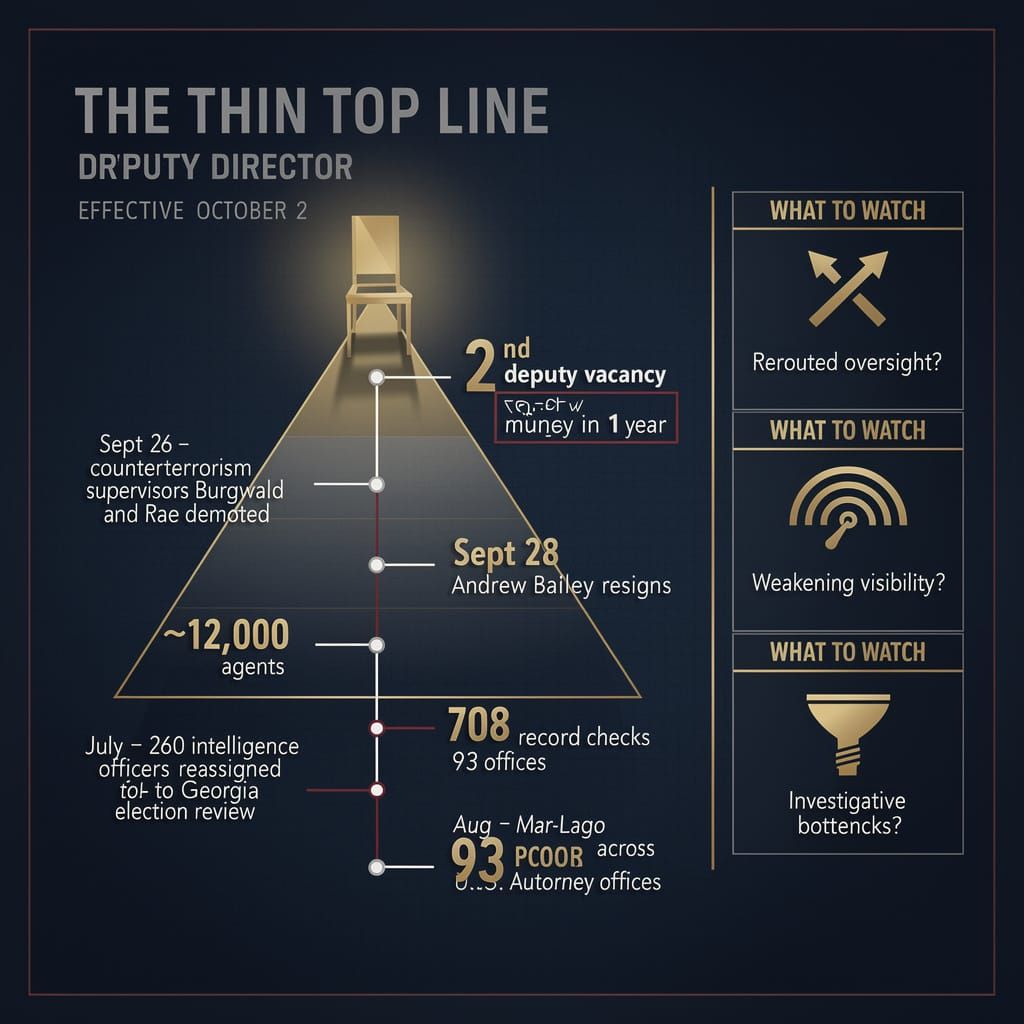
The FBI's top tier just lost its second co-deputy in under a year. Andrew Bailey resigned Sept. 28 after friction with Director Kash Patel over counterterrorism staffing — two weeks after supervisors Burgwald and Rae were demoted over the disputed Katie Miller harassment probe. The signal isn't one resignation; it's the pattern: when a No. 2's authority over staffing gets overridden, surviving deputies recalibrate what they'll touch. With Chris Raia now the sole co-deputy, the open question is whether risk reporting gets quieter and decisions bottleneck. Three indicators would distinguish a realignment from a cascade: slower threat cases, fewer forward-looking assessments, and delayed sign-offs.
Effective October 2, the FBI's co-deputy director position is vacant again. Andrew Bailey, the former Missouri attorney general tapped as Kash Patel's No. 2 roughly a year ago, submitted his resignation on September 28 after an unusually public run. The departure is being framed around family priorities — Patel thanked Bailey for his "fantastic contribution" in an internal email and on X — but multiple anonymous sources describing the exit point to something narrower: a widening friction between Bailey and Patel over how counterterrorism leadership was being reshuffled.
The timeline matters. On September 26, FBI Senior Counterterrorism Supervisors Michael Burgwald and Courtland Rae were demoted from the Washington Field Office after disputing the investigation into allegedly harassing phone calls made to Katie Miller, wife of White House adviser Stephen Miller. Both had deep counterterrorism credentials — Burgwald and Rae worked the Boston Marathon bombing case and earned awards for counterterrorism work in 2016. The FBI confirmed the removals, citing the harassment probe's lack of a proper legal basis relative to terrorism matters; investigators determined the calls lacked any nexus to terrorism and did not warrant further investigation. Bailey's frustration reportedly centered not just on those personnel decisions but on being excluded from certain meetings and on not being selected for the top job when Patel took the director's seat.
Darren Cox, the Washington field office assistant director, disputed direct involvement in the demotions, which were framed internally as personnel decisions based on mission needs. Both agents were subsequently transferred back to headquarters.
Deeper bench, thinner field
The structural signal here isn't the resignation itself — it's the pattern it completes. Deputy director is now the second senior position in the Bureau's top tier to turn over within a year. Dan Bongino, the other original co-deputy, left in January. Chris Raia remains as the sole co-deputy. That leaves the FBI's senior leadership operating with reduced depth precisely at a moment when the administration is pushing hard on personnel alignment.
What's observable is the causal chain, not the motivation. A separate lawsuit filed August 4 alleges hundreds of FBI officers were terminated in connection with probes into Trump's post-election actions, with roughly 12,000 agents purged in what legal briefs describe as a "broad sweep" of politically misaligned investigators. Burgwald and Rae's demotions sit squarely inside that pattern: supervisors who handle cases that draw White House attention are removed, and those removals create new political terrain that senior deputies must navigate. Bailey's own history — a Trump supporter elevated from the Missouri attorney general's office — made him an unlikely source of ideological friction. His exit reads less as philosophical opposition and more as a positional assessment: when the No. 2's authority over counterterrorism staffing is repeatedly overridden, the role's actual leverage shrinks, and staying becomes a statement about tolerance rather than mission.
That pattern extends beyond the deputy suite. Court filings and administration moves through 2026 show the same mechanism operating across the Bureau and the wider federal law-enforcement apparatus. In July, Patel directed roughly 260 FBI intelligence officers — most of them weekend volunteers — to focus exclusively on reopening the 2020 Georgia election investigation, despite prior court rulings rejecting the underlying fraud claims; completed 708 record checks followed on July 17. In August, the DOJ announced a probe of FBI agents who conducted the 2022 Mar-a-Lago search warrant, targeting all 93 U.S. Attorney's offices nationwide, which former federal prosecutor Glenn Kirschner called "searingly corrosive" to law enforcement. Each move follows the same design: cases or investigations that draw political scrutiny are reopened, defunded, or adjudicated by personnel judgment rather than legal merit, and every decision changes what the people below are willing to touch.
The counterevidence is real and should temper any clean narrative. The stated reason for Bailey's exit is family, Patel publicly praised him, and at least one account frames the resignation as a private personal decision with no acrimony. Anonymous sourcing about internal tension is inherently unreliable, and personnel turnover at this level is not itself proof of dysfunction. Two of the three reported drivers — frustration over promotion and Patel's aggressive style — are contested or unconfirmed. Hiring-standard criticism also cuts against a single purge narrative: in August, former assistant special agent Michael Feinberg called the relaxed vetting that now permits applicants who solicited sex workers "insane," a separate concern about composition that points to inconsistent and disputed decision-making rather than one coherent agenda. Rank-and-file agents do report concern about politicization of personnel decisions, but that sentiment is self-reported and uneven.
What to watch
The risk isn't that turnover happens; it's what the turnover reveals about decision rights. When a deputy can't protect the people under them from politically driven demotions, the people who remain recalibrate. The questions worth tracking, tied to the evidence here:
- Do counterterrorism supervisors and agents begin routing information and decisions through channels they judge less politically exposed, measurable through slower case progression or more formal escalation?
- Does the demotion of supervisors who raised threat-handling concerns — and the summer's directed Georgia review and Mar-a-Lago probe — reduce the volume of forward-looking risk reporting, i.e., do quieter threat assessments start showing up in downstream intelligence products?
- With Raia now the sole co-deputy, does the span of control compress to the point that senior decisions bottleneck, visible in delayed sign-offs or additional interim appointments?
Those are the indicators that would distinguish a smooth realignment from a cascade. Bailey's departure, on its own, is one resignation among many in an administration actively reshaping federal personnel. But the demotions, reviews, and probes that surrounded it — with named supervisors, confirmed dates, and acknowledged transfers — are the mechanism worth watching, because losing a deputy is a headline, while losing the willingness of supervisors to raise concerns is a structural change that shows up later and stays longer.

Comments ()