Nigeria convicts 21 firms, hardening the licensing gate on investment operators
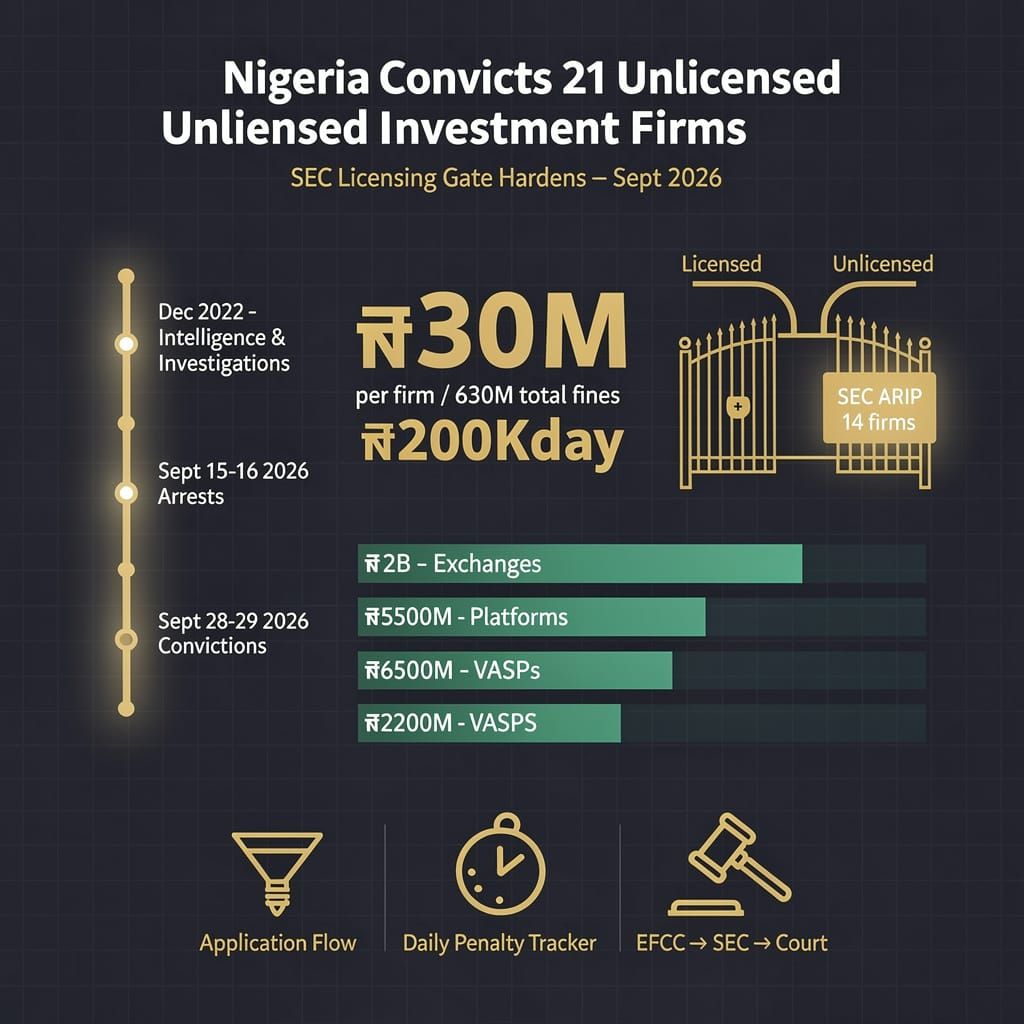
⚖️ Nigeria's enforcement gate just got real. On Sept 28, a Federal High Court convicted 21 companies for running investment businesses without valid SEC licences — a N30M fine each (N630M total before daily accruals), plus N200,000 per day under Section 57(1) of the 2020 Act, after EFCC prosecution. The bigger shift: courts, EFCC, and SEC now form a working pipeline — intelligence → arrest → prosecution → conviction — converting regulatory documentation into prosecutable records. It lands precisely as the SEC raises the licensed gate's cost: a proposed N2 billion minimum capital for exchanges and N200M for VASPs, with ARIP entrances already at 14 firms. The tradeoff: penalties hit convictions, but no restitution to investors was ordered — and licensed entry costs keep climbing for everyone.
On September 28, 2026, the Federal High Court in Lafia, Nasarawa State, convicted 21 companies for operating financial investment businesses without valid Securities and Exchange Commission (SEC) licences. Presiding Justice Anyalewa Onoja-Alapa imposed a fine of N30 million on each company, plus N200,000 per day for the duration of each offense, after the Economic and Financial Crimes Commission's (EFCC) Abuja Zonal Directorate prosecuted the cases under Section 57(1) of the Banks and Other Financial Institutions Act, 2020. The ruling changes the calculus of running unlicensed money-management operations in Nigeria.
The mechanism: a six-year enforcement gap closes
The convictions did not arrive quickly. EFCC intelligence linking the companies to investment fraud surfaced as early as December 2022, when promoters were summoned for interrogation; some reportedly evaded those inquiries until arrests on September 15-16, 2026. The Lagos and Lafia courts confirmed the convictions across September 28-29, 2026.
The legal hook matters as much as the verdicts. Section 57(1) of the 2020 Act makes it an offense to carry on specialized financial businesses without a licence from the Central Bank of Nigeria or, for investment-related services, the SEC. The court accepted witness testimony and CAC/SEC documentation showing the companies advertised and ran investment management operations outside that licensing perimeter.
How value and risk now redistribute
The enforcement has three measurable downstream effects. First, a direct financial sanction: aggregated across the 21 entities, base fines total N630 million before accruing daily penalties. A company paying the reported N130 million described for named operators would face an unhedged cash outflow absent active litigation.
Second, the verdicts reprice unlicensed intermediation risk just as the SEC expands and formalizes the licensed route. The SEC's Accelerated Regulatory Incubation Program has been absorbing entrants in stages: after the July 2026 admission of seven crypto firms (Luno Fintech Nigeria, Bitbarter Technologies, GetEquity, Koinkoin Global Network, Wrapped CBDC Ltd, Trovotech Ltd, and Blockvault Custodian Ltd), a mid-August 2026 round added three more — Pisi Payments Solution Limited, BC Access Nigeria Limited (Blockchain.com), and Yellow Card Financial Limited — lifting ARIP participants to 14. On August 23, 2026, the SEC formalized the cost of that sanctioned gate: a proposed N2 billion minimum capital for exchanges and custodians, N500 million for digital asset offering platforms, N200 million for VASPs, N30 million registration fees, 25% fidelity insurance bonds on paid-up capital, and supervisory charges running from 0.0075% to 0.025% of turnover. The named convicted firms — Ngwuoke Daniels Technologies, Credio Banco Ltd, Co Request Capital Nigeria Ltd, Qnet Nigeria Ltd, Norland Global Ltd, Oxford International, Kwakol Markets Ltd, and others — absorbed what courts treat as verified violations, while staying licensed carries a rising entry cost. The compliance cost of collecting third-party capital without authorization has risen on both sides of the gate.
Third, leverage shifts toward the gatekeepers. The EFCC's Abuja Directorate, the SEC, and the Federal High Court now form a working enforcement pipeline: intelligence, arrest, prosecution, conviction. That is the structural change. Rather than relying on reactive client complaints, the pipeline converts regulatory documentation into prosecutable records, which deterrence-sensitive entrants must price into their structure.
The counter-signal
The record carries unresolved ambiguity. The companies were largely absent during trial; counsel entered not-guilty pleas on their behalf, and one briefing indicates a defence motion was filed while sentencing proceeded. Reported figures describe fines but not restitution orders to investors, so the aggregate liability represents a penalty, not necessarily what harmed third parties recover. Notably, neither the court record nor the SEC's parallel crypto-incubation expansion specifies how the licensed and unlicensed tracks interact, and the EFCC's December 2022-to-2026 timeline shows enforcement can clear only a fraction of the unlicensed market in a given cycle.
Monitoring indicators
Three observable signals will show whether this ruling changes market structure:
- Licence-application activity: Whether the SEC's ARIP cohort, at 14 firms after the August admissions, expands further in the 6-12 months after the final crypto rules — confirming its sanctioned route is absorbing would-be unlicensed managers.
- Daily-penalty enforcement: Whether the N200,000/day accruals are actively collected or lapse under appeal demonstrates how far the courts are willing to press.
- Follow-on prosecutions: The EFCC's stated intention to monitor remaining unlicensed operators, and whether further convictions materialize, tests whether the pipeline is durable or event-specific.
The Lafia judgment, on its own, is a fine-and-conviction outcome. Its significance lies in establishing that operating an investment business outside the SEC licensing gate is now a traceable, prosecutable offense with real cash consequences — and that the enforcement infrastructure to prove it has been stood up.
Comments ()