Court: NMDPRA Breached PIA by Arbitrary Fuel Import Licensing
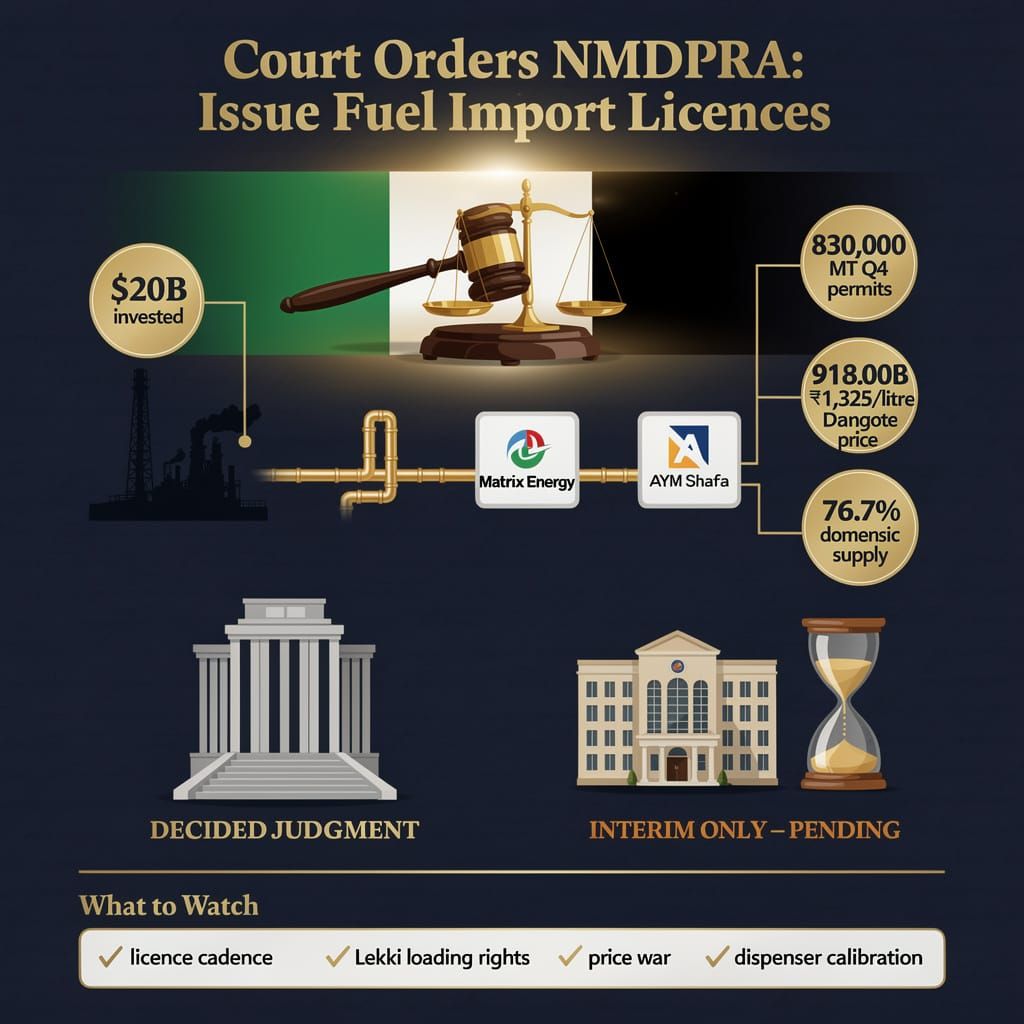
⚖️ Nigerian court rules NMDPRA's on-again, off-again fuel import licensing behind AA Rano, Matrix Energy, and AYM Shafa amounts to "direct non-compliance" with the Petroleum Industry Act. Justice Ekwo held the regulator can't withhold licences as a discretionary favor—approval must follow the law's published conditions, not preference for a single local refinery. The marketers have $20B+ sunk in infrastructure. But the fight isn't over: Q4 permits (≈830,000 tonnes) are docketed, while Dangote's N100B action in Lagos sits at interim-injunction stage only. Watch the licensing cadence over the next two quarters—that's whether this judgment actually lands. Will NMDPRA read the PIA "out loud"?
Abuja, Oct. 1, 2026 — For the better part of a year, Nigerian fuel marketers waited while the Nigeria Midstream and Downstream Petroleum Regulatory Authority (NMDPRA) granted, renewed, and occasionally refused import licences like a barman rationing a scarce bottle of something. On Monday, a judge finally poured the whole thing out into the open.
Justice Inyang Ekwo of the Federal High Court in Abuja ruled that NMDPRA's pattern of sporadic approvals—literally since July 2025—amounted to "direct non-compliance" with the Petroleum Industry Act (PIA) of 2021. The ruling orders the regulator to keep issuing petroleum import licences to Matrix Energy, AA Rano, and AYM Shafa, provided they meet the statutory conditions on the books.
What Actually Happened
The mechanics matter, so let's slow the tape. The three marketers—represented by Senior Advocate Ahmed Raji—sued in June after NMDPRA's on-again, off-again licensing left them guessing whether their multi-billion-dollar operations had a future. The court invoked Sections 31 and 32 of the PIA, plus Section 72 of the Federal Competition and Consumer Protection Act, and found the regulator was treating import licences as a discretionary favor rather than a statutory right—not a policy call, but a direct breach of the law's plain text.
The key finding: the PIA does not ban fuel imports. The law explicitly lets a qualified downstream operator hold an import licence, and NMDPRA—though it keeps its power to grant or cancel—can't simply decline to exercise that power because it would rather everyone buy from one particular local refinery.
Which brings us to the elephant refining in the room.
The $20 Billion Question
AA Rano's affidavit claims the three marketers have sunk more than $20 billion combined into infrastructure, logistics, and retail networks. That's not pocket money even by crude-export standards. Their argument, which the court evidently found persuasive, is that imports plus domestic refining preserves competition and keeps any single player from holding the market hostage.
The timing is worth noting. Just days before the ruling, NMDPRA approved roughly 830,000 metric tonnes of petrol import permits for the fourth quarter—covering Matrix Energy, AA Rano, AYM Shafa, NIPCO, Pinnacle Oil, and Bono Energy. So the regulator is capable of saying yes when it wants to. The approval, dated around September, was sold as forward-stocking for Christmas and New Year demand.
Here's where the numbers get philosophically awkward. In the same window, Dangote Refinery sliced its ex-depot petrol price to ₦1,325 per litre on September 21—below the average import-cost equivalent—citing sufficient domestic production. And official figures show domestic refineries already supplied 76.7% of national petrol demand. So Abuja authorized roughly 830,000 tonnes of imports even as the home team claimed it could cover the shelves itself. That tension didn't escape the courtroom.
Meanwhile, Dangote Petroleum Refinery has its own N100 billion action pending at the Lagos Federal High Court, challenging those very import licences. Complicating the picture: in late August, Justice Akintayo Aluko granted the Lagos court an interim injunction blocking NMDPRA from enforcing its August 24 directive that had suspended petroleum loading and truck-out at the Lekki Free Zone refinery. The regulator's authority inside that free zone—flagged by an Attorney-General's letter dated March 2—remains the live jurisdictional question there. The two cases are the argument over Nigeria's fuel future, playing out in parallel courtrooms. Note, precisely, the distinction: the Abuja ruling is a decided judgment; the Lagos Dangote matter is still an unresolved application with interim protection only.
What It Means, And What To Watch
Justice Ekwo didn't strip NMDPRA of its authority. The regulator still grants and cancels licences. The court simply said: stop being arbitrary about it, and follow the law's conditions. Approval now follows rules, not moods.
Note the status distinctions: the Abuja judgment is a decided ruling; the Lagos Dangote suit is an unresolved application with only interim relief granted. And the Q4 import permits are approved and docketed—but approval and loading are different beats.
A few signals to track:
- Whether NMDPRA begins issuing licences more predictably, or finds new creative ways to delay
- The substantive outcome of the Dangote action in Lagos, where interim protection is not a final verdict
- Whether the marketers' next fight shifts to price competition, now that a ₦1,325 ex-depot price sits below import landing costs
- NMDPRA's parallel enforcement push—a September "Riot Act" ordering nationwide dispenser calibration, with licence revocation as the stick for persistent under-dispensing
The Cynic's Footnote
Here's the irony. The regulator that pushed domestic refining as a matter of policy now has a court reminding it that "policy preference" is not the same as "law." The marketers didn't win a right to import—they won the right to be judged by published criteria rather than by a licensing roulette wheel. For operators guarding $20 billion in sunk assets, that's a meaningful distinction.
The Bottom Line
As of this writing, the ruling is on the books, Q4 import permits have been docketed, and the Lagos suit hasn't resolved past an interim stage. Operators cleared the first hurdle, but the course is unchanged: competition stays a litigation sport until someone settles it at the refinery gate or in the corridors of the regulator. Watch license issuance cadence over the next two quarters—that's the tell for whether this judgment actually landed or just got filed away. The open questions now: will NMDPRA read the PIA out loud and live by it, will the Lagos court translate interim protection into a final ruling that reshapes who loads at Lekki, and can import economics survive with the home refinery pricing below landing costs?

Comments ()