Spain suspends vulnerable-tenant evictions until 2030 — landlords and funds scramble
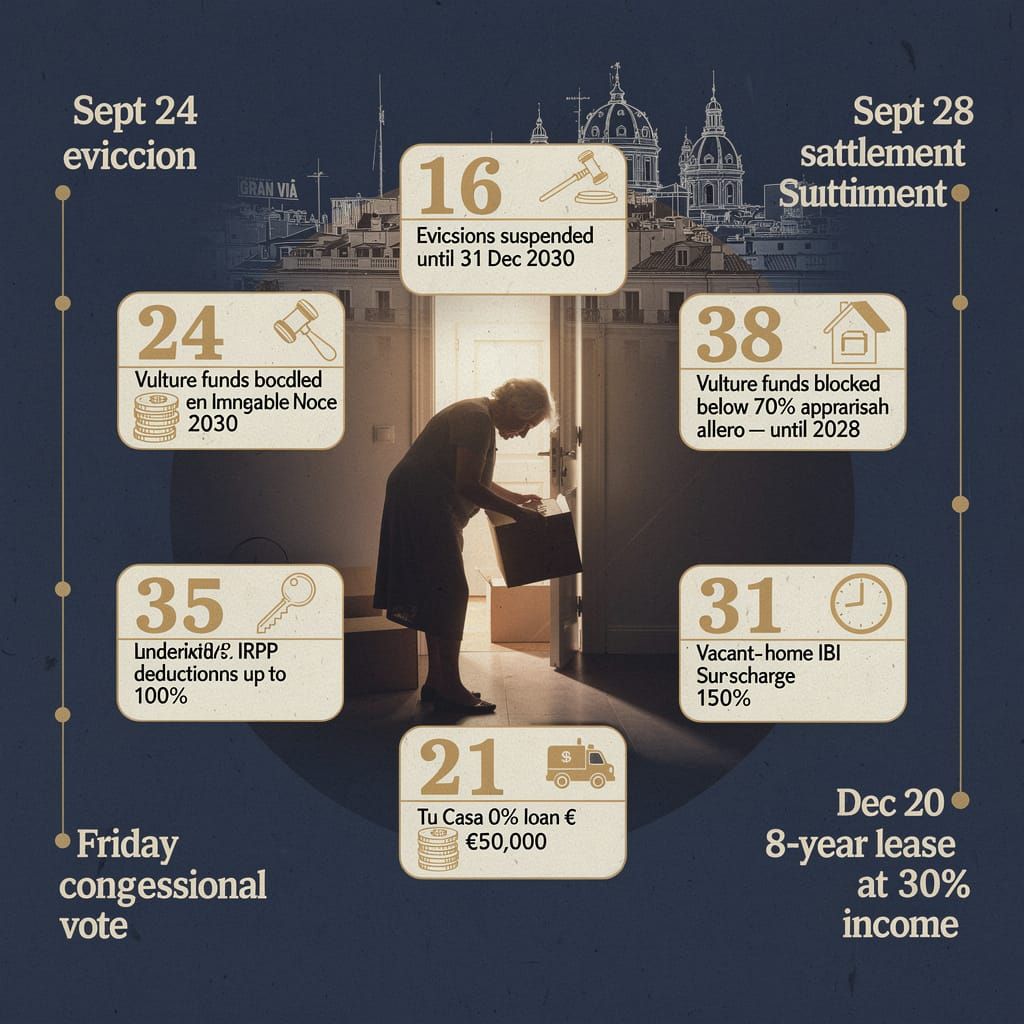
Spain just made housing policy law by decree—and it's far-reaching. Real Decreto-Ley 26/2026 publishes today. Key moves: • Evictions of vulnerable tenants suspended to Dec 31, 2030 • "Vulture funds" blocked from buying homes below 70% of appraisal until 2028 • Landlords: 50% IRPF deduction, up to 100% for cutting rents >5% • Tourist-property owners: IBI surcharges up to 150% • First-time buyers: 0% interest loans up to €50,000 For landlords and operators, the work is literal: check renewals against the 2028 window and keep compensation paperwork ready. Congress still votes Friday, and the second decree faces an uncertain path.
Somewhere between a national emergency and a legislative car crash, Spain's housing policy just took a very sharp turn. On Wednesday, the Boletín Oficial del Estado published Real Decreto-Ley 26/2026, the first of two housing decrees the Council of Ministers approved Tuesday—and it's a doozy. If you own, rent, buy, or simply read news from Madrid, this one reaches past your mailbox and into your bank account.
The numbers that actually matter
Let's skip the ministerial theater and land on arithmetic. The decree's headline: evictions of vulnerable tenants who lack alternative housing are suspended until December 31, 2030. That's not a proposal—it's final, published law. Read it twice because the fine print matters as much as the deadline.
And about that political pressure: it isn't abstract. The face of this crisis is María del Carmen Abascal, the 87-year-old tenant Urbagestión Desarrollo e Inversión S.L. pushed out of her Madrid flat on September 24, after 70-plus years inside and a Supreme Court ruling that went the company's way in March. The rent math was brutal—about €500 a month she had been paying, versus a demand near €2,500. The UN Committee on Economic, Social and Cultural Rights warned Spain in June to stop the eviction or offer alternatives. The eviction proceeded anyway. Police removed her; an ambulance was involved; the slogans outside the cordon were "Maricarmen, you are not alone" and "Murderers!"
Then came the twist: on September 28, the Eviction Defense Coalition brokered a settlement letting Abascal return under an 8-year lease capped at 30 percent of her net earnings. Madrid's coalition had its headlines, and the trade-off is baked into the decree—industry watchers already call it the "decreto Maricarmen."
Where the money changes hands
The clever bit—and the cynics' favorite—is Article 2. When an eviction is suspended for a small landlord, the autonomous communities get two months to either offer alternative housing or pay the unpaid rents and utility debts. The state then reimburses regions through aid lines. Miss the deadline? Interest accrues on those payments to landlords. The architecture is elegant: tenants keep their homes, small owners get paid (eventually), and the regions eat administrative risk until Madrid makes good.
CEOE, the employers' federation, called the drafting "an adección of deficient legislative technique." That's polite for "lawyers are going to bill a lot of hours on this."
The vulture fund carve-out with a 70% test
Speculative buyers get a time-out. Until December 31, 2028, entities classified as "vulture funds" can't acquire residential property priced below 70% of appraisal value. The decree defines a vulture fund as any entity—with or without legal personality—buying homes or defaulted mortgages without economic compensation. Exempt: public territorial entities and public-sector bodies. A workaround exists for funds willing to lease affordably for five years to dependent or vulnerable tenants. Note the wiggle room: judges decide whether an entity "counts" as speculative, which tees up years of litigation.
The tax carve-up
Fiscal instruments arrive fully loaded:
- IRPF: 50% general deduction for landlords; up to 100% if they cut rents by more than 5%; up to 15% if rents rise over 20%.
- Owners of 4+ tourist properties face IBI surcharges up to 100%; vacant homes over three years (2+ properties) get surcharges to 150%.
- Tourist rental VAT: 10%. Protected housing construction: 4%.
- SOCIMIs: a 15–25% surcharge on benefits.
The "Tu Casa" credit line
First-time buyers get a 0% interest loan up to €50,000 or 20% of the property value, with up to a 30-year amortization. Conditional: beneficiaries can't resell above the CPI-linked price. Confident fiscalists call this a subsidy; skeptics call it a balloon payment disguised as generosity.
What still moves the needle
Two things remain unsettled. Congress validates the decrees Friday—the second decree faces a genuinely uncertain vote after negotiations ran through Monday night, with Junts publicly warning the government is "walking away from the agreement." Second, expect a second measures package later; a preliminary "Maricarmen" draft is already slated for December 2026.
The observable conditions to watch: whether the regional compensation clock actually pays landlords within two months (interest or no), and how courts rule on who qualifies as "vulnerable." If past eviction moratoria are precedent, the queue of tests will be long, the rulings slow, and the analysts busier than the bailiffs.
For operators, the roadmap is literal but not simple: check contract dates against the 2028 renewals window, price renewals against the IRAV index, and keep the compensation paperwork ready. The decree is in force; the market is not yet in equilibrium. That's reporting, not advice—but it does look like the era of the 2% cap, the 0% rate, and the 150% surcharge has begun. And somewhere in Puerta del Sol, an 87-year-old is unpacking boxes under a lease she fought 70 years to keep.


Comments ()