Romania rejects 2nd cabinet as president weighs dissolving Parliament
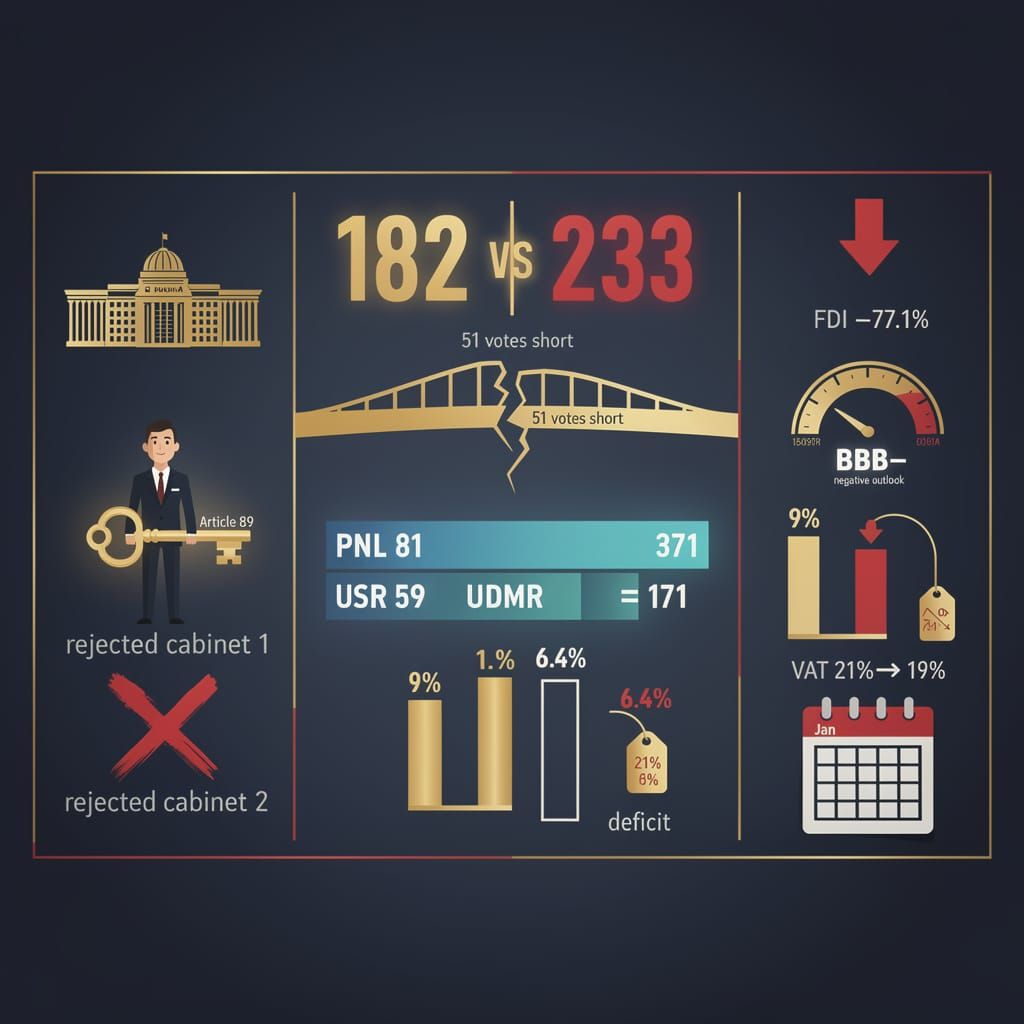
Romania just rejected a second cabinet in a row. Siegfried Mureșan's coalition pulled in 182 votes — a full 51 short of the 233 needed to form a government. Now President Nicușor Dan holds the constitutional key under Article 89: two failed proposals plus 60 days passed clears the legal path to dissolve Parliament. But he's not compelled to use it. Why this matters beyond Bucharest: the crisis is running while Fitch has Romania at BBB− with a negative outlook, external debt tops €235B, and the pre-2027 consolidation deadline keeps slipping. The last deficit exceeded 9% of GDP. The options: early elections, a CCR constitutional knife fight, or a third doomed investiture. Three months to prove fiscal capability before Fitch's January review.
Let me get this straight: Romania just rejected a second government in a row, the president is dangling the nuclear option of dissolving Parliament, and the constitutional lawyers are about to have a very, very busy week. Buckle up.
The Scoreboard Reads 182-233
On Wednesday, September 30, Siegfried Mureșan's proposed cabinet went before Parliament and pulled in 182 votes — a full 51 votes short of the 233 needed to form a government. That's not a close miss; that's a "did we even try?" gap.
For context, the outgoing Veștea cabinet had secured exactly 233 votes when it came into being. Mureșan's coalition math — PNL, USR, and UDMR combined — allegedly added up to only 170 parliamentarians. UDMR's own Kelemen Hunor had already run the numbers: 81 PNL, 59 USR, 31 UDMR — 171 votes if everyone showed up, 188 in a perfect-world scenario. Neither gets you to 233. So even in the best-case scenario, the arithmetic was never there. The 182 votes cast on Wednesday suggest some friendly fire from outside the formal coalition, but not nearly enough.
The Blame Game Has Already Started
Because of course it has. PSD's Sorin Grindeanu took precisely zero seconds to point fingers, declaring Romania "lost ten days to the egos of its leaders" — this from the man who weeks earlier declared "nothing coming from USR can be taken into account." USR is demanding early elections outright and refusing to entertain another PSD-led government. PNL, meanwhile, says it's ready to build an alternative to "the current austerity."
Radu Miruță, USR's defense minister pick, is playing the wounded party: he says USR will focus on "current issues rather than this topic" — which, in parliamentary-speak, translates to "we're pretending we aren't about to run the clock out on the president."
Enter Article 89, Stage Left
Here's where it gets constitutional. Article 89 of Romania's constitution gives President Nicușor Dan the power to dissolve Parliament — but only under two conditions: at least 60 days must have passed since the initial investiture request, and at least two government proposals must have been rejected.
Check and check. Mureșan's failure was the second strike.
So the ball is in the president's court. Constitutional Article 89 grants him discretion — it doesn't compel him to act. President Dan has been publicly urging parties to end the crisis and prioritize "national interest," warning that anticipated elections would prolong instability and hammer citizen confidence and public finances.
The Constitutional Court Threat Game
Here's the delicious part. If the president doesn't call early elections, PNL says it will haul the matter before the Constitutional Court. PNL vice president Alexandru Muraru insists "the president should not be suspended" but concedes "there is disagreement on constitutional interpretation."
Translation: nobody actually knows what happens next, and every party is trying to weaponize the ambiguity.
CSR: transport minister Cătălin Drulă agrees with the Liberal view that the president must call early elections. USR's Eugen Tomac is also cited as having an opinion. The president alone decides.
The Fiscal Elephant in the Voting Booth
Here's the part nobody in the plenary wants to talk about. This whole crisis is playing out while Romania's finances are doing… not great. Mureșan, in a move that sums up the moment, has pledged to restore the VAT to 19% from its current 21% — a rollback that only materializes "conditional on fiscal space."
And the fiscal space? It's a mirage. Fitch already downgraded Romania to BBB minus back in late July 2026 — the last investment-grade rung before the fall. The agency's own analyst, Malgorzata Krzywicka, has been on record warning that prolonged crisis "increases questions about fiscal predictability" and the ability to make the necessary adjustments. In other words: the word "junk" isn't just whispered around Brussels anymore — Fitch's own people are saying it with names attached. PSD chairman Grindeanu has already announced the party will demand an official Fitch perspective if the agency's assessment shifts. Bold strategy, especially while your country can't get a government seated.
The numbers back up the pessimism. FDI collapsed 77.1% year-on-year to €1.127 billion, external debt ticked past €235 billion, and the previous government left a deficit that exceeded 9% of GDP. Fitch's own estimate puts the 2026 deficit at 5.9% of GDP — just barely under the 6.2% target, and that was before a third doomed investiture.
The Consolidation That Can't Happen
Officially, the consolidation package aims to trim the deficit to 7.5% in 2025 and 6.4% in 2026. That's the plan. The reality is a caretaker government, an interim executive authority in place since the Senate dismissed the Bolojan government back on May 5, 2026, and a parliament that can't pass its own investiture vote — let alone a deficit-cutting package with real teeth.
Fitch has made the condition explicit: the government must demonstrate budget deficit reduction capabilities before the January 2027 review. So what's the timeline? Roughly three months for a country currently polling its third potential cabinet to prove it can pass fiscal policy. Sure. Nothing could go wrong.
What Actually Comes Next
Picture this: three possible futures, all with different flavors of chaos:
- President Dan calls early elections — the cleanest constitutional path, but he's been reluctant since it prolongs instability and hits public finances.
- President Dan declines — PNL goes to the CCR, and we get a weeks-long constitutional knife fight.
- A third prime-minister candidate emerges — because Romania apparently enjoys running this gauntlet in triplicate.
Six ministers audited this week, including energy's Sebastian Burduja, agriculture's Tanczos Barna, defense's Miruță, transport's Drulă, finance's Alexandru Nazare, and economy's Irineu Darău. Only two — Barna and Nazare — got favorable opinions. Which tells you how much confidence this whole process is generating.
The Bottom Line
So what's the honest takeaway? Romania is stuck in a parliamentary loop where no single bloc can cross the 233-vote threshold, the president holds the constitutional key but is understandably cagey about using it, and the political class is spending more energy drafting blame statements than actual governance. Mureșan has promised "a solution to end the crisis" — but that promise landed in the same file as his 51 missing votes. And every week the loop spins, a deficit projection adds another zero.
Fitch reviews in January 2027. The rating is BBB minus with a negative outlook. The political crisis has been running since May 5. Do the math — those three facts are not trending toward a happy ending. Whether this ends in early elections, a CCR showdown, or a third doomed investiture remains to be seen. But one thing's certain: Romania's parliamentary calendar just became the most-watched soap opera in the region — and the financial markets are rating the reruns.
Comments ()