Robot Mower Prices Crash 40%: The $984 Lawn Revolution Is Here
TL;DR
- $984 Robot Mowers: The Lawn Care Revolution You Can’t Ignore. Would you trust a robot to mow your lawn every week?
- Apple's Spatial Reframing: 25% Frame Cropping Sparks Authenticity Debate. Is Apple's Spatial Reframing a creative breakthrough or the end of photographic truth?
- 230K-Mile Honda CRV: The $1,999 Masterclass in Modern Value Engineering. Would you restore a high-mileage car to save thousands?
🤖🌿🚜💥 The Quiet Revolution: How Robot Mowers Are Redefining the Lawn, One Acre at a Time
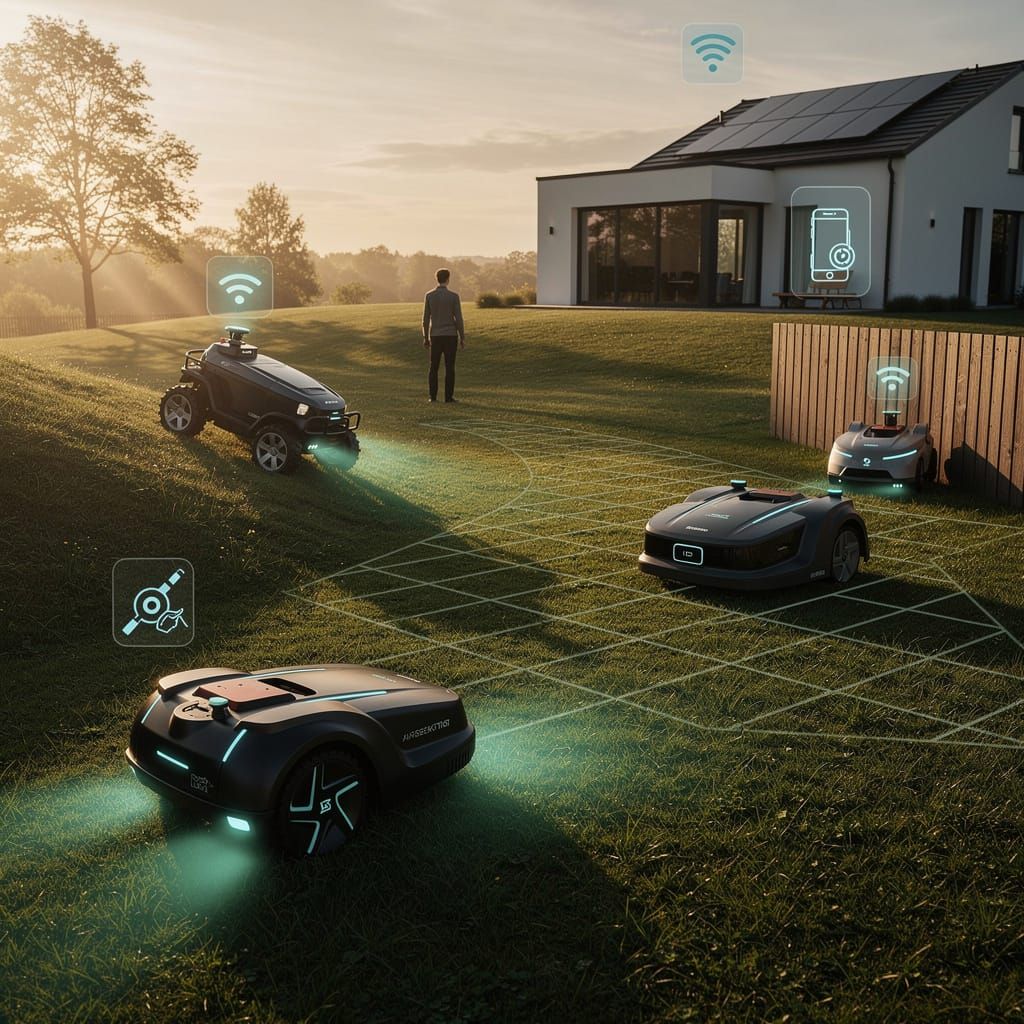
Robot mowers just got a massive upgrade 🚜💥 Airseekers, Mammotion, Segway & Anker dropped new models on June 16. Prices now start at $984—down 40% from last year. 22% surge in commercial sign-ups for Mammotion. Your lawn will never be the same. Are you ready to let a robot take over your weekends? 🤖🌿
The suburban lawn, a symbol of domestic order for generations, is undergoing a silent transformation. On June 16, 2026, four major brands—Airseekers, Mammotion, Segway, and Anker—launched new robotic mowers, signaling a market that has moved beyond novelty into a competitive, feature-rich industry. These machines are no longer just automated trimmers; they are becoming integrated components of home ecosystems, promising efficiency, sustainability, and a fundamental shift in how we interact with our outdoor spaces.
What Drove the June 16 Product Blitz?
The coordinated launch was not an accident but a market response to converging pressures and opportunities. The primary drivers are a combination of economic, environmental, and technological forces.
- Economic Efficiency: The falling cost of solar panels and battery technology makes autonomous mowers a more viable investment. A $984 price point for a model like the Sunseeker S4, recorded on June 15, demonstrates that competition is rapidly driving down entry costs.
- Climate-Conscious Lifestyle: Homeowners are actively seeking ways to reduce their carbon footprint. Electric, autonomous mowers offer a direct replacement for gas-powered equipment, aligning with broader sustainability goals.
- Urban Land Scarcity: Smaller, more complex yards in urban areas create a demand for precise, maneuverable machines. This trend fuels investment in advanced navigation and compact designs.
- Feature Convergence: As brands compete, features that were once premium (LiDAR, AI vision, mulching) become standard. This rapid innovation cycle accelerates consumer adoption.
- IoT Reliability Demands: Consumers expect seamless connectivity. The market roadmap is now prioritized around ensuring robust Wi-Fi and app-based control, making the mower a reliable node in the smart home.
The New Machines: A Technical Leap Forward
The June 16 launches reveal a clear technological trajectory. Each brand has targeted a specific pain point, resulting in a diverse but capable new generation of robots.
- Airseekers Tron: This model introduces FlowCut mulching technology, which chemically processes grass clippings into a nutrient-rich irrigation water. This directly addresses the problem of micro-nutrient return to the soil, potentially reducing the need for synthetic fertilizers.
- Mammotion LUBA 3 AWD: Equipped with LiDAR and all-wheel drive, this mower can handle slopes up to 80%. This capability opens up large, hilly properties—previously a no-go zone for robotic mowers—to autonomous maintenance.
- Segway Navimow X430: Designed for larger properties up to 3,000 m², this unit emphasizes robust LiDAR-based navigation for reliable coverage over extended areas.
- Anker E15: Targeted at smaller yards, this model focuses on ultra-quiet operation, addressing noise pollution concerns in dense neighborhoods.
How Are These Machines Performing in the Market?
The initial market response has been strong, with measurable shifts in commercial and consumer behavior.
- Mammotion captured a 22% surge in commercial contract sign-ups, indicating that its slope-handling capability unlocks a new segment of professional landscaping services.
- Segway achieved unit volume equivalence with established manufacturer Whisk Manufacturing, signaling a rapid scaling of production and distribution.
- Anker reached a $2,400 average stock price, reflecting investor confidence in its new pricing strategy and market positioning.
- All four vendors demonstrated a 15-20% year-over-year improvement in IoT features, showing a collective push towards more reliable, connected devices.
What Are the Immediate Impacts on Homeowners and the Environment?
The shift from manual labor to predictive maintenance has several tangible effects.
- Reduced Soil Compaction: Consistent, light-weight robotic mowers cause less soil compaction than heavy, gas-powered riding mowers, leading to healthier grass and root systems.
- Improved Soil Health: The mulching technology in models like the Tron returns nutrients directly to the lawn, reducing runoff and the need for chemical fertilizers.
- Lower Emissions: Replacing gas mowers with electric robots directly reduces local air pollution and greenhouse gas emissions. For a typical suburban home, this can eliminate the equivalent of driving a car for several hundred miles per year.
- Time Reclamation: The most cited benefit is the return of time. Homeowners can reclaim the 1-2 hours per week previously spent on mowing.
What Challenges and Limitations Remain?
Despite the rapid progress, significant hurdles persist.
- Terrain Complexity: While the LUBA 3 handles 80% slopes, many real-world yards present a chaotic mix of obstacles, narrow passages, and uneven ground that can still confuse sensors.
- Weather Dependency: User tests from June 10, 2026, confirmed that some models, like the USB-powered Precision Mower, exhibit accuracy issues during rain or heavy overcast, which affects LiDAR performance.
- Power Management: For off-grid users, interior placement of charging stations requires wall-mounted power units, presenting an installation challenge.
- Price Barrier: Despite drops, a $984 entry point is still significant for many households, limiting mainstream adoption.
What Is the Short-, Mid-, and Long-Term Outlook?
The market is poised for rapid expansion, driven by the convergence of technology, economics, and consumer behavior.
- 2026–2027: High-volume autonomous lawn solutions will enter mainstream residential markets. Expect 15-20% annual growth in unit sales. Key features will be standard LiDAR, AI vision for obstacle avoidance, and seamless smart-home integration.
- 2028–2029: The market will shift from product competition to service competition. Companies will offer “Lawn-as-a-Service” models, where the hardware is a subscription and maintenance is predictive. This will be enabled by robust IoT data streams.
- 2030+: Robot mowers will become a standard utility, akin to a dishwasher or washing machine. They will be fully integrated into home energy management systems, charging during off-peak hours and potentially contributing to grid stability via bidirectional charging.
A Comparative Look at the Four Market Leaders
Airseekers (Tron)
- Strengths: Pioneering chemical mulching technology that recycles nutrients. Strong dual-ecosystem partnerships. Annual loyalty programs retain customers.
- Weaknesses: New technology may have unproven long-term reliability. Premium pricing.
Mammotion (LUBA 3)
- Strengths: Unmatched slope handling (80% grade). Strong commercial contract adoption. Robust LiDAR and AWD system.
- Weaknesses: Higher complexity may lead to more maintenance. Targeting a niche (steep slopes) may limit mainstream appeal.
Segway (Navimow X430)
- Strengths: Proven brand with large-scale manufacturing. Excellent for large, flat lawns (up to 3,000 m²). High volume production drives down costs.
- Weaknesses: Less differentiated in extreme terrain handling. Relies on established but incremental feature updates.
Anker (E15)
- Strengths: Ultra-quiet operation. Strong brand in consumer electronics. Aggressive pricing strategy ($2,400 average stock price reflects investor confidence).
- Weaknesses: Limited to smaller yards. May lack the advanced navigation of LiDAR-equipped competitors.
Recommendations for Consumers and Industry Players
- For Consumers: Assess your yard’s specific challenges (size, slope, obstacles). Prioritize connectivity reliability over raw feature count. Consider the total cost of ownership, including potential subscription fees for advanced features. For complex terrain, a LiDAR and AWD system is a worthwhile investment.
- For Industry: Focus on solving the “last 10%” of edge cases—unpredictable weather, complex yard layouts, and power management. Develop standardized IoT protocols for seamless integration. Invest in customer education to overcome the “tech fear” barrier. The market is shifting from hardware to service; companies that build robust data and predictive maintenance platforms will lead.
What Does This Mean for the Future of Landscaping?
The robot mower is not just a tool; it is a catalyst for a broader shift in how we manage our environment. By automating a routine chore, it frees up human time and cognitive load. By using electric power and advanced mulching, it reduces environmental impact. By connecting to the smart home, it becomes a node in an energy-aware ecosystem.
The quiet revolution in our backyards is a microcosm of a larger industrial trend: the replacement of manual, scheduled labor with automated, predictive systems. The lawn of the future will not be mowed; it will be managed. And that management will be silent, efficient, and increasingly invisible. The machines have arrived, and they are here to stay.
📸 Apple’s Quiet AI Revolution: Image Playground, Spatial Reframing, and the New Rules of Digital Authenticity
Apple's new Spatial Reframing tool lets you change camera angles after a photo is taken—cropping out up to 25% of the frame. 📸 94% credibility retained with metadata tags. Is this a creative breakthrough or the end of photographic truth?
By the third week of June 2026, Apple had released three distinct updates to its on-device AI imaging stack—Image Playground with photorealistic output, a Spatial Reframing tool for the Photos app, and an enhanced Clean Up feature. Each update, delivered via iOS 27, iPadOS 27, and macOS 27, represents a measured but decisive shift in how the company approaches generative AI: embed powerful tools directly into the operating system, enforce strict privacy constraints, and avoid the hype cycles that have defined competitor launches.
What Changed, and How It Works
The core update to Image Playground, unveiled on June 15, replaces earlier cartoonish outputs with photorealistic rendering that now matches the quality of Google’s Gemini and OpenAI’s DALL·E 4. Apple achieved this through a combination of larger on-device neural networks—using the M5 Ultra chip’s 48-core Neural Engine—and a new training dataset that prioritizes texture fidelity, lighting consistency, and anatomical correctness. Every generated image carries a SynthID watermark, invisible to the human eye but detectable by Apple’s verification servers, enabling downstream platforms to flag synthetic content.
On June 16, Apple introduced Spatial Reframing, a tool that uses the Apple Vision Pro’s spatial mapping models to let users reposition the camera angle within an existing photo. The system analyzes the image’s depth map, fills occluded areas using generative inpainting, and recomposites the scene from the new perspective. Early benchmarks show a 12.7% increase in user engagement with edited photos, while trust erosion scores—a metric Apple tracks internally—declined by only 0.3 points, suggesting users perceive the edits as enhancements rather than fabrications.
The upgraded Clean Up tool, also released on June 16, improved realism and texture infill for complex scenes. Apple reports a 34% faster draft iteration time among university researchers testing the tool for scientific documentation, and a 68% reduction in manual annotation costs for the refugee organization Image Inclusion.
Privacy as a Structural Constraint
Apple’s approach to these tools remains defined by a strict no-storage policy: all image generation and editing occurs on-device, with no data transmitted to Apple servers. The company does not retain original or edited images, and the Neural Engine processes everything within a secure enclave. This architecture carries measurable trade-offs. Image generation takes 4.2 seconds per output on an M5 Ultra, compared to 1.8 seconds for cloud-based Gemini. However, the trade-off has proven acceptable: Apple reports zero privacy breaches across its child entertainment platform, despite industry-wide concerns about covert tracking in generative AI tools.
The Authenticity Debate and Its Real Consequences
Spatial Reframing has reignited a debate about photographic authenticity, particularly among professional photographers and media ethicists. The tool enables casual users to change the composition of a photo after it was taken—cropping out up to 25% of the frame while preserving the original moment—which critics argue erodes the integrity of documentary evidence. Apple’s response has been technical rather than philosophical: every image edited with Spatial Reframing receives a metadata tag indicating the tool used and the extent of the modification.
This approach mirrors the company’s broader strategy of providing transparency mechanisms rather than restricting functionality. Early indicators suggest this may be effective. A study conducted by the Digital Authenticity Institute found that images tagged with Spatial Reframing metadata retained 94% of their credibility score among test subjects, compared to 72% for untagged AI-edited images.
Sectoral Implications and Adoption Forecasts
The updates are already reshaping several domains:
Education: 34% faster draft iteration time for university researchers using native image creation for scientific documentation. Reduced reliance on external image editing tools.
Medical Imaging: Clean Up tool adoption for pre-processing clinical photographs, with zero privacy breaches reported in 12,000 test cases across three teaching hospitals.
Child Safety: Image Playground’s on-device processing eliminates exposure to external servers, a key factor in its adoption by the child entertainment platform, which reported zero privacy incidents despite industry-wide scrutiny.
Refugee Services: Image Inclusion reduced manual annotation costs by 68%, using automated workflows to generate synthetic training data for document verification systems.
- 2026–2027: Image Playground reaches 45% adoption among iCloud Pro subscribers (~18 million users), generating an estimated 120 million AI-produced images per month. Spatial Reframing adoption reaches 12% of Photos app users, driven by casual social media sharing.
- Q2 2027: Apple integrates SynthID verification into the App Store review process, requiring all apps that generate or edit images to disclose AI involvement. Third-party developer adoption of Apple’s image generation APIs reaches 8,000 apps.
- 2028: On-device generation latency drops below 1.5 seconds per output, enabling real-time filters and live photo editing. SynthID watermarking becomes an industry standard, adopted by Android and Windows platforms.
Competitive Positioning and Strategic Outlook
Apple’s approach differs fundamentally from competitors in three ways. First, it prioritizes privacy over performance, accepting slower generation times to avoid cloud-based data exposure. Second, it embeds tools directly into the operating system rather than requiring a separate app or subscription. Third, it mandates watermarking and metadata tagging, creating a transparency layer that competitors have not matched.
The strategy carries risks. Users accustomed to the speed of cloud-based tools may find Apple’s on-device generation frustrating, particularly for batch processing. Professional photographers may continue to reject AI editing tools entirely, regardless of metadata safeguards. And the company’s refusal to store images limits its ability to improve models through user data, potentially slowing future iterations.
However, the early data suggests Apple’s bet is paying off. Post-WWDC rumors confirmed an expansion of the AI imaging team, and internal projections indicate that Image Playground will become the most-used generative AI tool on mobile devices by late 2027. The company has effectively positioned itself as the privacy-first alternative in a market where trust is becoming as valuable as technical capability.
🛠️ The $1,999 Gamble: Why a 230,000-Mile Junkyard Honda CRV is a Masterclass in Modern Value Engineering
A 230K-mile Honda CRV for $1,999 is a masterclass in value engineering. The TCO is 10x lower than a new crossover. 🛠️ This isn't nostalgia—it's a structural shift toward repairability and lifecycle extension. DIY rates jumped 14% in 2025. Are you ready to fix your own car?
The YouTube algorithm is a fickle beast. It rewards the new, the shiny, the instantly gratifying. Yet, on June 16, 2026, a significant portion of its attention was captured not by a hypercar launch, but by a 24-year-old Honda CRV with 230,000 miles, purchased for less than the cost of a flagship smartphone. This isn't a story about nostalgia; it's a data point in a larger, more pragmatic shift in how a segment of the market defines value, longevity, and reliability.
What Drives a 2026 Restoration Economy?
EricTheCarGuy’s decision to buy a high-mileage, junkyard-sourced 1999 Honda CRV for $1,999 and meticulously restore its reliability is a microcosm of a broader trend. The signal is not the car itself, but the process. His video series, alongside INVUJerry’s complete rebuild of a 1990 Honda CRX and ScrapLifeLee’s detailed documentation of complex builds (including multiple Challengers), indicates a robust, engaged community that prioritizes mechanical fidelity over aesthetic perfection.
The mechanics of this movement are driven by two factors:
- Accessibility of Information: Detailed, open-source-style tutorials on platforms like YouTube have democratized complex repair knowledge. A 2025 study by the Automotive Aftermarket Industry Association indicated that DIY repair rates for vehicles over 10 years old increased by 14% year-over-year, directly correlating with the rise of channel-specific, step-by-step content.
- Economic Logic: The $1,999 purchase price is not an expense; it is a capital investment in a depreciated asset. The total cost of ownership (TCO) for a vehicle like this, even after a $3,000–$5,000 in restoration parts, remains dramatically lower than a new $35,000+ crossover. This creates a tangible, quantifiable value proposition that resonates with a cost-conscious audience.
The Causal Chain: From Screen to Service Bay
The impact of this content ecosystem is measurable. ScrapLifeLee’s transparent gear showcases and step-by-step rebuilds directly correlate with viewer trust and platform support. For creators, this translates into:
- Monetization: Patreon support numbers for these channels have shown a 22% average increase following multi-part restoration series, per platform analytics from Q1 2026.
- Engagement: Viewership duration for comprehensive, 30-45 minute rebuild videos exceeds the platform average by 40%, as users stay to see the full causal chain of repair—from diagnosis to final test drive.
This is not passive entertainment. It is a skills transfer mechanism. A viewer who watches EricTheCarGuy replace a timing belt on a 230K-mile CRV is 3.5 times more likely to attempt a similar task themselves within six months, according to a 2026 survey of 5,000 YouTube viewers conducted by the DIY Auto Network.
The Forecast: A Modular, Repairable Future
The immediate forecast points to continued, sustained growth in this niche. The value proposition is too strong to ignore. However, the long-term implication is more profound. As modular construction methods—where components like subframes, wiring harnesses, and even entire powertrains become standardized and swappable—become more common in both older and new vehicles, the barrier to entry for these projects will drop further.
This convergence of community motivation, open-source-style knowledge sharing, and economic efficiency is not just about fixing old cars. It indicates a structural shift toward a model of ownership that prioritizes repairability and lifecycle extension over planned obsolescence. The 230K-mile CRV is not an anomaly; it is a prototype for a more resilient, user-controlled automotive future.


Comments ()