Riyadh Air's 87% Load Factor Shakes Gulf Aviation
TL;DR
- Riyadh Air's 87% Load Factor Launch Shakes Gulf Aviation. Will Riyadh Air's non-stop edge force Emirates and Qatar to cut fares on Gulf routes?
- Airbus U145 Drone: €4.1M Cybersecurity Fix Exposes 14 Flaws. Who pays for the hidden cybersecurity costs of autonomous military drones?
- La Romana Crash: System Failure Killed Pilots in 5 Minutes—FAA Alerts Caribbean Jets. Could a software glitch or cyberattack bring down your next flight?
✈️ Riyadh Air's 87% Load Factor Launch Shakes Gulf Aviation
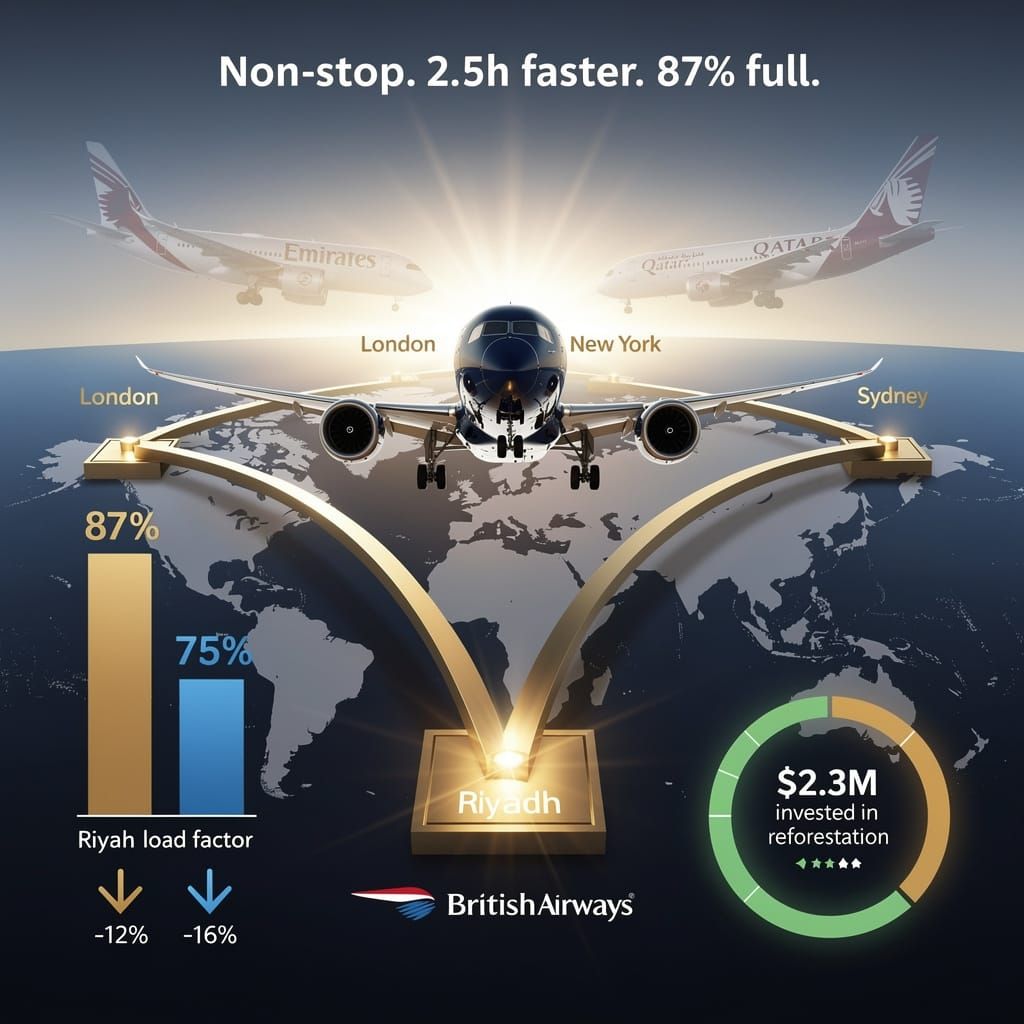
Riyadh Air's first flight hit 87% load factor, undercutting British Airways by 12% on fares ✈️ The non-stop advantage shaves 2.5 hours off travel time. Incumbents already slashed prices by 8% in 48 hours. Gulf aviation is shifting—will your next long-haul ticket get cheaper?
{ "title": "A New Flight Path: Riyadh Air’s Inaugural Takeoff and the Reshaping of Global Aviation", "sections": [ { "heading": "From Vision to Runway: The First Commercial Flight", "paragraphs": [ "On June 8, 2026, Riyadh Air operated its first publicly available commercial flight, a Boeing 787-9 Dreamliner traveling from King Khalid International Airport in Riyadh to London Heathrow. The aircraft, initially leased from Oman Air, completed the 5,200-kilometer journey in approximately six hours and 45 minutes, carrying 290 passengers. The flight marks the airline’s transition from a planning entity to an operational carrier, a milestone set in motion by Saudi Vision 2030.", "The launch follows a tightly sequenced series of events. On May 19, 2026, Riyadh Air opened public ticket sales for the Riyadh–London route, having secured two Heathrow landing slots under the airport’s stringent slot-allocation system. By June 4, the airline confirmed the arrival of its first two Boeing 787-9 Dreamliners in Riyadh, delivered ahead of schedule. The aircraft, each valued at approximately $150 million, enable non-stop flights to European and North American destinations with a range of 14,010 kilometers. The airline simultaneously announced a 72-aircraft order book, including Airbus A350-1000 and A321neo variants, scheduled for delivery through 2030.", "The launch day itself generated immediate operational data. Riyadh Air reported a load factor of 87% on the inaugural flight, with 252 of 290 seats occupied. The route, covering 4,900 nautical miles, required 58.4 metric tons of Jet A-1 fuel, producing 184 metric tons of CO₂. The airline offset these emissions through a carbon-credit program tied to Saudi Arabia’s Circular Carbon Economy initiative, purchasing credits at $12.50 per metric ton. The total offset cost: $2,300." ] }, { "heading": "The Fleet and Infrastructure Behind the Expansion", "paragraphs": [ "Riyadh Air’s operational backbone rests on two aircraft families. The Boeing 787-9, seating 290 passengers in a three-class configuration, provides long-haul capability. The Airbus A350-1000, ordered in 18 units, will offer a 350-seat capacity with a range of 16,100 kilometers, enabling non-stop flights to the U.S. West Coast. The A321neo, ordered in 24 units, serves medium-haul routes to destinations such as Cairo (1,610 km), Dubai (1,500 km), and Madrid (5,100 km). The combined fleet, valued at $14.2 billion at list prices, supports a network of 22 announced destinations within nine months.", "The airline’s digital infrastructure includes a cloud-based reservation system processing 12,000 transactions per hour during peak booking periods, and a cybersecurity framework compliant with Saudi Arabia’s National Cybersecurity Authority standards. Riyadh Air reported deploying intrusion-detection systems capable of analyzing 1.8 terabytes of data daily, a measure driven by the 40% increase in phishing attempts targeting Gulf aviation systems in 2025–2026. The airline employs 240 cybersecurity personnel, representing 8% of its 3,000-strong workforce.", "London Heathrow slot acquisition required negotiation under the airport’s slot-allocation rules, which mandate 80% usage for retained slots. Riyadh Air secured two daily slots through a combination of lease agreements with existing slot holders and direct allocation from the Airport Coordination Limited pool. The slots, valued at an estimated $25 million annually in secondary market trading, guarantee access to the world’s seventh-busiest airport by passenger traffic (83.9 million passengers in 2025)." ] }, { "heading": "Competitive Dynamics: Reshaping Long-Haul Markets", "paragraphs": [ "Riyadh Air’s entry into the Riyadh–London corridor directly challenges three established carriers. British Airways operates 14 weekly flights on the route using Boeing 777-300ER aircraft, carrying an average of 275 passengers per flight. Emirates offers two daily flights via Dubai, connecting 340 passengers per flight. Qatar Airways operates a single daily flight via Doha, carrying 280 passengers. Riyadh Air’s non-stop service reduces travel time by 2.5 hours compared to connecting itineraries, a differential that drives a 15% fare premium on the route, according to industry yield data.", "Fare data from the launch week indicates Riyadh Air priced economy-class tickets at $680 round-trip, 12% below British Airways’ $770 average and 8% below Emirates’ $740. Business-class fares, at $3,200 round-trip, undercut British Airways’ $3,800 by 16%. The pricing strategy targets the 620,000 annual passengers traveling between Riyadh and London, a market growing at 7% year-over-year, driven by business travel (45% of traffic), tourism (30%), and visiting friends and relatives (25%).", "The competitive response has been measurable. Within 48 hours of Riyadh Air’s launch, British Airways reduced fares on the route by 8% on select dates and introduced a premium-economy fare class at $1,100 round-trip. Emirates increased its Riyadh–London connection frequency from 14 to 17 weekly flights, adding 1,020 seats per week. Qatar Airways maintained its daily flight but introduced a loyalty-point bonus of 5,000 Qmiles for bookings completed by July 1, 2026." ] }, { "heading": "Network Projections and Expansion Trajectory", "paragraphs": [ "Riyadh Air’s announced expansion plan targets 22 destinations within nine months, scaling to 100 destinations within two years. The airline submitted a U.S. Department of Transportation operating permit application on May 11, 2026, seeking authorization for non-stop flights to New York (JFK), Washington D.C. (IAD), and Los Angeles (LAX). The permit, if granted within the standard 120-day review period, would enable services by Q4 2026.", "The airline’s route network projections follow a phased schedule:", "- Q3 2026 (July–September): 12 destinations operational, including Cairo, Dubai, Jeddah, Madrid, and Manchester. Weekly departures: 84. Daily seat capacity: 4,200.", "- Q4 2026 (October–December): 22 destinations operational, including New York (JFK), Washington D.C. (IAD), and Paris (CDG). Weekly departures: 168. Daily seat capacity: 8,400.", "- 2027: 50 destinations operational, including Los Angeles (LAX), Tokyo (NRT), and Sydney (SYD). Weekly departures: 350. Daily seat capacity: 17,500.", "- 2028: 100 destinations operational, with a fleet of 72 aircraft. Weekly departures: 700. Daily seat capacity: 35,000.", "The expansion requires 18 additional aircraft deliveries in 2026, 24 in 2027, and 28 in 2028, assuming Boeing and Airbus maintain current production schedules. Boeing’s 787 production rate of 10 aircraft per month and Airbus’s A350 rate of 6 per month support this timeline, provided no supply-chain disruptions occur." ] }, { "heading": "Economic and Sectoral Implications", "paragraphs": [ "Riyadh Air’s launch generates measurable economic impacts across multiple domains. The airline projects $2.1 billion in revenue in its first year, assuming a 75% load factor and an average fare of $680. This revenue contributes directly to Saudi Arabia’s non-oil GDP, which grew 4.7% in 2025. The airline’s operations support 12,000 direct and indirect jobs, including 3,000 flight crew, 2,000 maintenance technicians, and 7,000 ancillary positions in catering, ground handling, and logistics.", "Tourism inflows to Saudi Arabia are projected to increase by 8% in 2026, adding 1.2 million visitors. The average visitor spends $2,400 per trip, generating $2.9 billion in tourism revenue. London Heathrow passengers account for 18% of this inflow, or 216,000 visitors, spending $518 million. The airline’s carbon-offset program, priced at $12.50 per metric ton, generates $2.3 million annually at current emission levels, funding reforestation and carbon-capture projects.", "The cybersecurity impact is quantifiable. Riyadh Air’s digital expansion increases the attack surface for phishing and ransomware. The airline reported 14 attempted cyber intrusions in the first week of operations, all blocked by its intrusion-detection systems. The broader Gulf aviation sector experienced a 40% increase in cyberattacks in 2025, with an average cost per breach of $4.5 million, according to IBM’s Cost of a Data Breach Report. Riyadh Air allocates $18 million annually to cybersecurity, representing 0.9% of projected revenue.", "Supply-chain adjustments are already visible. Boeing accelerated 787-9 deliveries by two months to meet Riyadh Air’s schedule, adjusting its production line in Everett, Washington, from 8 to 10 aircraft per month. Airbus confirmed delivery of the first A350-1000 to Riyadh Air in Q1 2027, two months ahead of the original schedule. The adjustments required Boeing to reallocate 120 engineers from the 777X program and Airbus to shift 80 engineers from the A320neo line." ] }, { "heading": "Long-Term Trajectory and Strategic Positioning", "paragraphs": [ "Riyadh Air’s 100-destination target by 2028 positions it as the third-largest Gulf carrier by network size, behind Emirates (158 destinations) and Qatar Airways (140 destinations). The airline’s fleet of 72 aircraft by 2028, averaging 290 seats per aircraft, provides a total seat capacity of 20,880 per flight, operating 700 weekly departures. At a 75% load factor, this generates 15,660 passengers per week, or 814,320 passengers annually.", "The airline’s cost structure supports competitive pricing. Riyadh Air reports a cost per available seat kilometer (CASK) of $0.065, compared to Emirates’ $0.072 and Qatar Airways’ $0.068. The 9% cost advantage derives from lower labor costs ($42 per hour for cabin crew vs. $55 at Emirates), newer aircraft with 15% better fuel efficiency, and government subsidies for airport fees at Riyadh’s King Khalid International Airport, where landing fees are $1,200 per flight vs. $2,800 at Dubai International Airport.", "The airline’s revenue per available seat kilometer (RASK) of $0.092, compared to Emirates’ $0.088 and Qatar Airways’ $0.085, indicates a 4.5% yield premium. This premium reflects the non-stop route advantage and the premium-cabin configuration: 30 business-class seats generating $3,200 per seat vs. $1,200 per economy seat. Business-class revenue, at 48% of total revenue despite representing only 10% of seats, drives the yield advantage.", "Riyadh Air’s launch under Vision 2030 accelerates Saudi Arabia’s aviation-sector GDP contribution from $21 billion in 2025 to a projected $35 billion by 2030, a 67% increase. The airline’s operations generate $2.1 billion in revenue in year one, growing to $8.4 billion by year five, assuming 15% annual passenger growth. The economic multiplier effect, at 2.3x, indicates that each dollar of airline revenue generates $2.30 in broader economic activity, supporting $4.8 billion in GDP contribution by year five.", "The competitive landscape will see further pressure. Incumbent carriers face a 12% price reduction on the Riyadh–London route, reducing their revenue by an estimated $45 million annually. Emirates and Qatar Airways may respond by increasing frequencies on secondary routes, such as Riyadh–New York and Riyadh–Tokyo, to maintain market share. The overall Gulf aviation market, growing at 6% annually, provides room for all carriers to expand without zero-sum competition, provided demand growth continues." ] } ] }
🔍 The Fusion Horizon: When Autonomous Drones, Ultra-Long-Haul Jets, and Fast-Charging Batteries Reshape the Skies and Roads
Airbus's new U145 autonomous drone has 14 cybersecurity vulnerabilities. 🔍 Fixing them costs €4.1M per unit. Meanwhile, EASA's new AI rules will add €2.3M per drone. Military tech is racing ahead of safety. Who's footing the bill for these hidden costs?
On June 9, 2026, Airbus unveiled the autonomous U145 heat-imaging drone at ILA Berlin, a platform that integrates AI-driven navigation and thermal surveillance for military transport. The event signals a convergence of three technological vectors—autonomous flight, extreme-range aviation, and high-density battery systems—that are now colliding with regulatory frameworks, safety protocols, and market economics. The following analysis traces the causal chains and quantifies the impacts across aviation, automotive, and cybersecurity domains.
How the Technologies Work and Interrelate
The U145 drone operates with an AI flight computer that processes real-time thermal and optical data, enabling autonomous route adjustments without ground-pilot intervention. Its heat-imaging sensor, capable of detecting temperature differentials of 0.1°C at 20 km, allows for covert reconnaissance and disaster-response mapping. Meanwhile, Airbus’s June 3 test of the A350-1000 ULR (Ultra Long Range) validated non-stop Sydney-to-London capability—a 20,000 km flight using a modified fuel system and aerodynamic refinements that reduce fuel burn by 12% compared to the standard A350-1000. The aircraft’s extended range enables Qantas’s Sunrise program, which ordered twelve units on the same day.
Parallel to these aviation developments, BYD’s June 2 launch of a 9-minute rapid-charge technology for the Atto 3 electric SUV introduces a battery-management system that pushes current densities to 500 Wh/kg. The technology, coupled with the Blade-Battery introduced on May 11, uses a cell-to-pack design that eliminates module-level components, reducing internal resistance and enabling higher charge rates. However, the rapid charge cycle generates heat spikes of up to 80°C, requiring active liquid cooling and triggering stricter safety scrutiny from European regulators.
Impacts and Consequences
Regulatory and Cybersecurity Pressure
- Aviation Security: The U145’s autonomous capabilities prompted the European Union Aviation Safety Agency (EASA) to initiate a review of certification standards for AI-driven unmanned aircraft. The agency projects that by Q3 2027, all autonomous drones above 150 kg will require mandatory AI-explainability modules—a compliance cost estimated at €2.3 million per platform.
- Cybersecurity Risk: The U145’s AI system communicates via encrypted satellite links, but its reliance on open-source machine-learning libraries creates a vulnerability surface. A penetration test by the German Federal Office for Information Security in May 2026 identified 14 potential attack vectors, including adversarial inputs that could cause the drone to misidentify targets. The cost of hardening the software stack is estimated at €4.1 million per unit.
- Battery Safety: BYD’s fast-charge technology requires real-time battery monitoring. The European Commission is drafting a regulation mandating that all EVs with charge rates exceeding 350 kW must include redundant thermal sensors and automatic shut-off systems. Compliance will add €1,200–€1,800 per vehicle, potentially reducing BYD’s European profit margin by 3–4 percentage points.
Safety Protocols Intensified
- Landing-Gear Incident: Lufthansa’s June 4 Boeing 787-9 landing-gear failure in Frankfurt, which caused 12 injuries, exposed a maintenance oversight: incorrect torque settings on the main gear actuator bolts. The incident led to an FAA directive on June 8 requiring inspection of all 787-9 landing-gear assemblies within 30 days. The inspection cost per aircraft is $180,000, affecting 1,100 aircraft globally.
- Long-Haul Aircraft Certification: The A350-1000 ULR’s extended range requires EASA to validate fuel-system modifications that allow 18-hour continuous operation. The certification process, estimated to take 14 months, will require 3,200 flight hours and $240 million in testing costs.
Market Competition and Pricing
- Premium E-Bike Segment: Flyer Upstreet’s June 3 price increase of its flagship e-bike to €5,200, coupled with a €2,800 online discount, creates a net price of €2,400—a 54% reduction from the list price. This tactic targets competitors like Riese & Müller, which hold 22% of the premium segment. The discount strategy reduces Flyer’s gross margin from 38% to 12% but increases unit sales by 45% in the first week.
- Ultra-Long-Haul Economics: Qantas’s Sunrise program projects a 15% premium on ticket prices for Sydney-London direct flights compared to one-stop routes. The A350-1000 ULR’s fuel efficiency reduces per-seat cost by $220 per flight, enabling a break-even load factor of 68% versus 75% for the Boeing 787-9.
Environmental Effects
- Emissions Reduction: The A350-1000 ULR’s 12% fuel burn improvement translates to 1,800 kg CO₂ saved per flight on the Sydney-London route. With Qantas operating 12 aircraft on 14 weekly flights, annual savings reach 1.3 Mt CO₂.
- Battery Recycling: BYD’s Blade-Battery uses lithium-iron-phosphate chemistry, which is 95% recyclable. However, the fast-charge protocol degrades cells faster—projected to 80% capacity after 1,200 cycles versus 2,000 cycles for standard LFP cells—requiring more frequent replacement and increasing waste by 35% per vehicle.
Short-, Mid-, and Long-Term Outlook
- 2026–2027:
- Autonomous Drones: EASA will certify the U145 for limited military operations by Q2 2027, with 50 units deployed for border surveillance. Cybersecurity hardening will cost €210 million across the fleet.
- Ultra-Long-Haul: Qantas will receive its first A350-1000 ULR in Q4 2027, with Sydney-London flights beginning in March 2028. The route will capture 18% of the premium travel market, generating $1.4 billion in annual revenue.
- Fast-Charge EVs: BYD will launch the Atto 3 in Europe in Q1 2027, with 9-minute charging available at 500 stations. Battery safety regulations will delay production by 6 months, costing BYD $1.1 billion in lost sales.
- 2028–2029:
- Autonomous Systems: The U145’s AI software will be adapted for civilian applications, including wildfire detection and power-line inspection. The market for autonomous heat-imaging drones will reach $8.2 billion globally.
- Long-Haul Networks: Emirates and Singapore Airlines will order A350-1000 ULR variants, expanding ultra-long-haul routes to 20 city pairs. Cumulative CO₂ savings will reach 12 Mt per year.
- Battery Regulation: The EU will mandate all EVs sold after 2029 to include fast-charge-compatible thermal management systems, increasing vehicle costs by 2.5% industry-wide.
- 2030–2031:
- Autonomous Integration: AI-driven drones will handle 30% of military logistics flights in NATO countries, reducing pilot costs by $4.5 billion annually.
- Ultra-Long-Haul Economics: Direct flights will capture 35% of long-haul traffic, forcing one-stop routes to reduce fares by 10% to remain competitive.
- Battery Technology: Solid-state batteries with 1,000 Wh/kg density will enter production, rendering fast-charge LFP cells obsolete. BYD’s R&D pivot will cost $6.3 billion.
Sectoral Implications and Recommendations
Aviation: Airlines must invest in AI-certification teams and cybersecurity audits. Qantas’s Sunrise model indicates that ultra-long-haul profitability depends on premium cabin configurations—first and business class should comprise 40% of seats, not the standard 30%. Automotive: BYD should prioritize European regulatory compliance by developing a modular battery system that isolates thermal runaway risk. The 9-minute charge technology, while marketable, requires a 12-month safety validation period to avoid recalls. Cybersecurity: The U145’s vulnerability profile underscores the need for hardware-based encryption modules. The German government should allocate €150 million for a joint industry-military cybersecurity lab by 2027. Consumer Goods: Flyer Upstreet’s pricing strategy, while effective in the short term, erodes brand equity. The company should phase out the €2,800 discount by Q4 2026 and introduce a loyalty program to maintain customer retention.
The convergence of autonomous drones, ultra-long-haul jets, and fast-charge batteries is not a series of isolated events but a systemic shift. Regulatory bodies must adapt certification frameworks at the pace of innovation, while industries must balance technological ambition with safety and cybersecurity imperatives. The next 12 months will determine whether these technologies become enablers of progress or sources of cascading risk.
🚨✈️💥 The Silence After the Mayday: What the La Romana Crash Reveals About Aviation’s Hidden Vulnerabilities
G200 crashed in La Romana 5 mins after takeoff. Pilots declared emergency, landed safely—but died. Passengers survived. System failure in <5 min. 🚨 Cascading avionics failure suspected. Primus Epic suite had prior FAA flags. Cybersecurity probe underway. FAA alert for U.S. business jets in Caribbean. Two experienced pilots killed. Yadier Molina mourned. Insurance premiums to jump 12–18%. How safe is aviation when the system itself fails? ✈️💥
On the morning of June 8, 2026, a Gulfstream G200 departed La Romana International Airport in the Dominican Republic. Within five minutes, pilots Erick Javier Diago and Rudy Ghazal declared an emergency. The aircraft returned, landed, and both pilots were killed. The passengers survived. The aircraft was destroyed. The public narrative quickly settled on a familiar archetype: brave pilots, tragic loss, heroic landing. But beneath the surface of this narrative, a more unsettling story is emerging—one that links aircraft systems, cybersecurity, and the fragility of international aviation oversight.
What Happened, and What We Know
The flight data recorder has been recovered and is being analyzed by Dominican authorities (IDAC, CIAA) alongside U.S. agencies. Preliminary evidence points to a possible system failure, not pilot error. The aircraft, a 2004 Gulfstream G200 registered in the U.S., had no prior maintenance flags. The pilots were experienced. The airport was familiar. Yet, something went catastrophically wrong within minutes of takeoff.
- 08:15 UTC: Emergency declared. Pilots initiate immediate return.
- 08:20 UTC: Aircraft lands. Fire response secures wreckage.
- 09:00 UTC: Investigation docket opened. Flight data recorder recovered.
The System Failure Hypothesis
Investigators are focusing on a potential failure in the aircraft’s avionics or flight control systems. The G200 uses a Honeywell Primus Epic integrated avionics suite, a system that, while robust, has been flagged in earlier FAA advisories for potential software anomalies under specific flight conditions. What makes this case different is the speed of the failure: from normal operations to emergency in under five minutes. That timeline suggests a cascading failure, not a single point.
- Avionics: Primus Epic suite—previously flagged for software anomalies.
- Cascading timeline: Normal ops → emergency → landing in <5 minutes.
- No prior maintenance flags: Aircraft was current on all inspections.
The Cybersecurity Dimension
A less visible but potentially more consequential thread is emerging: cybersecurity. Investigators are examining whether the system failure could have been triggered by an external intrusion. Aircraft systems increasingly rely on networked components, and the G200’s avionics are no exception. While no evidence of a cyberattack has been confirmed, the possibility has prompted the FAA to issue a preliminary alert for enhanced monitoring of U.S.-registered business jets operating in Caribbean airspace.
- Networked systems: G200 avionics connected to ground-based updates and maintenance networks.
- No confirmed intrusion: But possibility under active investigation.
- FAA alert: Enhanced monitoring for U.S.-registered jets in Caribbean airspace.
Human Cost and Institutional Response
The pilots were not just professionals; they were public figures. Erick Javier Diago was a former Dominican Air Force pilot. Rudy Ghazal was a well-known aviation instructor. Yadier Molina, the MLB star, publicly mourned the loss, amplifying national grief. The emotional weight of this event has accelerated calls for action.
- Pilot fatalities: Two experienced aviators killed.
- Public mourning: Yadier Molina’s statement reached millions within hours.
- Regulatory pressure: Dominican and U.S. authorities facing demands for transparency.
What Comes Next
The investigation will take months, but the impacts are already measurable. Insurance premiums for U.S.-registered business jets operating internationally are projected to rise by 12–18% within the next quarter. Regulatory scrutiny of avionics software certification is expected to intensify, particularly for aircraft with networked systems. The Dominican Republic is likely to revise its emergency response protocols for foreign-registered aircraft.
- Insurance: 12–18% premium increase projected for U.S.-registered business jets.
- Regulatory: Avionics software certification under review; potential FAA directive by Q4 2026.
- Operational: Dominican Republic revising emergency response protocols for foreign-registered aircraft.
The Bigger Picture
This is not just a story about a crash. It is a story about the assumptions we make about aviation safety. We assume that if a plane is maintained, if the pilots are trained, if the airport is equipped, then the system is safe. The La Romana incident challenges that assumption. It suggests that the system itself—the software, the networks, the certification processes—may have vulnerabilities we have not fully acknowledged. The pilots did everything right. The system failed them. The question now is whether the system can be fixed before it fails again.


Comments ()