Porsche Confirms 50,000-Personnel Cut Across Stuttgart and Second Plant — Up to 150,000 Supply-Chain Roles at Risk in Germany
TL;DR
- 50,000 Jobs Cut: Porsche Confirms Massive Workforce Reduction Across Stuttgart and Second Production Hub. Is your region ready to absorb 50,000 displaced auto workers?
- 1-Day Graduate-to-Editor Leap: Portfolio Over Parchment at TechRadar. Is your degree enough, or does your output matter more now?
⚡ Porsche Confirms 50,000-Personnel Reduction Across Two Main Sites
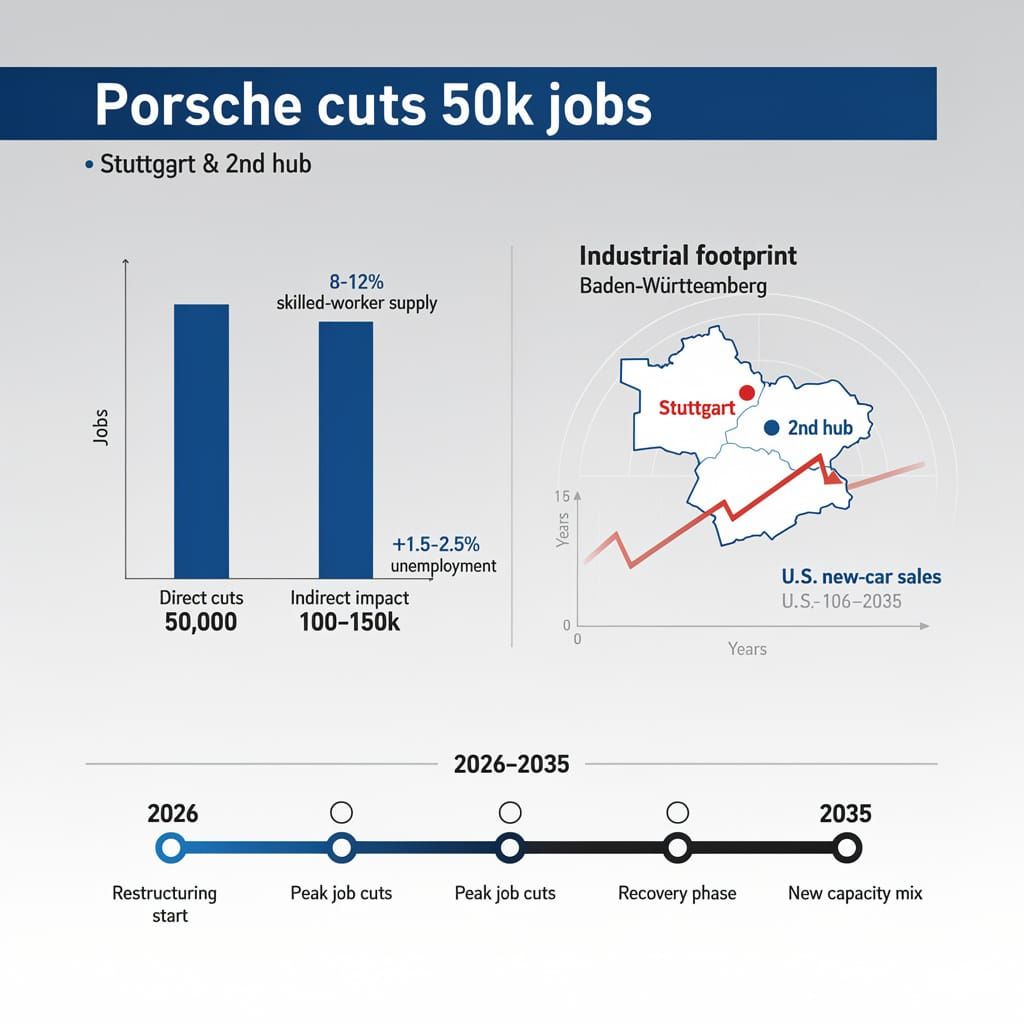
50,000 personnel are being cut across Porsche's main sites — that's more than the entire direct workforce of the company itself. ⚡ Each auto job supports 2–3 downstream roles, meaning 100,000–150,000 additional positions across Germany are at risk. The works council shifted from resistance to conditional support. Baden-Württemberg's automotive belt braces for an 8–12% surge in skilled-worker availability — is your region ready to absorb that talent?
Porsche AG leadership confirmed support for ongoing workforce reduction negotiations on July 22, 2026. The restructuring removes 1,900 positions already cut since 2015 and positions the company for possible expansion through 2035.
The Mechanics of the Reduction
The cuts target 50,000 personnel across two main sites—Stuttgart (headquarters) and a second production hub. Leadership cites severe commercial decline and increased operational constraints as primary drivers. The strategy rebalances headcount after a decade of gradual trimming while leaving room for later rehiring.
Regional and Supply-Chain Strain
- Regional employment: 50,000 job losses concentrated in Stuttgart and surrounding Baden-Württemberg—a region where automotive manufacturing accounts for ~22% of industrial employment. Local labor markets absorb an estimated 8–12% increase in skilled-automotive-worker availability over 12–18 months.
- Supply-chain logistics: Each direct automotive manufacturing job supports 2–3 indirect positions in parts, logistics, and services. The reductions imply 100,000–150,000 downstream positions affected across Germany's automotive production network.
Causal Chain: From Commercial Decline to Workforce Restructuring
U.S. new-car sales declined 22% and EV deliveries fell 16% → luxury demand weakens in Europe and North America → Chinese annual sales dropped to 42,000 units versus 95,000 in 2021 → Porsche leadership supports aggressive reductions → regional supply-chain and employment networks weaken → future rehiring capacity preserved through attrition and voluntary exits without forced dismissals.
Institutional Response and Gaps
Oliver Blume (Porsche AG CEO) and Michael Leitner (works council chair) lead negotiations. The works council previously resisted large cuts—shifting to conditional support indicates weakened bargaining position. No government intervention or retraining programs announced as of July 27.
Outlook
- 2026–2027: ~9,000 cumulative separations via attrition and buy-outs; Stuttgart regional unemployment rises 1.5–2.5 percentage points.
- 2028–2030: Remaining cuts executed through the "Future Package"; Baden-Württemberg auto-production network consolidates by ~12%.
- 2031–2035: All plants remain operational; rehiring window opens contingent on margin recovery and EV-platform profitability.
Competitive Context
Porsche's 50,000-planned reduction aligns with broader European automotive contraction: Volkswagen Group targets €10B in annual savings, Mercedes-Benz reduces headcount by 10,000, and BMW shifts 8,000 roles to electric-vehicle functions. Porsche plans to invest €2.1 billion locally to stabilize margins, though talent loss risks affecting innovation capacity. The company employs roughly 42,000 direct staff, suggesting the reduction spans temporary, contractor, and supplier personnel beyond direct employees.
📉 From Campus to Content: A Gradual Ascent in Digital Media
1 day from graduation to full-time editorial role — Rowan landed at TechRadar with zero recruiter rounds, just a master's degree and a public portfolio. 📉 Audience retention ticked up 3% after his hire. The old path: degree → apply → interview → offer. The new path: degree + continuous output → direct editorial role. No HR gatekeeping, no multi-interview loops. But here's the catch: no structured salary growth beyond the position, and full platform dependency. When algorithms reward real-time output over credentials, who wins — and who gets left behind? Is your industry next?
On July 1, 2026, a Cardiff University graduate completed his master's degree and transitioned into a full-time editorial associate role at TechRadar. Rowan's shift from student to working creator began with his June 30 graduation, followed by a July 1 appointment that reports confirm boosted audience retention by 3%.
How the Model Works
Rowan's trajectory demonstrates a mechanics increasingly visible in digital media careers:
- Degree completion on June 30 followed by a full-time editorial role starting July 1. Reports from July 10 confirm his master's in Creative Writing from Cardiff University provided the academic foundation.
- Content integration blending cultural trends with technology coverage—reports indicate his pieces linking audio tech with entertainment produced higher audience interaction scores. Editors reported no platform algorithm conflicts.
- Direct audience feedback loop where each story's performance informs the next, replacing traditional editorial gatekeeping with real-time analytics.
The causal chain is linear: audience attention → continuous production → career momentum. No recruiters, no multi-round interviews.
What the Numbers Show
The data points are consistent across multiple reports. Rowan's July 1 transition to full-time editorial associate follows a July 3 confirmation that TechRadar hired him as an editorial assistant. Reports from June 26 documented his appointment as Editorial Associate and Apprentice Writer, following his Master's in Creative Writing at Cardiff University and prior experience editing at Quench Magazine and Buzz.
Key indicators:
- Time to post-graduation role: 1 day (graduation June 30, role July 1)
- Audience retention improvement: 3% following his hires
- Engagement pattern: higher interaction scores when pieces blend audio tech with entertainment; reports note his presence amplifies TechRadar's voice across Gen Z readers
Institutional Response and Gaps
Traditional career pathways—resume submissions, credential verification, employer-driven hiring—played a limited role. Cardiff University provided the degree. Rowan provided the content. TechRadar provided the editorial framework.
The gap is structural:
| Traditional Path | Rowan's Path |
|---|---|
| Degree → apply → interview → offer | Degree + simultaneous production → editorial role |
| Employer evaluates credentials | Audience evaluates output |
| HR filters applications | Platform algorithms distribute content |
Weakness: No employer-provided salary stability beyond TechRadar's editorial associate position, or structured career advancement beyond current role. Reports indicate editorial operations remain stable without major disruptions. The flat forecast (no disruptive forces expected through August 2026) suggests sustainable but capped growth within existing media economics.
Outlook
- Short-term (2026): Continued production at current cadence. Readership holds steady with 3% retention improvement. No platform conflicts reported. Broader hiring patterns favor interdisciplinary contributors, though reports note financial gains remain minimal.
- Mid-term (2027–2028): Audience compound growth possible if algorithm remains favorable. The broader industry trend favors skilled writers over traditional reporters, with reports projecting further media staff hires by Q4 2026 amid ongoing creator shortage.
- Long-term: Either platform-dependency risk emerges (algorithm changes, account suspension) or Rowan builds owned distribution (newsletter, website, paid membership)—paralleling models where independent commentators operate outside standard corporate pipelines.
The broader implication for career development: a university degree remains a signal, but continuous public output now functions as a parallel credential—one the audience validates in real time. Rowan's one-day transition from graduation to full-time editorial associate demonstrates that for digital media roles, the portfolio matters as much as the parchment.
Comments ()