📉 PayPal cuts 251 San Jose roles in AI-driven restructuring
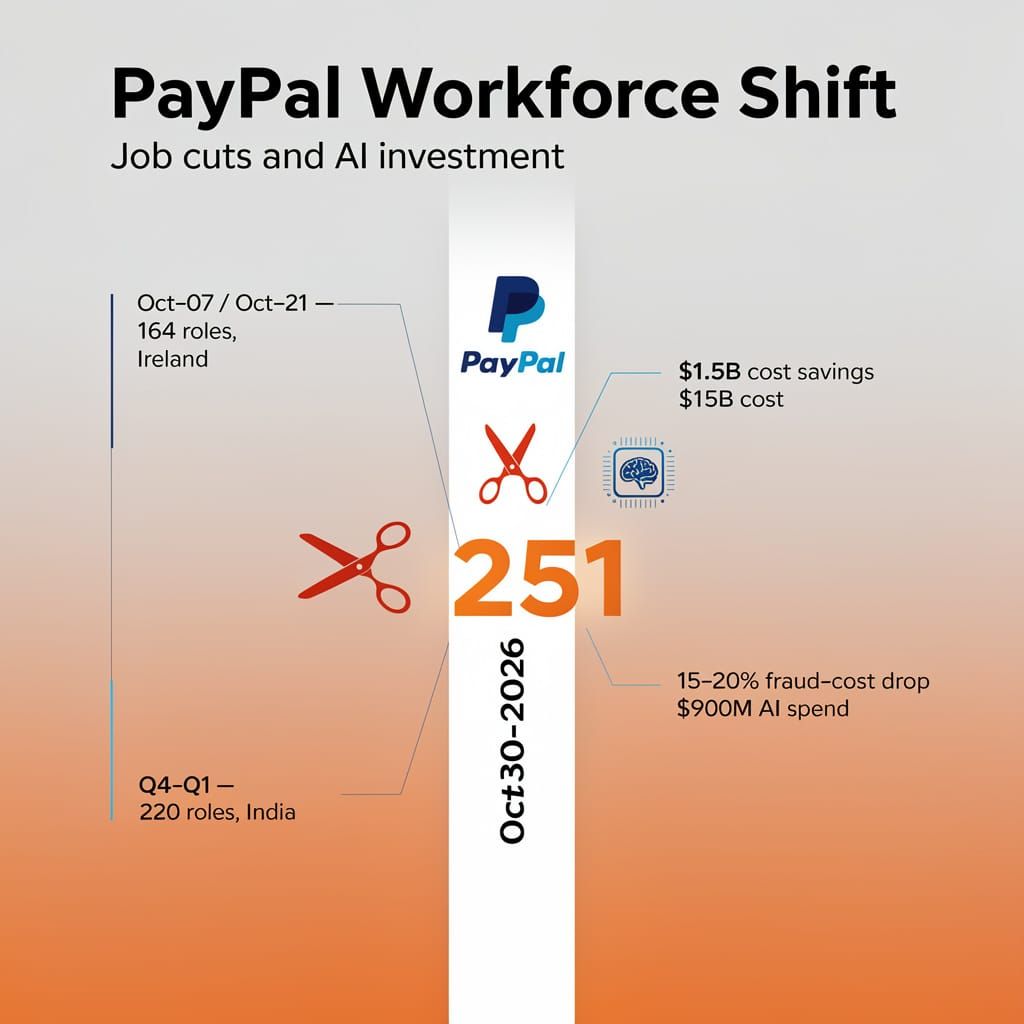
PayPal cuts 251 roles at San Jose HQ—over 100 engineering, 50+ senior software engineers, nearly 50 directors. This is the largest single-site reduction in the company's history, part of a 20% global workforce cut targeting $1.5B in savings as CEO Enrique Lores pivots capital into AI-driven payment systems and fraud detection. The Bay Area now absorbs 251 experienced professionals—some earning $300K+—into a market already digesting 1,200 Google and 800 Apple layoffs from Q2. Mid-level tech salaries in Silicon Valley face an estimated 4–7% compression through end of 2026. Are you seeing compensation shifts in your market?
PayPal notified California regulators on September 5 that it will eliminate 251 positions starting October 30, 2026—the largest single-site reduction in the company's history. The cuts at its San Jose headquarters affect over 100 engineering positions, more than 50 senior software engineers, nearly 50 directors, and over 40 senior managers. CEO Enrique Lores, who took the helm in March 2026, is driving a global workforce reduction targeting roughly 20% of staff—approximately 4,760 roles from a base of 23,800 employees—with a cost-savings target of $1.5 billion over 2–3 years.
How the Restructuring Unfolds
Lores moved immediately after his March appointment to reorganize operations following disappointing Q1 investor results. The company split into three business units in April: Checkout Solutions & PayPal, Consumer Financial Services & Venmo, and Payment Services & Crypto. Anshu Bhardwaj was appointed chief AI transformation and simplification officer. The San Jose notification represents the first major tranche of reductions.
- October 30, 2026: 251 roles eliminated at San Jose campus, including 42 senior software engineers, 9 directors of product management, and 8 directors of software engineering.
- October 7–21, 2026: 164 roles cut from PayPal's Irish operation in Blanchardstown—nearly 12% of local workforce.
- Q4 2026–Q1 2027: Additional reductions expected across India, Israel, and Arkansas offices, with 220 roles already confirmed in India.
What Drives the Cuts
PayPal is reallocating capital from manual-process and customer-support roles into AI-driven payment systems, fraud detection, and automated reconciliation tools. The shift reflects a broader industry pattern: Google and Apple made similar AI-focused resource reallocations in 2025–2026. Apple cut ~147 software engineering and machine learning roles in August 2026 across Vision Pro and Siri projects, while Google eliminated 2,000–3,000 engineering positions in June 2026. PayPal's move projects a reduction of 15–20% in fraud-related operational costs annually post-restructuring, offset by $900 million in AI infrastructure spending over two years. The company also reported $486.4 billion in payment volume for Q2 2026 (+10% YoY) and launched its PYUSD stablecoin on Polygon across 70 markets—indicating the cuts fund expansion into crypto-adjacent infrastructure. Competitive pressure from Apple, Google, Stripe, and Klarna accelerated the timeline.
Impact on Tech Talent Markets
The San Jose region alone adds 251 experienced professionals—including senior directors earning above $300,000 annually—to a Bay Area market already absorbing layoffs from Google (1,200 roles in Q2 2026) and Apple (800 roles across services units). Nationwide, June 2026 saw approximately 97,000 AI-linked job cuts, with Oracle reducing its workforce by 21,000 and Meta cutting 8,000 roles in May. The concentration of displaced talent creates downward pressure on salary benchmarks for mid-level product and operations roles in Silicon Valley—estimated at 4–7% compression in total compensation packages for the remainder of 2026.
Competition
PayPal vs. Fintech Specialists: Stripe and Block maintain lower operating leverage by relying on smaller AI-native teams. Block and Coinbase reported AI-driven layoffs in May 2026, and Meta eliminated 700 engineering manager roles as part of a drive toward a 1-to-50 engineer-to-manager ratio. PayPal's $1.5B savings bring its cost structure closer to competitors but lag in per-employee revenue. PayPal vs. Big Tech: Google and Apple absorbed similar restructuring shocks earlier; both report 60–90-day reemployment rates above 75% for displaced staff due to broader R&D pipelines. PayPal vs. Regional Markets: Chennai and Bangalore offices face steeper challenges—mid-skill tech roles in India report 3.5x more applicants per opening in H2 2026.
Weaknesses
Timing Risk: Announcing cuts three months post-CEO appointment signals instability; Glassdoor ratings dropped from 3.8 to 3.2 between March and August 2026. Execution Risk: AI migration timelines of 18 months may overlap with additional reductions, creating knowledge-transfer gaps in payment-processing continuity. Meta and Google's repeated management flattening cycles demonstrate that lean structures generate organizational debt and resignation waves when human oversight elements are removed. Talent Retention: Key engineers overseeing core payment rails received 40% higher-than-market retention offers from competitors within 30 days of the September 5 announcement. The June 2026 departure of Ryan Murphy from Yelp after 20 years—launching EM Accelerator as a free engineering leadership training platform—illustrates rising dissatisfaction with managerial practices in post-layoff environments.
Career Implications for Professionals
PwC's June 2026 Global AI Jobs Barometer found that qualified AI personnel earn a median salary uplift of 28%, with AI-exposed technology roles seeing 42% wage increases globally. A Mercer survey from June 2026 shows 99% of CEOs expect AI to reduce headcount within two years, accelerating demand for specialists. The data indicates a structural premium for AI-adjacent skills:
- Prompt engineering, model evaluation, and compliance automation carry 25–35% salary premiums over traditional equivalents. Global hiring for AI prompt engineering roles grew 120% year-over-year as of June 2026.
- Geographic diversification matters: secondary tech hubs (Austin, Denver, Phoenix) report 30% faster reemployment timelines than saturated Bay Area markets.
- Turnover declines 40% among newly trained AI talent cohorts, per PwC's June data, indicating that upskilling investments improve retention.
- Leadership skills that reduce ambiguity and remove organizational noise become increasingly valuable as management spans widen. Stephane's June 2026 analysis shows that manager behavior drives 70% of team engagement variance, and effective delegation reduces team interruptions by an average of 23 minutes per day.
Professionals in affected roles face a job market where the average time-to-offer for mid-skill tech positions in California extended to 14.2 weeks in Q3 2026, up from 9.8 weeks in Q1. The near-term outlook indicates continued consolidation across large fintech and payments firms, with further reductions concentrated among companies that expanded headcount rapidly between 2020 and 2023.
Comments ()