🧵 Bangladesh garment sector sheds 600,000 jobs in 2026
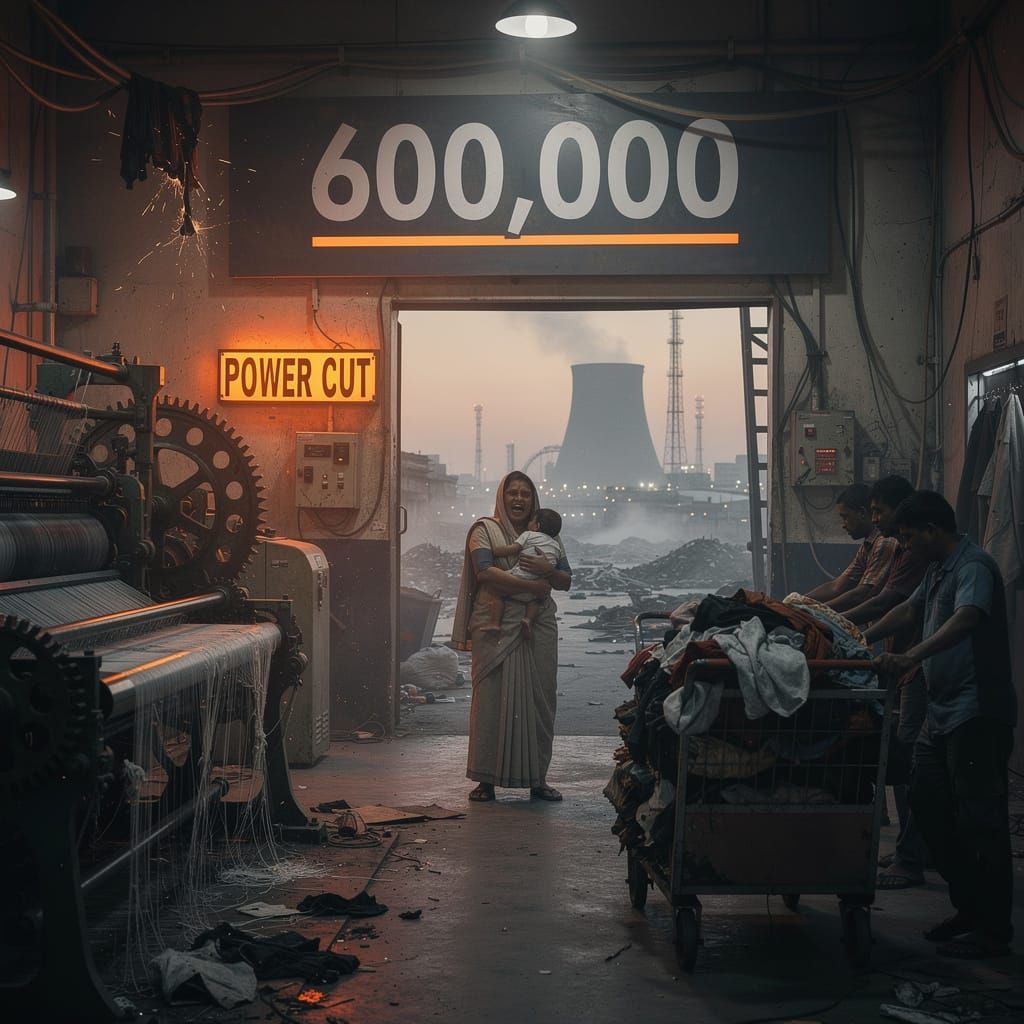
600,000 garment jobs lost in Bangladesh since January — that's one in every 11 workers in the country's largest formal employer. Energy crunch at the Moghulkhali LNG terminal triggered plant closures, a 92% collapse in export revenue, and a foreign-hiring freeze. 2.4 million dependents lost their primary income source. Women, who make up 57% of the workforce, are hit hardest. Can Bangladesh rebuild its export engine before 2028?
The numbers are stark. By September 7, 2026, Bangladesh’s garment sector—historically the engine of its export economy—has shed over 600,000 jobs since January. The layoffs do not stem from a single shock but from a cascading failure: plant closures tied to an energy crunch at the Moghulkhali LNG terminal, collapsed foreign-labour hiring, and export revenue that has fallen to roughly 8% of prior benchmarks.
How the Crisis Unfolded
- January–August 2026: Garment factories began shutting down as natural-gas supply to Moghulkhali LNG became erratic. Power shortages forced mills to operate at 40–50% capacity for months. Production delays triggered order cancellations from European and North American buyers.
- September 6, 2026: Reports confirm that the closure rate accelerated. More than 2,300 factories have halted operations permanently or indefinitely. The Bangladesh Garment Manufacturers and Exporters Association (BGMEA) recorded a 72% drop in new orders versus the same period in 2025.
- Exports and revenue: Monthly export receipts fell from an average of $3.2 billion in 2025 to approximately $260 million by August 2026. The 92% contraction leaves manufacturers unable to cover marginal input costs, let alone wages.
The Energy–Layoff Link
Each plant closure traces directly to the Moghulkhali LNG bottleneck. The terminal supplies roughly 30% of the national grid’s gas-fired generation. When delivery pressure dropped by 60% in July 2026, industrial zones in Dhaka and Chattogram experienced rolling blackouts of 10–14 hours per day. Compounding the crisis, Shell reported on June 30, 2026, that LNG trade instability linked to the Iranian-Iranian War disrupting Strait of Hormuz transit has suppressed supply across the region, with elevated prices further straining Asian importers. Factory managers report that a single eight-hour power outage destroys the viability of a $50,000 export order because quality guarantees lapse.
Impacts Beyond the Factory Floor
- Employment: 600,000+ garment workers laid off means 600,000 households—roughly 2.4 million dependents—lost their primary income source. The ready-made-garments sector accounted for 84% of Bangladesh’s total exports; its collapse removes the country’s largest formal employer. For the 57% of the workforce who are women, the crisis compounds a pre-existing childcare gap: in April 2026, Parliament extended paid maternity leave to 120 days, yet factory daycare capacity remains limited to 12–13 children per site with two caregivers. Workers such as Morsheda, a 33-year-old with 15 years in the industry, returned from leave to 10–14 hour shifts but could not bring her infant to the factory despite a designated breastfeeding room—no one could transport the baby. An ILO survey found that 54% of working parents view inadequate childcare as a major employment barrier, and 18% have left jobs due to caregiving responsibilities.
- Foreign-labour hiring: Reduced export earnings prompted the government to cap overseas-worker recruitment at 15,000 per month (down from 55,000 in early 2026). This eliminates remittance inflows that previously offset trade deficits. In June 2026, Prime Minister Tarique Rahman requested Malaysia reopen its labour market to Bangladeshi workers, with Malaysian PM Anwar Ibrahim acknowledging the need for recruitment transparency—but no formal agreement has followed.
- Manufacturing diversification: A small number of plants have retooled for synthetic-fabric recycling and low-voltage textile finishing, but these lines require half the workforce and carry smaller margins.
What the Data Projects Next
- Q4 2026–Q1 2027: Without LNG terminal repair and consistent gas supply, another 150,000–200,000 job losses are probable. Export revenue will bottom near $150–180 million per month. The broader energy disruption also threatens other sectors: Bangladesh’s health system, already strained by a measles outbreak targeting 18 million children in a mass vaccination campaign launched June 2026 after 528 deaths, cannot absorb additional pressure from a worsening economic contraction.
- Mid-2027: If mitigation—emergency LNG imports, power-rationing schemes for priority industries—fails to stabilize the grid, the BGMEA forecasts a “confidence crisis” among international buyers. No factory-based recovery can occur before 2028.
- Sectoral shift: Agriculture and low-end services absorbed approximately 40,000 displaced workers in August 2026, but wages in those sectors average 60% less than garment work. Formal-sector employment may take five years to return to pre-crisis levels.
The numbers trace a clear causal chain: energy disruption → export collapse → mass layoffs → foreign-hiring freeze. Each link tightens the next. Whether the chain breaks depends on interventions that have not yet arrived.
Comments ()