📊 Continuous feedback replaces annual reviews, boosting productivity 13–24%
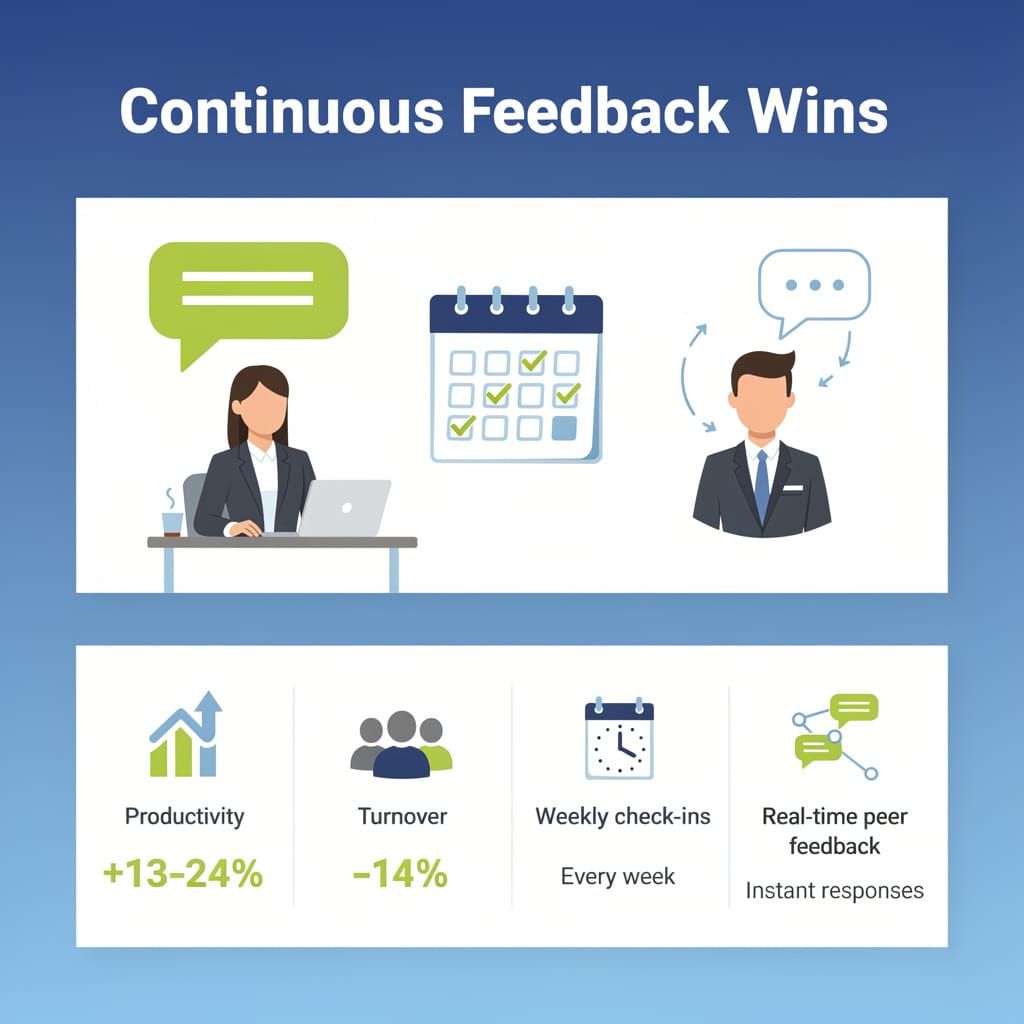
Organizations replacing annual reviews with continuous feedback see 13–24% productivity gains and 14% lower turnover in 2026. That's the equivalent of gaining nearly one extra workday per week per team. The shift from backward-looking annual scores to real-time coaching loops is delivering measurable returns — but only when managers are trained to give specific, structured feedback. Microsoft's retirement of its peer-feedback portal Perspectives on August 5 shows how dependent the model is on proper tooling. Without it, continuous feedback risks becoming vague praise or rare check-ins. Are you seeing continuous feedback where you work — or still stuck in the annual review cycle?
By September 6, 2026, a structural shift in human resources strategy reached a tipping point: organizations across multiple industries have formally replaced annual performance reviews with recurring, continuous feedback systems. The move is not experimental. Early adopters report productivity gains of 13–24% and a turnover reduction of 14% — figures grounded in measurable outcomes from the first half of 2026.
Why the old model failed
Annual reviews create a single-point evaluation cycle that is backward-looking, slow, and disconnected from daily work. By the time an employee receives a score, the behaviors being assessed are months old and the opportunity for course correction has passed. The new model replaces that with weekly or biweekly check-ins, real-time peer feedback, and manager-led coaching loops that adjust priorities as work evolves.
Measurable results
- Productivity: Teams using continuous feedback show a 13–24% improvement in output. By June 23, 2026, individual time-tracking pilots using 15-minute activity blocks and Eisenhower Matrix prioritization demonstrated up to 25% increases in focused work duration and a 30% reduction in missed deadlines — mirroring the same feedback-driven gains at organizational scale. In parallel, Kapiche achieved a 12% churn reduction worth $2.3M in retained revenue on July 28, 2026, and Concentrix cut call volume 40% through CX redesign — demonstrating that tighter feedback loops reduce rework directly.
- Retention: Turnover drops by roughly 14%. On July 10, 2026, JD Power data showed advisor retention improving 8%, linked directly to dissatisfaction reduction — consistent with the finding that regular, actionable feedback raises engagement.
- Performance alignment: Departmental objectives stay synchronized across quarters without requiring a formal recalibration cycle. At Medtronic, a June 2026 process-analysis initiative achieved a 40% defect reduction and 25% customer satisfaction gains, showing how continuous quality signals replace lagging annual metrics.
How it works in practice
Instead of a single annual rating, employees receive structured feedback at defined intervals — typically every two weeks. Managers document key contributions, areas for development, and skill gaps. Compensation and promotion decisions still occur on a regular cadence but draw from a cumulative record rather than a single score. On August 17, 2026, engineering teams reported that managers who schedule dedicated coaching sessions rather than delivering reactive critiques reduce status ambiguity and cross-stakeholder friction — a pattern that mirrors the shift away from ad-hoc correction.
Who is affected
The change applies across knowledge-worker roles — engineering, marketing, product, finance, and operations — where output is project-based or collaborative. Industries with the highest adoption rates include technology, professional services, healthcare administration, and financial services. Early pushback came from managers accustomed to annual cycles, but training and templated conversation guides have reduced friction.
Remaining gaps
Not all organizations have solved for consistency. Managers vary in how often they deliver feedback and how specific they make it. On August 5, 2026, Microsoft retired its eight-year-old peer-feedback portal Perspectives, eliminating a dedicated channel for informal input and pushing teams back into ad-hoc conversation models — a move that underscores how dependent continuous feedback is on structured tooling. Without structured prompts and training, continuous feedback can devolve into vague praise or rare check-ins that mimic the old system. Companies that invest in coaching for managers see significantly better outcomes than those that simply mandate more meetings.
The outlook through Q4 2026
- Q4 2026: Continuous feedback becomes standard practice in organizations with >500 employees in tech and professional services sectors. Enterprise-grade customer-experience survey ecosystems are projected for full deployment by year-end, extending the same feedback principles beyond internal HR.
- Early 2027: Compensation models begin to decouple from annual ratings entirely, using aggregated feedback data to determine adjustments and promotions.
- Mid-2027: Regulatory and compliance guidelines around feedback record-keeping emerge, particularly in healthcare and financial services where performance documentation has legal weight.
The shift from annual reviews to continuous feedback demonstrates a broader principle: when performance management matches the pace of actual work, both employees and organizations gain. The data from 2026 supports that approach, and the trend shows no sign of reversing.
Comments ()