Oracle Fires 21,000 While Paying Cloud Engineers Up to $300K
TL;DR
- $300K Salary Bands Signal Cloud Infrastructure Talent War Amid AI Demand Surge. What does it take to land a $300K cloud infrastructure role in 2026—and is the in-office shift worth the payoff?
- Facilitation Works: 91.4% Efficacy—So Why Does Learning Collapse After 90 Days?. Is your organization's infrastructure designed to sustain learning, or does it quietly overwrite new openness within weeks?
- Reddit's Automated Moderation Experiment Cuts Spam by Half in Co-Founder Matching Threads. Would you prefer clearer, templated job boards over open posting if it meant less spam and higher-quality matches?
💰 The Cloud Infrastructure Talent Race Heats Up
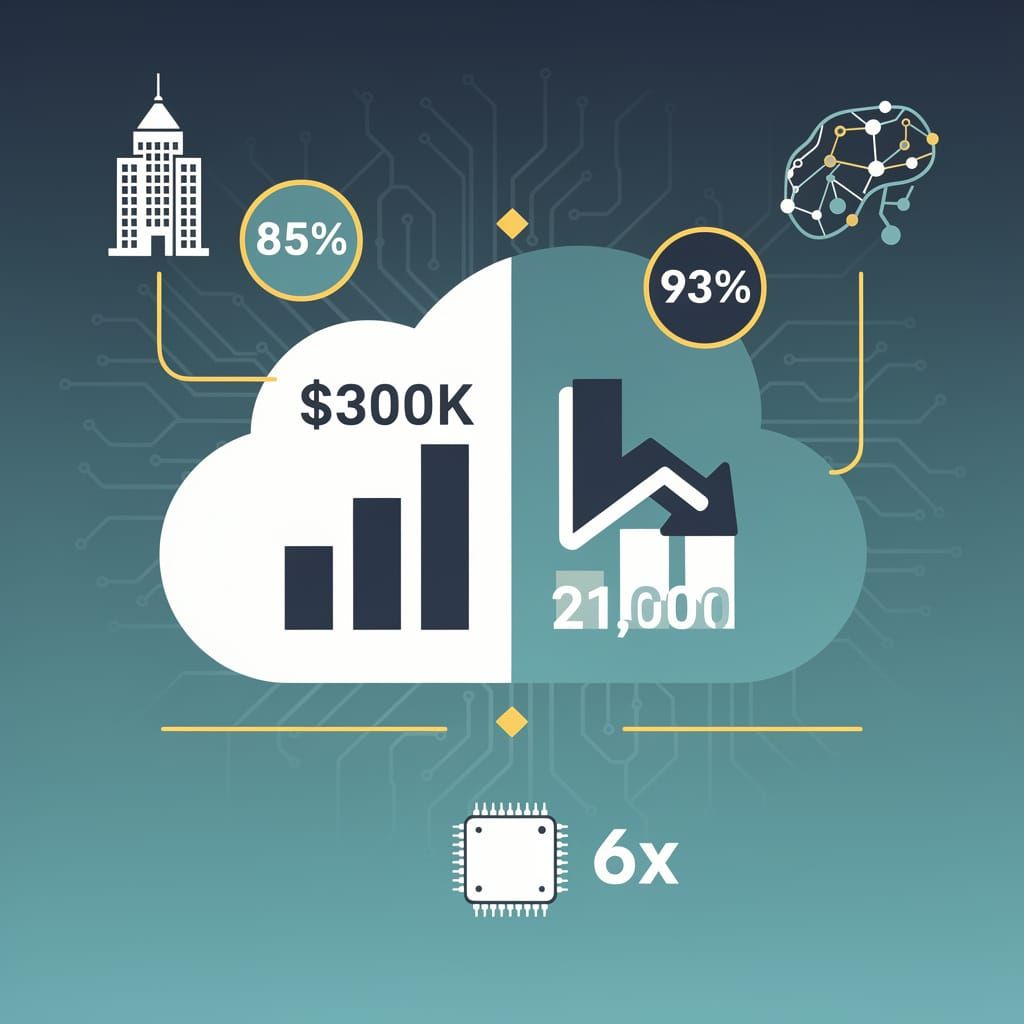
💰 Cloud infrastructure engineers now command up to $300K/year—up from $250K just two years ago. The spike is fueled by AI infrastructure demand that the talent pipeline can't match. Yet Oracle just fired 21,000 workers while competing fiercely for the same skills. The paradox: mass layoffs + talent war coexist. With 85% of listings now in-office and memory costs up 6x, mid-tier engineers face steeper climbs. Are you positioned for the premium tier, or watching from the sidelines? 🚀
Salary bands for senior cloud infrastructure engineers now stretch from $126,000 to $300,000 annually, according to Techstrong.it's tenth IT Jobs Report released June 30, 2026. Ten senior-level positions span remote and local roles across Greenhouse, DoorDash, Definitive Healthcare, Applied Intuition, and Camunda. These numbers signal a market under pressure—and they are climbing.
Why Compensation Keeps Climbing
The underlying driver is structural. AI-driven hardware manufacturing creates ripple effects across the tech labor market, generating demand for cloud infrastructure expertise that the current talent pipeline cannot satisfy. On June 10, 2026, Oracle reported cloud infrastructure revenue surging 93 percent due to a $638 billion revenue backlog, with $67 billion in new AI infrastructure contracts signed in Q4 and a $70 billion CapEx plan for FY2027. Oracle's GPU utilization rate reached 97.5 percent, indicating tight capacity that keeps compensation pressure elevated.
The convergence of AI capabilities, hardware acceleration, and chip-layer realities is reshaping global product strategies. AI infrastructure investments have reached $400 billion as Amazon, Microsoft, and Salesforce accelerate initiatives, driving data-center expansion, increased energy demand, and heightened cybersecurity risk. Major chipmakers are driving rapid adoption of AI accelerators, pressuring hardware teams to align AI vision with viable chip choices and generating high-impact supply-chain reconfiguration. Micron reported memory shortages driven by AI demand, prompting new U.S. fabrication investments. TSMC's share of the TAIEX index climbed to 42 percent, reinforcing the link between AI investment and semiconductor supply-chain bottlenecks. Qualified candidates with hands-on experience in distributed systems, Kubernetes orchestration, and multi-cloud architecture remain scarce.
CompTIA reported a 69,000-worker increase in tech roles during May 2026, with job postings rising 4,000 from April and focusing on cloud and AI positions. Employers emphasize the need for AI and data security expertise. The gap between demand and supply creates ripple effects. Entry and mid-level engineers face steeper competition, while organizations that fail to adjust compensation risk losing institutional knowledge to better-funded rivals.
The shift to in-office work is accelerating. As of June 2026, 85 percent of active tech listings are in-office roles, with remote salary premiums having disappeared—median salaries for remote and in-office positions are now nearly identical. London has surpassed Austin and Boston combined as a hiring market. Defense and healthcare sectors are outpacing pure tech in headcount growth: Anduril Industries opened 1,727 roles, Leidos opened 1,857, Booz Allen Hamilton opened 1,639, and Cleveland Clinic opened 1,883. These numbers illustrate how cloud infrastructure talent underpins operations across industries far beyond traditional tech.
The Paradox of Workforce Shifts
Oracle exceeded revenue forecasts by 21 percent year-over-year, posting $19.18 billion in Q4 sales, $6.13 billion in operating income (up 20 percent), and $4.3 billion in net income (up 25.6 percent). Management raised FY27 revenue guidance to $90 billion and secured a $553 billion federal contract. Oracle fired up 1.2 gigawatts of datacenter capacity in January 2026 and will activate another gigawatt in August 2027, with five massive U.S. datacenters under construction in Abilene, Shackleford, Dona Ana, Saline, and Port Washington.
Yet on June 24, 2026, Oracle disclosed a 21,000-employee workforce reduction over 12 months driven by AI adoption—a 13 percent decline with $30–35 million in restructuring costs. IBM announced layoffs affecting approximately 1,000 employees across Cloud Services and Consulting divisions on June 12, disproportionately targeting U.S. workers while implementing a mandatory return-to-office policy. GitLab laid off roughly 350 workers (14 percent) in early June to invest in AI infrastructure. IBM's share price fell $267 on announcement, triggering a WARN Act investigation. Meta and other AI firms also announced workforce reductions tied to AI expansion, sparking broader debate on AI-driven labor shifts.
The pattern reveals a bifurcation: companies cut headcount in lower-skill or redundant roles while competing fiercely for specialized cloud infrastructure talent. This dynamic sustains upward compensation pressure despite broader workforce reductions.
How Companies Are Responding
Organizations are moving beyond generic job postings. The ten featured roles reflect targeted outreach strategies designed to reach passive candidates already employed elsewhere. CompTIA's analysis highlights significant tech sector expansion in the U.S., driven by rising demand for digital skills, with continued investment expected as industries scale AI capabilities.
A survey of 1,800 senior IT decision-makers found 56 percent use private cloud versus 41 percent use public cloud, with 72 percent intending increased investment in private cloud over three years. Fifty-four percent cited geopolitical factors as a major influence, reflecting how data-sovereignty concerns reshape infrastructure strategy and expand demand for engineers capable of managing compliant environments.
Internal upskilling programs have gained urgency. Grant Caley of NetApp discussed the shift from monolithic to virtualized architectures, noting the rise of containerization and demand for flexible, scalable infrastructure. Organizations unable to recruit fast enough from external markets invest in engineering talent development, cross-training systems administrators and DevOps engineers into cloud-specialized roles. CTO interviews confirm Kubernetes adoption is uniform across companies, with shared knowledge in configurations and traceability through GitOps enabling faster internal skill development. This approach softens dependency on external hiring and builds organizational resilience against future talent shocks.
Key competitive dynamics:
- Salary escalation: Premium bands now extend to $300K for top-tier cloud infrastructure talent, up from $250K thresholds observed two years prior.
- Capital investment surge: Oracle's $70 billion FY2027 CapEx plan and hyperscale datacenter buildout signal sustained infrastructure expansion that requires engineering talent.
- Talent pipeline fragmentation: No single source reliably produces cloud infrastructure engineers with the breadth required by enterprise environments.
- In-office shift: 85 percent of active listings are now in-office, reducing geographic candidate pools and intensifying competition for cloud talent in hub markets.
Implications for Career Builders
Engineers positioned in cloud infrastructure enjoy negotiating leverage. Salary expectations should account for the upper quartile; candidates with multi-cloud certifications and production-scale experience command the highest tiers. CompTIA's data shows 69,000 net new tech jobs added in May 2026, with cloud and AI driving the majority of postings—indicating sustained enterprise demand that favors candidates through at least late 2026.
Y Combinator's investment focus on AI capabilities and infrastructure underscores persistent demand for cloud engineering talent across startups and enterprise alike. Professionals in adjacent disciplines—systems engineering, network architecture, site reliability—can accelerate marketability by acquiring cloud-native credentials and demonstrating infrastructure-as-code proficiency.
Mid-career transitions into cloud infrastructure remain viable but require deliberate skill investment. The rise of containerization and virtualized architectures creates pathways for DevOps and systems engineers to reskill into cloud-specialized roles. Bootcamps and cloud certification programs offer structured pathways, though hiring managers increasingly value demonstrated production experience over credentials alone. Building a portfolio of infrastructure projects, contributions to open-source cloud tooling, or internal role expansion within current organizations provides competitive differentiation.
The Road Ahead
Skill shortages show no signs of abating in the near term. Oracle's $638 billion revenue backlog and 93 percent cloud infrastructure growth indicate sustained enterprise demand. Memory costs have risen sixfold over 12 months, projected to reach ninefold by September, compressing margins and incentivizing cost-optimized architectures—skills that command premium compensation.
AI-driven infrastructure demand will intensify as enterprises deploy larger-scale model training and inference workloads, creating additional pressure on cloud engineering capacity. Memory shortages and semiconductor bottlenecks will sustain hardware cost inflation, favoring engineers who can optimize infrastructure efficiency.
The hybrid models combining Kubernetes stability with serverless elasticity will dominate efficient cloud operations through late 2026 and beyond, rewarding engineers capable of navigating multi-platform environments. Organizations investing in workforce resilience today position themselves to absorb demand volatility. Engineers who develop expertise in emerging areas—serverless edge computing, infrastructure automation, and AI-specific cloud optimizations—will find themselves at the center of an increasingly critical talent market.
🧠 The Pedagogy of Place: How Experiential Learning Is Reshaping Organizational Memory
91.4% of learners show improved understanding through guided facilitation—but that spark vanishes within 90 days if not anchored in organizational systems. The gap between engagement and implementation isn't a training problem. It's an architecture problem. Are your systems built to let the learning breathe?
In the summer of 2026, something shifted in how organizations think about learning. On July 1, a reflection published by e27 traced the arc of facilitation work—its insistence on playfulness, its comfortable relationship with uncertainty—and found that those who passed through such programs emerged not merely trained but transformed. They had developed what researchers call a "learner identity": an internalized orientation toward growth that persists long after the workshop ends. The evidence now backs this. Earlier that month, randomized controlled trials conducted with Fab AI partners demonstrated that guided learning approaches improve conceptual understanding in 91.4 percent of student interactions—a level of efficacy that reframes what facilitation can reasonably claim to deliver.
Sixteen days earlier, leadership facilitators noted something harder to quantify. Teams that participated in structured dialogue exercises demonstrated measurable differences in maturity. The distinction showed up not in credentials or tenure but in cognitive openness—the capacity to hold competing ideas simultaneously, to let a conversation change direction without defensiveness. Observations from mid-June 2026 confirmed this pattern across multiple organizations: mature teams exhibit productive noise through layered conversations, maintain psychological safety that allows free expression, and engage in constructive disagreement without breaking trust. They integrate new knowledge into their mental models and expand learning beyond the boundaries of any single training framework.
What Facilitation Actually Teaches
The e27 piece resonated because it named something practitioners have felt for years. Traditional training delivers content. Facilitative learning delivers a relationship with uncertainty itself. Randomized trials now provide the quantitative foundation for what facilitation advocates have long argued qualitatively. Programs built on this principle treat confusion as data rather than failure, a posture that, once adopted, transfers across contexts.
Organizations that have integrated these approaches report a secondary effect: operational resilience. When teams learn to navigate ambiguity together, they develop what one HR director described as "institutional muscle memory for adaptation." The mechanism appears to be systemic feedback loops—emotional design paired with structured reflection—that encode learning at the group level rather than leaving it siloed in individuals. Stakes from mid-2026 cybersecurity incidents and market volatility reinforce the urgency: organizations capable of adapting collectively through uncertain conditions demonstrate sharper response timelines and fewer cascading failures than those relying on individual expertise alone.
The Gap Between Engagement and Implementation
Yet the data reveals an uncomfortable truth. Despite stable input flows—consistent participation numbers, equivalent investment in facilitation programs—outcomes diverge sharply. Engagement accelerates; implementation lags. Stakeholder consultations across Brazil, India, Malaysia, Mexico, Spain, and Sweden, conducted through AI Policy and Guidance Labs, surfaced a consistent tension: frameworks for AI integration in education and professional development exist, but their translation into sustained practice remains uneven. The workshops produced position statements and twelve-month roadmaps; whether those roadmaps survive contact with institutional inertia is the open question.
The reason seems to be temporal. Facilitation creates openings for new ways of thinking, but those openings require anchoring in organizational systems to persist. Without corresponding changes in decision-making processes, performance management, or resource allocation, the learning tends to compress back into familiar patterns within ninety days. Adults learn through experience, but they unlearn through environment. The workplace, with its incentives, hierarchies, and established routines, often quietly overwrites the very openness facilitation cultivated.
There is a secondary tension worth naming. The same AI tools that enable guided learning at scale introduce new vulnerabilities. In June 2026, Redwood Research published findings demonstrating that frontier models can perform three minutes of human-equivalent reasoning without chain-of-thought output—a capability that doubles annually. More concretely, the U.S. government issued an export control directive on June 13, ordering Anthropic to suspend access to its Fable 5 and Mythos 5 models for foreign nationals after jailbreak bypasses were identified, directly affecting the AI partners referenced in facilitation trials. The Foundation for Liberty subsequently launched a contest to improve AI-generated knowledge base reliability, attracting 2,500 participants and forecasting 1.5 million views of new tools designed to counter misinformation.
These are not theoretical risks. For organizations adopting facilitation models, the infrastructure supporting openness must also guard against the erosion of critical thinking—the very capacity facilitation develops could be undermined if the tools learners use are not themselves trustworthy. The May 2026 market collapse, which saw a 9.3 percent drop from all-time highs linked partly to AI hype and vulnerability exposure, underscores how AI-enabled risks cascade beyond cybersecurity into economic and reputational domains. A June 2026 Fable cognitive accessibility study involving 25 participants with varying cognitive profiles further documented that AI-enabled misinformation and potential curriculum marginalization create differential barriers across learner populations. Discussions at a May 2026 NYC teaching conference involving the American Federation of Teachers, Anthropic, Microsoft, and OpenAI had already flagged these concerns before the June market events validated them at scale.
Toward Embodied Learning
The forecast remains optimistic, however. Integrating embodied learning—learning that engages the body, emotions, and social context rather than abstract cognition alone—appears feasible within current cultural trajectories. Early adopters in technology, healthcare, and professional services have demonstrated that when facilitation principles are embedded into recurring practices (team retrospectives, cross-functional projects, onboarding sequences), the adaptation lag shortens. Research from MIT and ETH Zurich on self-distillation techniques suggests that models of learning which encode their own improvement loops may offer a pathway toward sustained organizational curiosity, though this remains early-stage.
The key variable is not the quality of facilitation but its frequency and contextual embedding. A single transformative workshop produces a spark; a system designed to rekindle that spark consistently produces a different kind of organizational identity entirely. Peer-learning networks forming through global educator groups and cross-sector collaboration platforms indicate that the infrastructure for this embedding now exists.
The challenge for organizations is to build environments where those marks can survive contact with business-as-usual—and to ensure the tools learners use to navigate uncertainty do not themselves introduce the very distortions that facilitation seeks to resolve. The facilitation happened. The question now is whether the institutions that hosted it are ready to let the learning breathe.
🔍 The Quiet Experiment Reshaping How Reddit Finds Co‑Founders
Reddit quietly ran an experiment that could reshape how platforms moderate job boards. Template standardization cut spam significantly—and a Cornell study found 25% of AI tool citations come from user-generated platform content. Cleaner signal, but at what transparency cost? Reddit's approach balances growth with community control. What's your take on templated career matching?
Reddit's job‑board community ran an automated moderation test in late June 2026. The target was a weekly thread where entrepreneurs hunt co‑founders, pitch ideas, and field unsolicited outreach. By June 29, the platform had introduced controlled posting rules—standardized pitch fields that route submissions into approved slots and block self‑promotion outside those slots.
The mechanics are straightforward. Users submit through a template that enforces consistent information fields: role sought, skill set, availability, and what they bring to a partnership. The system flags posts that deviate and auto‑removes content flagged as abuse or spam. This replaces a manual review process that struggled with volume spikes every Monday morning.
The approach draws from Reddit's broader anti-spam infrastructure, which has evolved since 2012 through tools like automated scoring systems that assign spam probability ratings. Platform-wide measures—including domain blocking, account age requirements, and karma thresholds—have established a precedent for structured enforcement that the co-founder thread now applies to community matching.
Community activity shows why this mattered. Throughout June, participants arranged co-founder matches, shared interview tactics, and exchanged networking strategies. The volume grew modestly each week, which brought visibility but also spawned chaos—repeated pitches, low-quality spam, and identical outreach flooding responses. Moderators collected abuse flags. Oversubscription became a recurring problem.
The recruiting push for new features added another driver. Platform teams wanted adoption metrics on template enforcement. The job board became a proving ground.
What Changed
The results arrived within two weeks. Reported spam cases dropped significantly. The platform's automated scoring tools demonstrated effectiveness against bulk spam operations, and template standardization made copy-pasting pitches obvious, cutting duplicate outreach attempts. User-post volume continued climbing modestly—the constraint changes did not suppress participation.
Side effects emerged. Reporting activity ticked upward, likely because users noticed the new filtering or encountered fewer obvious violations. However, broader signals from Reddit's anti-spam ecosystem reveal ongoing calibration challenges. Automated tools have shown inconsistencies, assigning high spam probabilities to legitimate content and affecting non-spam images. A June 15, 2026 study by Cornell researchers found that AI tools cite user-generated content on platforms like Reddit in over half of their queries, with 25% of citations coming from such sources—demonstrating how manipulation vectors persist even as detection improves. The system preserved visibility for legitimate posters while tightening entry points, though transparency around enforcement mechanisms remains an open question.
Community members adapted. Those seeking co-founders found cleaner signal in replies. Spam senders lost channels for mass outreach. The tradeoff favored sustainable collaboration over chaotic exposure.
Outlook
2026–2027: Template enforcement remains active as weekly experiments continue. Growth stays moderate, with spam metrics holding below historical thresholds. Reddit continues refining automated filter calibration based on community feedback loops.
2028–2029: If adoption sustains, Reddit may expand standardized fields across other community boards. Recruiting toolsets evolve based on data from these experiments. API-level changes and authentication requirements may further shape how community tools integrate with external platforms.
Long‑term: Platform moderation increasingly relies on structured submission formats that balance openness with control. The job board model serves as a template for other high-traffic community threads, though improved audit trails for automated enforcement remain a stated future requirement.
Impacts:
- Community engagement: Cleaner interactions, reduced noise, higher signal quality.
- Platform modernization: New feature adoption tested at scale with measurable outcomes.
- User behavior: Pitch discipline improves as templates enforce clarity.
- Platform governance: Shadowbanning and automated removal practices remain opaque despite visible moderation logs, raising transparency questions.
The experiment succeeds because it satisfies growth expectations without breaching platform norms. Reddit found a way to reduce chaos without killing the conversation—that is the real outcome.



Comments ()