40% Energy Waste: 3D Silicon Thermal Crisis and Data Center Ecological Displacement
TL;DR
- 3D Silicon Integration: 40% Cooling Overhead Risks Hyperscaler ROI. Will 3D chip stacking fail due to unsustainable thermal density and cooling costs?
- 69,000 Sq Ft Data Center in Nashville: Compute Expansion Risks Ecological Displacement. Should legacy industrial permits allow data centers to be built adjacent to protected wildlife sanctuaries and residential zones?
🌡️ The 3D Silicon Mirage
40% of energy consumption now goes to cooling just to keep 3D chips from melting. This is a thermal nightmare 🌡️. We're swapping fans for glycol loops while the actual density gains remain theoretical. Is vertical stacking a breakthrough or just a costly gamble? Your data center's budget—at risk?
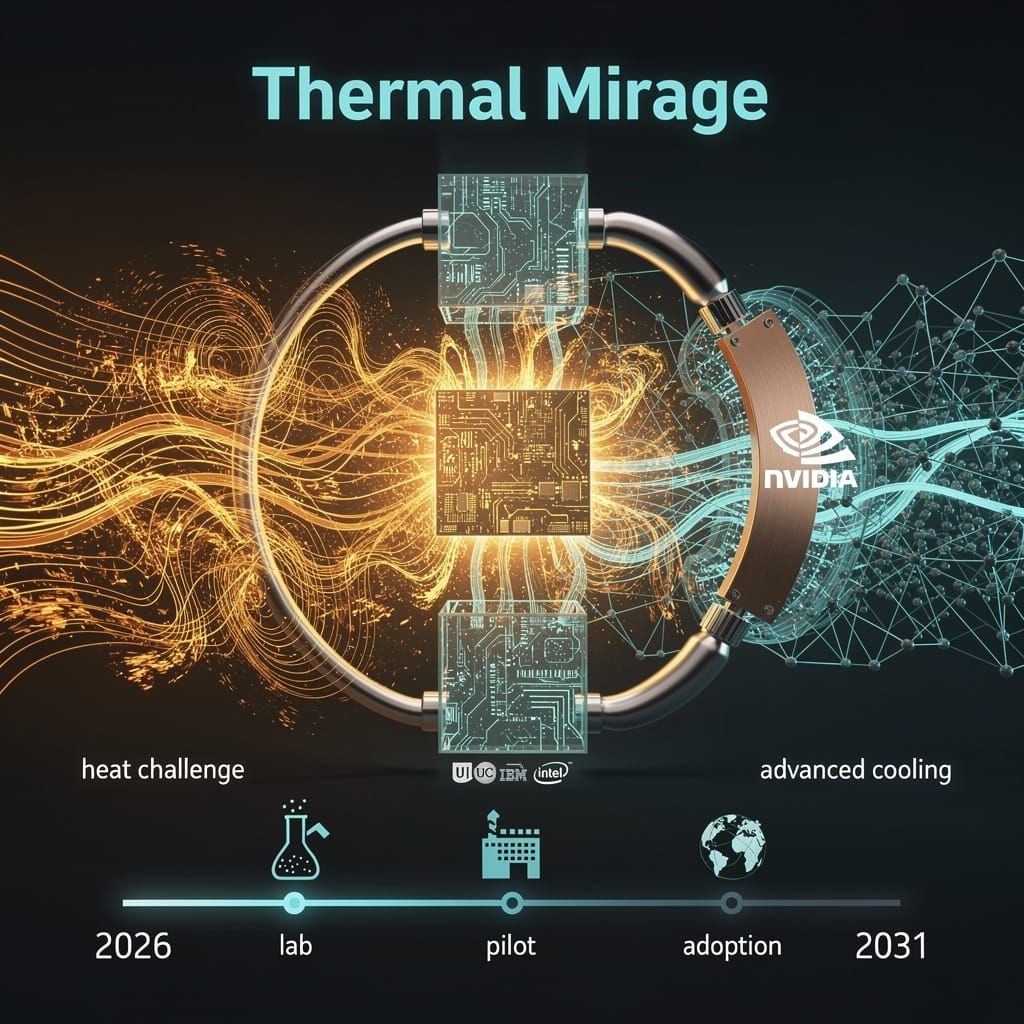
Recent claims regarding "breakthroughs" in 3D chip stacking attempt to rewrite the trajectory of semiconductor fabrication. On June 30, 2026, researchers from the University of Illinois Urbana-Champaign (UIUC), IBM, and Intel unveiled a monolithic 3D integration technique using sub-100°C processes and junctionless transistors to stack ultra-thin silicon nanomembranes. While this aims to bypass Moore’s Law via vertical density, the transition from laboratory disclosure to industrial scalability remains unproven amid a critical contraction in AI capital confidence.
Can Metamaterials Solve Thermal Density?
The primary obstacle in vertical integration is not layer fabrication, but heat dissipation. High-density stacking results in thermal throttling that offsets the latency gains of shorter interconnects. To counter this, researchers from Carnegie Mellon, Stanford, and Purdue demonstrated engineered metamaterials utilizing resonant coupling between metal nanoparticles and surface phonons to boost near-field radiative heat transfer.
However, a gap persists between component-level cooling and system-level viability. While UIUC’s Fabric8Labs developed copper cold plates that reduce pressure drops by 68%, and Nvidia unveiled the DSX AI factory architecture utilizing closed-loop liquid cooling with 45°C inlet temperatures, these are reactive measures. They address the symptoms of volumetric power density rather than the cause. The industry is swapping air fans for closed-loop glycol systems to prevent meltdown while the causal chain from nanomembrane density to sustainable clock speeds remains theoretical.
Integration Trajectory
- 2026–2027: Experimental validation in prototypes; commercial output stalled by 26.9% YoY rise in U.S. electronic component inflation and a 9.99% Kospi plunge triggering market circuit breakers.
- 2028–2029: Pilot integration in niche ASICs/FPGAs to test yield rates against the high risk of single-layer defects ruining monolithic stacks.
- 2031: Projected mainstream adoption, contingent on stabilizing supply chains and the realization of $452 billion in hyperscaler CAPEX into tangible returns.
Systemic Trade-offs
- Latency: Shorter vertical paths → reduced signal travel time.
- Thermal: Plasmonic-enhanced radiation → partial mitigation of the 400°C thermal ceiling.
- Yield: Monolithic integration → catastrophic failure risk from single-layer defects.
- Economics: Sub-100°C processing → lower fab CapEx, offset by 40% energy consumption attributed to cooling infrastructure.
Despite the narrative of "breakthroughs," monolithic 3D integration requires a total overhaul of data center architecture. Until the industry demonstrates that these metamaterials maintain stability across mass-produced wafers rather than lab samples, 3D silicon remains an architectural gamble.
🚩 The Industrial Encroachment of Compute Paradox
69,000 sq ft of compute next to a zoo is a blatant disregard for nature. That's nearly 1.5 football fields of concrete abutting 350 protected species 🚩. Legacy permits are being weaponized over ecology. Tech expansion or biological displacement? Nashville residents—is your local environment a fair price for more server racks?
DC BLOX initiated construction of a 69,000-square-foot data center on June 30, 2026, adjacent to the Nashville Zoo. While the developer utilizes legacy industrial permits to scale compute capacity, the deployment ignores the ecological requirements of a facility housing over 350 protected species. This project demonstrates a trajectory that treats urban ecosystems as externalities rather than constraints.
Efficiency or Displacement?
Corporate claims of "minimal impact" correlate poorly with measurable outcomes. In Dowagiac, Michigan, Hyperscale Data Inc. expanded a 30-megawatt facility, emitting noise levels between 58–63 dB—exceeding municipal limits and affecting ~1,300 homes. Residents report severe headaches and sleep disruption, while local property values decline. These figures suggest that the "waterless cooling" and noise barriers promised in Nashville are insufficient mitigation tools.
Environmental & Social Impacts:
- Acoustic: Constant humming disrupts nocturnal fauna and human health → physical invasion lawsuits.
- Fiscal: Utility rates in expansion zones (e.g., Virginia) project a 12% increase → heightened household cost burdens.
- Economic: Local opposition has delayed $36 billion in approvals → stagnation of projected infrastructure investment.
The Regulatory Friction
This expansion coincides with a systemic pivot in urban planning. The Nashville Metro Council advanced a permit moratorium on June 9, 2026, and the Metro Planning Commission held a critical hearing on June 11. This localized friction mirrors a national trend where regulatory inertia is being replaced by active restriction.
Timeline of Conflict:
- June 9, 2026: Nashville Metro Council advances temporary moratorium on data center permits.
- June 15, 2026: Virginia Governor Anne Spencer issues executive order halting all new expansions.
- June 18, 2026: Zoo-backed petition exceeds 400,000 signatures; Michigan residents sue Hyperscale Data.
- June 26, 2026: Mayor Freddie O'Connell signs executive order for oversight of siting and power.
- June 30, 2026: DC BLOX breaks ground; Governor Kathy Hochul faces vote on 20MW+ moratorium.
The conflict demonstrates a critical gap: the prioritization of compute capacity over biological and civic sovereignty. With 64% of the public opposing AI-driven infrastructure expansion, the Nashville Zoo's zoning appeal is not an isolated grievance but a symptom of a broader failure to integrate environmental impact assessments into the approval phase. Until strict adjacency buffers are mandated, the expansion of the compute footprint will continue to result in avoidable ecological and social degradation.


Comments ()