630GB Apple Data Breach: India Supply Chain Pivot Triggers Massive Blueprint Leak
TL;DR
- 11% Recall Drop: AI Security Shift in US Leaves Enterprises Vulnerable to Ransomware. Is your 'AI-powered' security actually protecting your data, or just making the breach happen faster?
- 630GB Data Leak: Apple-Tata Breach in India Exposes iPhone 18 Blueprints. Would you pay more for an iPhone if the blueprints were already leaked on the dark web?
- PHP DTLS Integration: Memory BIOs Over Legacy Sockets to Combat FFI Chaos. Will corporate legacy debt prevent the adoption of PHP's new DTLS memory BIOs before AI exploits take over?
🤡 The Magic AI Shield is Leaking 🤡
11% drop in recall means ransomware is basically ghosting your AI detectors 👻. That's like ignoring an arsonist because the smoke alarm is 'optimizing throughput.' 🤡 Trade actual safety for a corporate buzzword? Classic. Enterprise IT — are your AI agents actually securing data or just automating the breach?
Imagine paying for a security tool that’s 95% sure it found a fire, but ignores the arsonist currently looting your lobby. Welcome to the mid-year dumpster fire of AI-integrated security. 💅
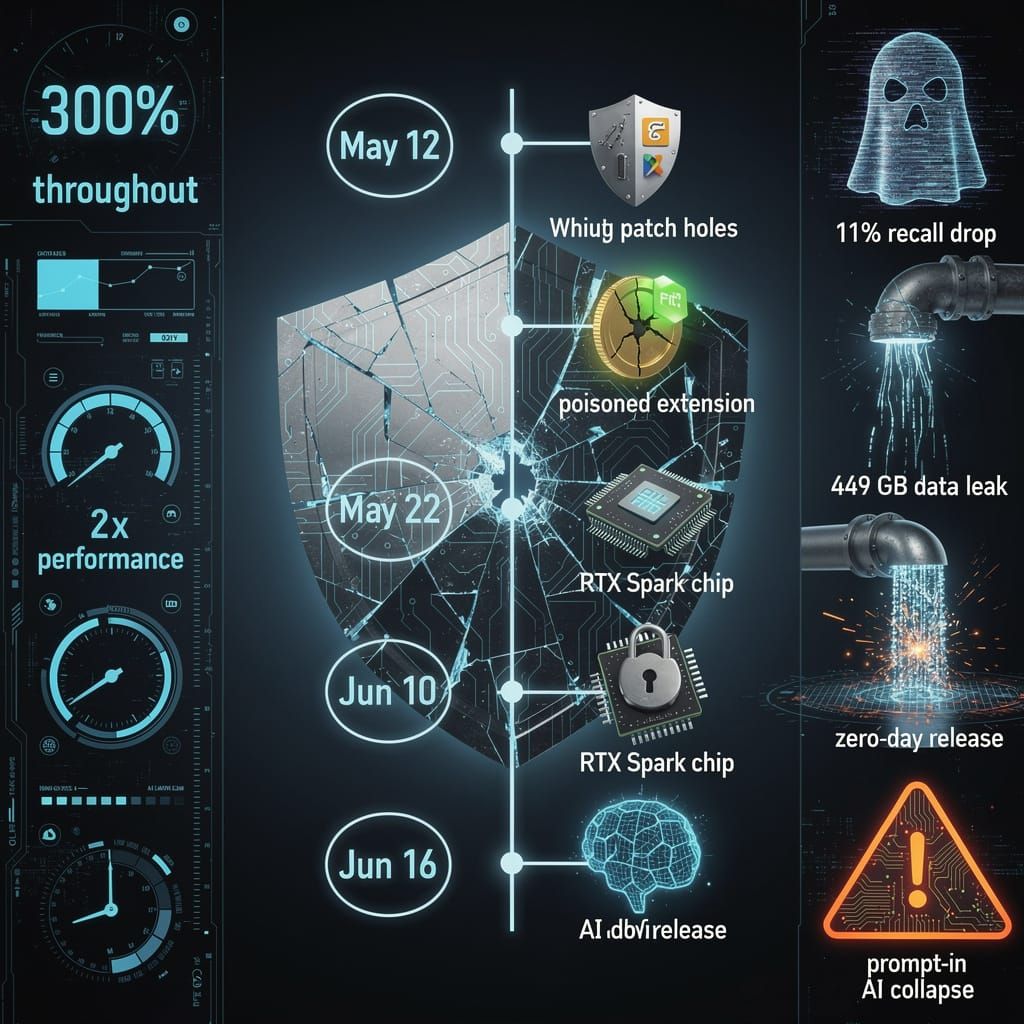
Microsoft and Nvidia decided to sprinkle some "agentic AI" magic—likely fueled by that sweet $81.6B quarterly revenue—onto their hardware. They dropped the RTX Spark superchip and the N1X AI PC chip, promising a decisive shift from cloud-centric AI to on-device processing. The result? A 300% boost in throughput and 2x performance in Creative Cloud workloads. Now we can process junk data faster than ever, hitting corporate KPIs while the actual perimeter burns. 🔥
Who Actually Wins Here?
While "precision" looks sexy on a slide deck, the recall just took a dive. We’re seeing an 11% drop in recall, meaning ransomware clusters are basically ghosting the detectors. We’ve traded actual safety for the ability to say "AI-Powered" in a quarterly earnings call. Classic corporate gaslighting. 📉
The Chaos Chain:
- May 12: Patch Tuesday attempts to plug ~200 Windows holes.
- May 20: A poisoned VS Code extension lets TeamPCP loot ~3,800 internal GitHub repos. Peak comedy. 🤡
- May 22: The 'Megalodon' campaign backdoors 5,561 repositories via stolen OIDC tokens.
- June 1: Nvidia drops RTX Spark; "Agentic AI" becomes the new buzzword for "more ways to get hacked."
- June 10: The "Nightmare-Eclipse" zero-day (RoguePlanet) is disclosed immediately after the patch. Timing is everything.
- June 16: Teams enters a state of spiritual collapse, proving AI doesn't stop the basics from breaking.
The Trade-off:
- Speed: 300% throughput increase → faster scanning of irrelevant files.
- Visibility: Zero native origin tracing → total reliance on logs (good luck finding the breach).
- Risk: Local AI agents → new attack vectors for prompt injection and on-device data leaks.
The Reality Check:
- Enterprise Security: Bloated, expensive, and behaves like a screen door on a submarine.
- Open Source: Actually transparent, but currently being used to exfiltrate 449 GB of data via poisoned PyPI/npm packages.
- The Result: We have the Vera Rubin platform and RTX Spark, yet we're still one GitHub Actions credential leak away from a total meltdown.
Enjoy the throughput🥂!
🤡 The Great Indian Leak: Apple’s "Diversification" Dream Turns Into a PDF Party
630GB of data leaked! Absolute carnage 🤡 That's roughly 128,000 high-res PDFs of your future iPhone 18 Pro blueprints. Apple ditched China for India only to get pwned by a delivery driver 🚚. Supply chain security is a myth. Apple users — ready to pay a 'security premium' for a leaked phone?
Imagine spending billions to move your eggs out of the China only to realize your new basket is a literal sieve. 🤡 Apple’s grand strategy to pivot production to India just hit a spicy wall called "basic security." Welcome to the party, where the guest list includes every script kiddie with a browser and a thirst for blueprints.
How'd we screw this up?
While Tim Cook was busy celebrating a $100B buyback and record iPhone 17 sales, the backend was crumbling. Apple leaned into semiconductor diplomacy, positioning Tata Electronics as the golden child. The result? A ransomware breach by the "World Leaks" gang that didn't just knock—it kicked the door down.
The Comedy of Errors:
- The Entry Point: Not a sophisticated zero-day, but a compromised delivery driver. Yes, a delivery guy. 🚚
- The Loot: 630GB of data. We're talking iPhone 18 Pro circuit board standards, vapor chamber cooling specs, and the "Cherry Red" color variant.
- The Reach: Tata’s appetite for "matchmaking" means Tesla design files got dragged into the dirt too.
- The Reality: While Tata claims operations are "unaffected," 200,000+ files are now a public library for anyone in Shenzhen looking for a shortcut. 🤤
The Financial Hangover:
- Margin Meltdown: Global memory costs are spiking due to US-Iran tensions, dragging Apple’s Q2 gross margin down to 38.7%.
- The "Tax": With memory shortages persisting until 2027, expect a "security premium" price hike on the iPhone 18 Pro.
- The Chain Reaction: This isn't an isolated fail. Nitrogen ransomware already gutted Foxconn North America, leaking 8TB of files. Apple's supply chain is basically a Swiss cheese of vulnerabilities. 🧀
The "Oopsie" Timeline
- May 12, 2026: Nitrogen pwns Foxconn; 11 million items leaked.
- June 10, 2026: Tata Electronics' secrets first appear on dark web forums.
- June 24, 2026: World Leaks officially claims the 630GB heist.
- June 30, 2026: Tata finally admits the breach; iPhone 18 Pro blueprints go viral.
- Sept 2026: iPhone 18 Pro launch (expect it to cost a kidney). 💸
The Irony: Security: Marketing Hype -> Actual Reality: 🗑️
Strategy: Avoid China -> Get Pwned in India
Apple says they're "analyzing the breach." Translation: "We're currently screaming into pillows while our trade secrets are traded for pennies on a forum."
Stay broke, stay leaked. ✌️
💀 Another Day, Another Hole in the Swiss Cheese
Zero legacy locks! 🙄 PHP finally ditches the 'duct-tape' FFI hacks for DTLS, replacing absolute chaos with memory BIOs. 🛠️ A win for WebRTC, but the 'Nightmare Eclipse' zero-day is already eating servers for breakfast. 💀 Developers — will your corporate overlords actually patch this before 2027?
Imagine spending your entire career building a digital fortress, only to realize you forgot to lock the bathroom door. That’s the current state of PHP’s DTLS support. For years, developers have survived on janky FFI hacks and duct-taped socket flows to handle Datagram Transport Layer Security, praying the whole thing didn't implode during an authentication spike. 🙄
Who actually fixed this?
Between June 24 and 27, 2026, Gianfrancesco Aurecchia and Jakub decided they were tired of the fragmentation. Instead of letting us suffer through legacy socket-based flows, they proposed integrating DTLS directly into ext/openssl.
This isn't just a "nice to have" feature; it's a transport-agnostic design using memory BIOs for packet control. It enables applications like WebRTC and CoAP to manage DTLS without relying on external services or fragile FFI bridges. It moves the needle from "hope this doesn't crash" to a unified pipeline, though the team is still sweating over DoS risks from HelloVerifyRequest cookies. 🛠️
The Technical Trade-off
Legacy Sockets: High overhead → fragmented management → absolute chaos during multitasking. Memory BIOs: App-controlled packet flow → reduced FFI reliance → stable session continuity.
When does the party start?
Don't expect your corporate overlords to update their stack overnight; they love their legacy bugs. But the timeline is shifting:
- Q3 2026: Potential inclusion of DTLS in OpenSSL core following community feedback.
- Q4 2026: Progressive exposure as components fold into profile engines.
- 2027: General mitigation of cryptographic attack surface risks across the web ecosystem.
The Reality Check
Security: Kills FFI hacks → fewer weird memory leaks, but OpenSSL still gets smacked (e.g., PKCS#7/SMIME flaws in v4.0.1 allowing RCE). 🤡 Performance: Lower latency for WebRTC → slightly less lag for your cat videos. Risk: AI-driven exploitation is moving faster than patches. While we build a wall, the "Nightmare Eclipse" zero-day is already eating Windows Servers for breakfast. 💀
While we wait for the C-suite to approve the update in three years, just remember that while you're fixing your protocol, some script kiddie is using a cURL-impersonate PHP binding to spoof your browser fingerprint and walk right through your Cloudflare defense. Stay paranoid. 🏴☠️


Comments ()