🇳🇬 Nigeria GDP Hits 4.43% but Non-Oil Sectors Carry 96% of Economy
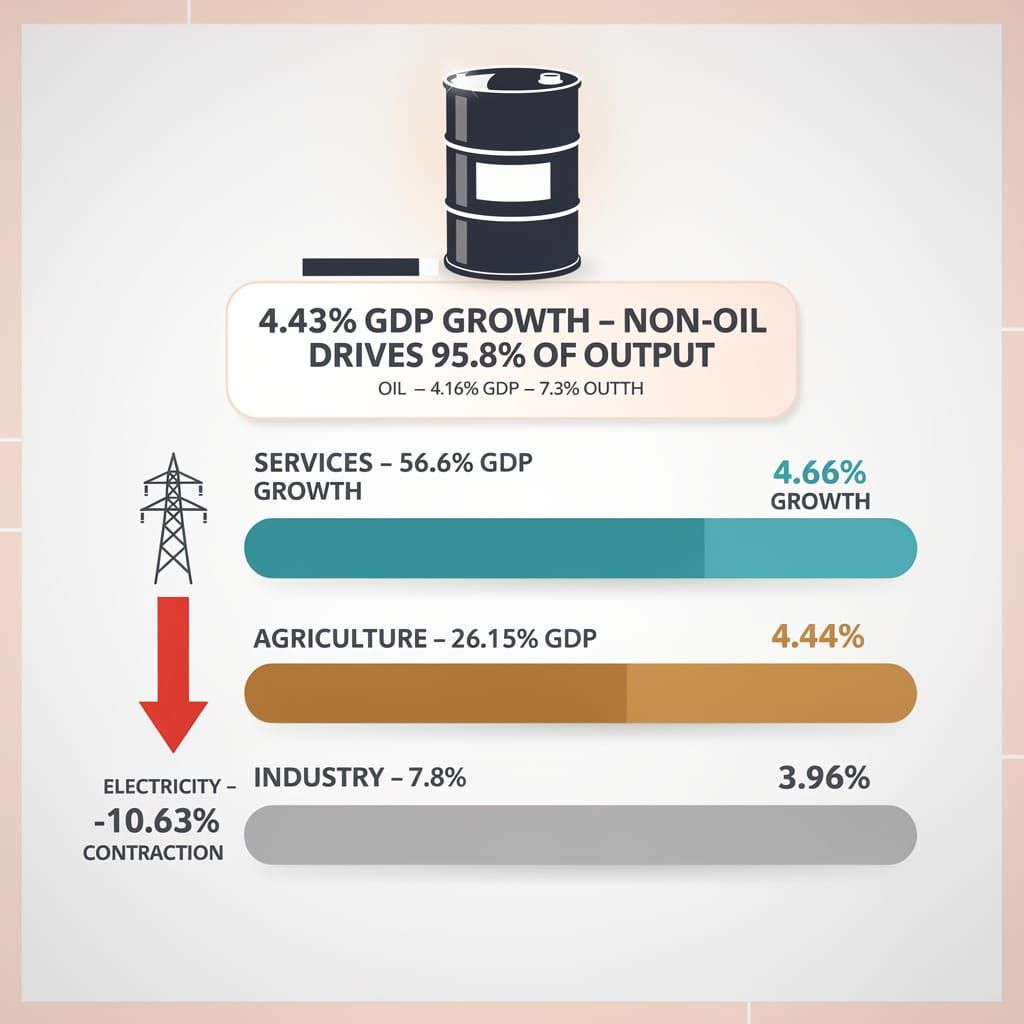
Nigeria's Q2 GDP hit +4.43% YoY — but non-oil sectors contributed 95.84% of output, growing at 4.31%. Oil refinining surged +43.94% from a negligible base. Industry growth halved to 3.96%. Power contracted -10.63%. Against a 7% annual target, this is not transformation. Still waiting for the main act? 🇳🇬
Nigeria's National Bureau of Statistics served up its Q2 2026 GDP report with a headline that practically begs for a victory lap: +4.43% year-on-year growth. Bayo Onanuga and assorted cheerleaders invoke "removal of macroeconomic constraints via reforms," a PMI uptick, and modular refineries. The only problem? The actual data tells an entirely different story.
The Non-Oil Story That Undermines the Oil Narrative
The government's preferred framing pins the growth on oil bouncing back. Oil did expand +7.31% YoY—but from a base so depleted by theft and underinvestment that any movement looks heroic. More critically, oil now constitutes just 4.16% of real GDP. The sector's contribution actually rose from 4.05% to 4.16%—a rounding error in a $250-billion-plus economy.
The real driver? Non-oil sectors contributed +4.31% growth, accounting for 95.84% of real domestic output. That undercuts the entire "oil mirage" argument, but it also raises a more uncomfortable question: if services (56.62% of GDP, growing at 4.60%) and agriculture (26.15%, growing at 4.39%) are doing the heavy lifting, why is the government still heralding oil as the hero?
Industry Isn't Collapsing—It's Decelerating, Which Is Almost Worse
The original draft flagged a manufacturing collapse. The actual numbers: industry grew at 3.96%, down sharply from 7.46% in Q2 2025. That is a slowdown, not a contraction—but a 47% deceleration in one year signals serious headwinds. Manufacturing's share of domestic output slipped from 7.81% to 7.72%. The electricity, gas, and steam subsector did contract by -10.63%, confirming that power remains the economy's Achilles' heel.
Bismarck Rewane of FDC Limited noted oil refining as the fastest-growing sector at +43.94% YoY, with modular refineries adding 28% growth. That is genuinely positive—but refining contributes a tiny fraction of GDP. The industrial engine is losing momentum, not stalling outright, which in some ways is worse: enough motion to avoid alarm, not enough to transform.
Agriculture: Better, but Not Transformed
Agriculture grew 4.39%, up from 2.82% in Q2 2025. That improvement is real. But the structural problems—low mechanization, poor productivity, climate vulnerability—persist. The Abuja Chamber of Commerce launched AGROMEQA EXPO 2026 in September to attract investment and promote mechanization, and Vice President Shettima adopted the AGROW program's final report in July, allocating $355 million across 32 states. These are steps, not solutions. A country that imports food while sitting on arable land is not a transformed economy; it is an economy that grew 4.39% this quarter instead of 2.82%.
What the Data Actually Says
- Non-oil sectors: +4.31% growth, 95.84% of GDP—the actual story.
- Oil & Gas: +7.31% from a depleted base; still only 4.16% of GDP.
- Oil refining: +43.94% YoY—genuine modular-refinery gains, but marginal in aggregate.
- Industry: +3.96%, halved from 7.46% a year ago. Manufacturing share shrinking.
- Electricity, gas, steam: -10.63% contraction—power infrastructure deteriorating.
- Agriculture: +4.39%, improved from 2.82%, but low productivity and mechanization remain.
- Services: +4.60%, dominant at 56.62% of GDP.
The Verdict (Such as It Is)
President Tinubu claims Nigeria is on an "irreversible path" to stronger growth. External reserves are at a 17-year high. GDP per capita income now crosses $12,000 annually. The economy expands six percentage points ahead of population growth at 2.0%. Trade surpluses exist. These are not nothing.
But 4.43% GDP growth against a 7% annual target is not transformation. The government would rather you focus on the oil-sector spike and the modular-refinery headlines. The more honest read: non-oil sectors are carrying the economy, industry is losing steam, power is buckling, and agriculture is improving incrementally without structural reform. As the data makes clear, the 7% yearly aim remains unreachable until fiscal discipline is enforced.
The headline is nice. The substance remains half-finished.


Comments ()