🚀 Stoke Space Ships Three Flight-Ready Engines as $1B Series E Fuels Nova's First Launch
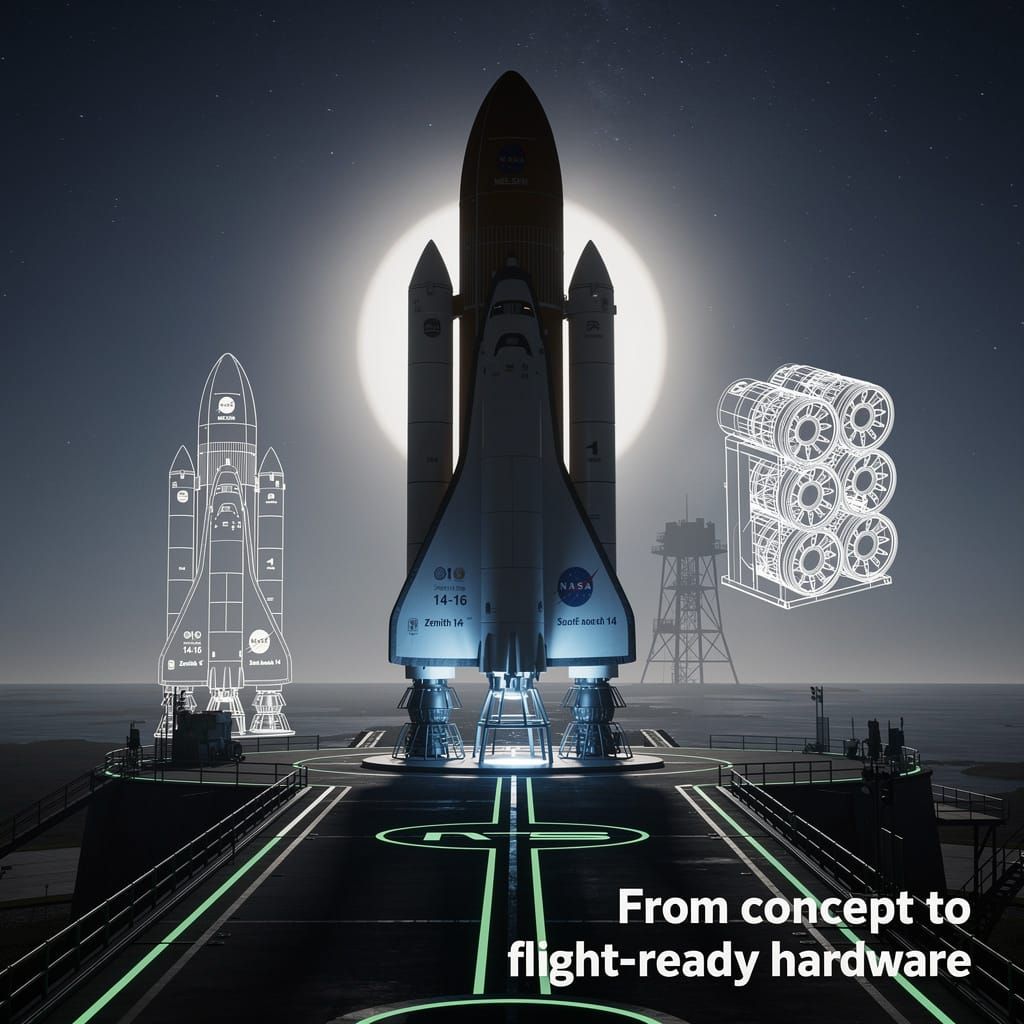
3 flight-ready engines shipped. $1B Series E closed. Nova's first flight is Q4 2026. 🚀 Stoke Space just proved its fully reusable medium-lift vehicle is real hardware, not a slide deck—and it's heading to Cape Canaveral. The FAA projects 4,000 commercial launches over the next decade. Who gets the payload contracts first?
By September 2026, the private spaceflight crowd has seen enough PowerPoint rockets to fill a small crater. But Stoke Space, the Washington-based upstart that's been quietly building a fully reusable medium-lift vehicle, just pulled off a move that shifts the conversation from "if" to "when."
On August 19, the company confirmed that its Nova vehicle passed all secondary-stage fit checks—matching payload module, second stage, and the Andromeda 2 engine—and shipped three flight-ready Zenith engines (Zenith 14, 15, and 16) to Moses Lake for hot-fire validation. That's not a rendering. That's hardware bolted together and ready to scream.
What Nova Actually Delivers
The Nova stack targets roughly 3,000 kg to low Earth orbit using a fully reusable two-stage architecture. That puts it in the medium-lift slot—below Falcon 9 but above Rocket Lab's Electron, and crucially, in the payload range that covers the bulk of commercial constellation deployment and government LEO missions.
The second stage runs on Andromeda 2, a cryogenic liquid hydrogen and liquid oxygen engine that enables longer loiter times and multiple relights—exactly what you need for complex orbital insertion or deorbit burn sequences. The partnership with NASA under an SBIR award focuses on refining those upper-stage entry, descent, and landing capabilities.
The Milestones That Matter
- August 19, 2026: Fit checks confirmed on the Nova second-stage assembly; three Zenith engines shipped to Moses Lake for static fire.
- September 8, 2026: Stoke Space closed a $1 billion Series E—co-led by Point72 Ventures and Spark Capital—bringing total capital raised to $2.3 billion, per the company's announcement. It's one of the larger private rounds in aerospace this year.
- Q4 2026: Nova's first flight from LC-14 at Cape Canaveral, following pad construction completed on July 8 under NASA collaboration. Relativity Space is building out adjacent LC-16 for Terran R in parallel.
- Early 2027: Nova Pathfinder debut launch targeted, with Series E funding directly supporting integration and qualification work.
- 2029: Block 2 variant aiming for 15 metric tons to LEO with a cylindrical second stage and 14 Zenith engines—public release details expected soon, per the company.
The Reusability Bet Without the Hype
Reusability isn't a new idea—SpaceX proved the economics. But doing it with a clean-sheet vehicle that starts small, uses full-flow staged combustion (FFSC) Zenith engines, and runs a hydrogen upper stage is the harder, less glamorous path. Stoke's approach: validate structural integrity early, run the engines hot, then fly. No heroics. No "we'll figure it out in flight."
The Series E signals that institutional investors see Nova not as a science project but as a revenue vehicle. The timing lines up: launch demand across the industry is outstripping supply in a big way. The FAA's July forecast projects up to 4,000 commercial launches between FY2026 and FY2036, with annual volumes doubling each decade. The Space Force alone expects 91 additional missions and a $17 billion budget increase by FY2032—and its launch ranges are already straining under a 1,100% operational tempo increase since 2019. SpaceX's SPCX trades in the $110–$135 band post-IPO despite $7.8B quarterly revenue. Any operator that can put 3 tons in orbit with a reusable first stage has a line of customers before the first flight even wraps.
What Happens Next
The pad is ready. The engines are in test. The funding is closed. If Nova lifts off in October as planned, Stoke Space will have gone from concept to flight-ready hardware in roughly four years—a timeline that, in aerospace, qualifies as fast.
The bigger question: can they land it? That answer comes after the first flight. But for now, the company has done something most launch startups don't—it reached the launch pad with hardware that's been tested, shipped, and bolted together. Everything else is just gravity doing its job.

Comments ()