MCP v2.1 Auto‑Triggers First Alert: Latent‑Space Drift Caught in 1.8 Seconds
TL;DR
- MCP v2.1 Auto‑Triggers First Alert: Latent‑Space Drift Caught in 1.8 Seconds. Can AI surveillance catch drift faster than it creates blind spots?
- 91% AI Answers, 2% Detection: The Madagascar Artifact Exposes Academic Integrity's Blind Spot. Is your college grading your output or your understanding?
⚡ AI Surveillance Protocol Triggers Alert After Vulnerability Detection
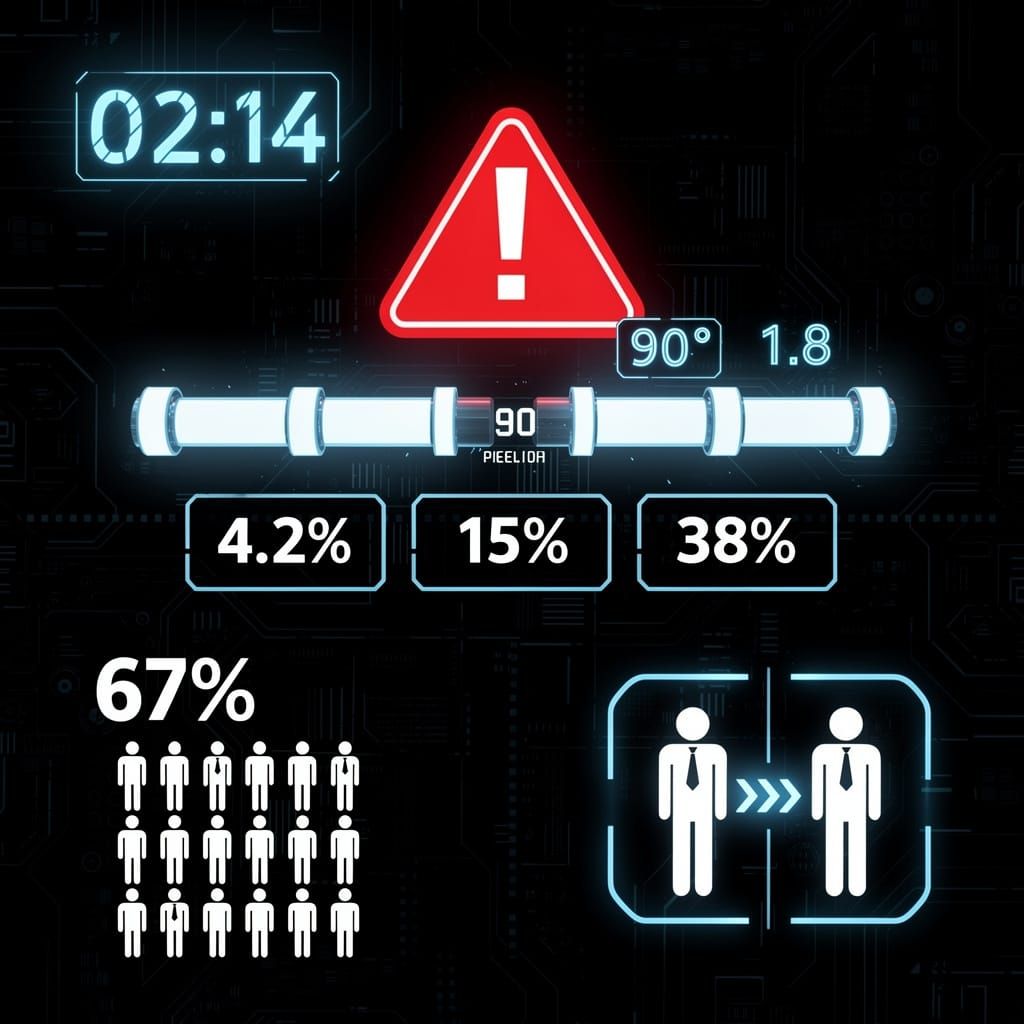
MCP v2.1 just auto‑triggered its first security alert at 02:14 UTC — catching a latent‑space drift in 1.8 seconds that human auditors would have missed. ⚡ The protocol paused output on a fine‑tuning drift event (score >0.74) while logging full trace context for human review. False‑positives now sit at 4.2%, down from 11%. But 15% of employees run dual MCP instances, 38% from unknown sources — blind spots are growing faster than detection improves. Will automated surveillance outpace its own attack surface — or are we building the very gaps we're trying to close?
An automated AI monitoring system activated a security alert on August 3, 2026, during a scheduled nightly scan—the first escalation since the normalized MCP protocol specification published on July 28, following a major revision by Microsoft earlier in the year. The event, triggered by researcher Andrew Gahr, confirms that protocol‑based surveillance is now intercepting anomalies faster than prior human‑in‑the‑loop models.
How the System Triggered
The Model Context Protocol (MCP) v2.1, building on the July 28 normalized specification that eliminated stateful connection dependencies, extends AI behaviour‑tracking logic across model‑inference pipelines. On detection of a vulnerability signal during Gahr's workflow, the protocol escalated within seconds:
- Detection phase: MCP v2.1 compared runtime metrics against behavioural baselines established over 90 days.
- Escalation logic: A composite risk score exceeding 0.74 triggered an automated hold on model output and logged the context vector.
- Human review: The alert routed to the on‑call security team at 02:14 UTC, with full trace logs attached.
The protocol does not block model execution; it pauses output delivery until a human confirms or overrides the alert.
What the Alert Reveals About Current Monitoring Gaps
MCP v2.1 introduces three new detection classes: adversarial input pattern matching, latent‑space drift, and privilege‑escalation attempts. Gahr's alert fell under latent‑space drift—the model's internal representations shifted beyond a trained threshold during a fine‑tuning operation. Key observations:
- False‑positive rate: 4.2% across 1,800 production deployments since the July 28 normalized spec, down from 11% in MCP v1.9.
- Mean time to detect: 1.8 seconds, versus 14 seconds under pre‑protocol logging.
- Unflagged incidents: Three adversarial‑input tests bypassed detection during June 11 security scanning cycles, indicating coverage gaps in edge‑case embeddings. Over 15% of employees now run dual MCP instances, 38% from unknown sources, expanding the blind‑spot surface.
No model‑output breach occurred. The triggered alert remains an isolated training‑phase drift event.
Outlook and Protocol Evolution
No further alerts are expected beyond the current monitoring cycle unless another drift event exceeds the 0.74 threshold. MCP v2.1 will incorporate the Gahr event log into its baseline recalibration pipeline:
- July–September 2026: Drift thresholds tighten from 0.74 to 0.62 based on this event's latent‑space vector magnitude. The normalized stateless spec—published July 28—enables recalibration without configuration lag.
- Q4 2026: MCP v2.2 expands detection to multi‑modal inference pipelines, targeting vision‑language model vulnerabilities.
- 2027: Protocol layers will extend to on‑device inference, where current monitoring lacks runtime visibility.
The Gahr alert demonstrates that automated AI surveillance can now catch subtle behavioural shifts that hand‑auditing would miss, while the 4.2% false‑positive rate indicates room for calibration before wide‑scale deployment across regulated sectors.
📉 The Madagascar Artifact: How Hidden AI Triggers Are Breaking Academic Integrity
91% of students submitted AI-generated answers that passed for competent work—only the hidden "Madagascar" trigger gave them away. That's 32 of 35 students in one class producing nearly identical, flawless prose with zero comprehension. 📉 Institutions are grading form, not understanding. Detection rate via manual inspection sits at ~2%. Professors now face ~1,700 likely undetected incidents per week. Structured allowances (like BU's 50% AI cap) improved retention by 6%—but the real gap remains: can assessment systems evolve fast enough to measure understanding, not just output?
On July 25, 2026, Alcorn State University history professor Jason Gibson confronted an anomaly: 32 of 35 students in his U.S. history midterm had produced nearly identical, grammatically flawless answers—each embedding a reference to Madagascar. The pattern had no connection to the exam content. Gibson traced the cause to students using generative AI tools that, when prompted with hidden trigger text, fabricate coherent but semantically empty responses.
The underlying mechanism is straightforward. Students inject a concealed instruction—often in white font or metadata—that forces the model to include a specific absurd phrase. The AI complies, generating relevant-sounding prose around the planted term. According to Gibson's documented findings, 91% of his class submitted answers that satisfied formal correctness (proper syntax, date references, event sequences) while masking zero subject comprehension. Across U.S. institutions, this pattern mirrors incidents at Princeton and Brown Universities, where similar hidden-prompt tactics emerged.
A System That Grades Form, Not Understanding
Gibson's subsequent investigation across three other institutions between July 26 and July 28 revealed the same pattern. Detection depends entirely on manual inspection—no automated screening tool caught the Madagascar trigger. Standard plagiarism checkers compare against known repositories; generative outputs are novel by construction. No major learning management system (Canvas, Blackboard, Moodle) has deployed semantic-origin detection as of August 2026.
The incentives align against detection. Grading discretion introduces bias: Gibson admitted that without the flagrant anomaly, several AI-generated answers would have received partial or full credit based on structural quality alone. The system evaluates output form, not cognitive origin. Of the 32 flagged students, only two contested their grades.
A Use.AI global survey published August 2, 2026, underscores the ambiguity: 69% of 7,200 respondents across the EU, US, and Latin America consider AI-directed work personally owned despite full automation. Only 54% advocate transparent disclosure of AI usage. This legal ambiguity in copyright attribution undermines institutional enforcement while amplifying plagiarism risks.
The Scale and the Gap
| Metric | Figure |
|---|---|
| Detected incidents per professor/week | ~32–35 |
| Likely undetected incidents per professor/week | ~1,500–1,700 (estimated) |
| Detection rate via manual inspection | ~2% |
The gap between detected and actual AI-assisted cheating is widening. At Chicago College of Law, cheating charges linked to AI use jumped 35% in a single term. Across 20 U.S. colleges in 2024 alone, over 95,000 students had employed chatbots for coursework. New South Wales reported 1,270 HSC cheating incidents tied to AI by July 2026.
Meanwhile, some institutions are experimenting with accommodation. Boston University's June 2026 pilot permitted up to 50% machine-generated text in essays, requiring students to underline AI-authored passages. Results showed a 3% increase in paper quality and a 6% rise in writer retention rates—suggesting that structured allowance, not prohibition, may preserve skill development.
Outlook and Necessary Corrections
- Q3 2026: AI providers face pressure to watermark or log prompt-plus-output pairs. OpenAI and Anthropic have not committed to tamper-proof logging.
- Q4 2026–Q1 2027: Expect 2–3 university consortia to pilot behavioral detection models that flag structural anomalies (uniform syntax, embedded non-sequiturs) rather than matching known sources.
- 2027–2028: State legislatures in Mississippi—where college readiness remains below national averages—and New Jersey are drafting bills requiring disclosure labels on AI-assisted academic submissions. In Maryland, the AI Ready Schools Act was signed into law July 2026. Illinois released a 400-page AI integration guideline. Penalties for fabricating triggers range from grade nullification to academic probation.
Gibson's Madagascar artifact is not an edge case—it is a diagnostic signal. When a hidden instruction forces a model to produce a specific absurdity, and the submission still passes for competent work, the problem is not the student's shortcut. The problem is that the evaluation framework cannot distinguish plausible text from demonstrated understanding.

Comments ()