KOSPI slides below 7,000 as U.S. yields hit chips
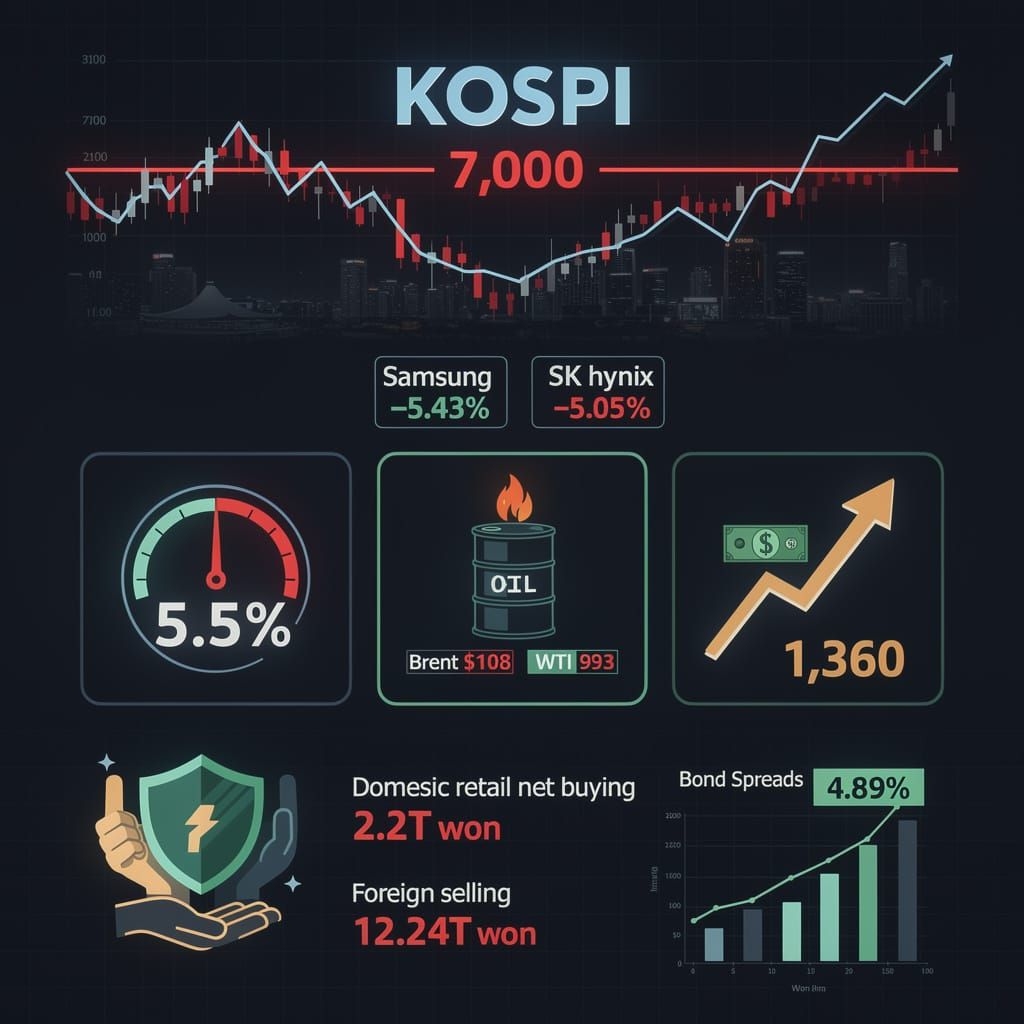
KOSPI broke below 7,000 as U.S. yields crossed 5.5% and WTI pushed past $93. 🇰🇷 The trigger isn't Korean—Samsung and SK hynix shed ~5% as foreign funds unloaded 12.24T won this month. Retail investors absorbed 2.2T won in a day, capping the slide. Is this a correction or a regime break? 📉
On the morning of September 29, Seoul's KOSPI opened at 6,844.41, down 0.66%, extending a slide that had already broken the psychologically critical 7,000-point barrier two days earlier. But the trigger isn't Korean at all. U.S. 10-year Treasury yields crossed 5.5% while spot WTI crude pushed past $93 a barrel, and the won-dollar rate ground toward 1,360. For Korean equities, the transmission is direct: a foreign portfolio that has spent late September unloading, and a domestic retail base that keeps absorbing the sale.
The U.S. funding backdrop hardened through September. The 10-year Treasury yield first pierced 5.012% on September 14—its highest print since October 2023, when it last touched that level—after an August CPI print that overshot the Federal Reserve's 2% target. That trajectory, grounded in energy costs and tighter monetary policy, re-priced the longest-duration cash flows first—and Korea's chip-heavy index is among the longest-duration earnings streams in any major market.
The energy input is what makes this particular repricing stick. Brent crude surged to $108.03 a barrel on September 24 after Iran-aligned Houthi forces forced Saudi Arabia to close its East-West pipeline—the main alternative to the already-disrupted Strait of Hormuz, running 5–7 million barrels a day. British gas prices rose 5% to records, and shipping through Hormuz slowed to four commodity vessels against a ten-day average of sixteen. That supply shock feeds directly into the duration math: higher energy costs raise the discount rate on long dated earnings, and semiconductor cash flows sit at the longest end of that curve.
The casualties are concentrated and predictable. Samsung Electronics fell 5.43% on the crash day and 0.56% a session later; SK hynix surrendered 5.05% in the first leg. The semiconductor complex shed more than 5% in a single session—a repeat of July, when SK hynix fell more than 15% and then 14.57% on AI-bubble fatigue before its HBM4 delivery forecasts softened. KOSDAQ, by contrast, firmed—up 0.38% on September 29—because its smaller-cap names carry less foreigners' exposure and more domestic ownership.
The counterweight is a conspicuously resilient domestic bid. Individual investors net bought 238.8 billion won on the 29th and roughly 2.2 trillion won the prior day, with institutions adding another 121 billion won. That retail defense has repeatedly capped decline—the same pattern as late July, when an 8.22% intraday drop triggered a 20-minute circuit breaker and margin loans had ballooned to a record 61.98 trillion won during the second quarter—but it has not reversed the trend. The exchange closed September 29 at 6,870.81, still below the 7,000 line.
What's unresolved is whether this is a correction or a regime break. The 7,000 threshold broke on September 28 from 7,057.86—just nine sessions after the index closed at 7,007.72 on September 21 on 427 billion won of combined foreign and institutional buying. The whipsaw in positioning is severe: foreign investors had net sold 12.24 trillion won of KOSPI shares through September, nearly 80% of it concentrated in Samsung Electronics and SK hynix, after ending a seven-month selling streak in August.
The domestic front shows early strain. On September 16, nearly 2 trillion won of commercial bank bonds flooded the Seoul market in a single day—KB Kookmin Bank issued 1 trillion won in 9-month discount bonds with a spread widening to nearly 10 basis points above benchmark, and Hana Bank placed 950 billion won in 3-year paper at 4.50%, 6.4 basis points above fair value. Five-year unsecured corporate bond yields had already climbed to 4.89% by September 21, quietly raising funding costs for Korea's lenders even as their share prices were weighed down.
Commercial paper alone reached 181 trillion won this month, up 29.1% year on year, leaving issuers far more exposed to the volatile short end that a 5.5% U.S. curve feeds. Samsung Card's short-term funding ratio doubled to 10.26% and Shinhan Card's rose to 8.63% by June—a build of refinancing risk that trades alongside the equity unwind.
Three signals will determine whether the 7,000 break becomes a floor or a ceiling: whether the 10-year Treasury yield can hold below 5.5% for consecutive sessions; whether foreign net selling narrows from the current ~2-3 trillion won weekly pace; and whether corporate bond spreads widen past the 4.89% print, which would signal liquidity strain migrating from equity flows into Korea's credit market. This is reporting and analysis, not a recommendation. Until those stabilize, Seoul's index is effectively hostage to a Federal Reserve policy cycle it does not set—and a domestic retail bid that is, for now, absorbing the global unwind.
Comments ()