Eiffel Tower CEO steps down after gender-exclusion order
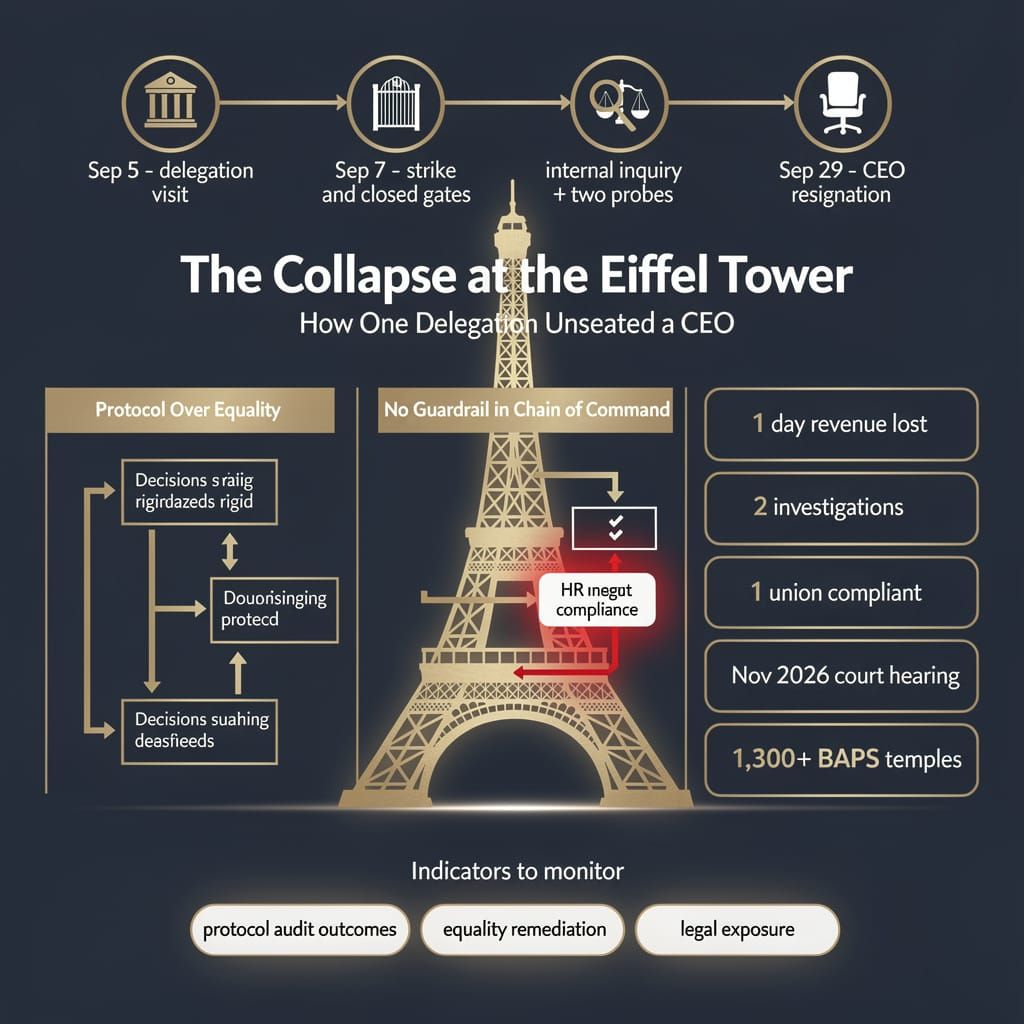
SETE CEO steps down after a gender-exclusion order sidelined female staff during a religious delegation visit 🗼⚖️ The September 5 protocol triggered a strike, a day of lost revenue, two investigations, and a Charter breach finding. Protocol won over workplace equality—until it collapsed: staff were told to be "invisible," nobody flagged it, and no guardrail existed to stop it. The mechanism that produced the failure remains in place even as the leader leaves. Could your organization's protocol overrun its own norms without anyone noticing?
On September 29, 2026, Société d'Exploitation de la Tour Eiffel (SETE) CEO Patrick Branco Ruivo announced he would step down at year-end. On paper, it's a standard leadership transition. In practice, it's the end point of a four-week cascade that began with a religious delegation, moved through a strike and a public closure, and ended with two investigations and a grievance that strips away SETE's veneer of routine operations.
The trigger
On September 5, a delegation from BAPS, the Hindu religious organization, visited the Eiffel Tower for a protocol event. Per an internal email later obtained by L'Œil du 20 Heures, staff—specifically female employees—were told to leave their posts and remain sidelined in facilities during the visit. The order appears to have been designed to keep women out of the delegation's interaction, reportedly to accommodate ritual requirements.
The action fractured along gender lines, and it wasn't quiet. The CGT union filed a complaint over the exclusion. On September 7, the monument's gates stayed closed all day as workers struck—an operational response that cost the site a full day of revenue and turned an internal grievance into a public spectacle at one of the world's most-visited landmarks.
The structural failure
The sequence reveals how the decision got made without friction at the time. SETE runs a tightly coupled, high-stakes operation: security protocols, VIP handling, and daily crowd flow are managed hierarchically. When the delegation arrived, the protocol machinery apparently overrode basic workplace norms—specifically, the requirement that employees are assigned to posts without gender-based exclusion. What's telling is that no one in the chain surfaced the concern before the instruction was distributed.
SETE's own internal investigation later confirmed "dysfunctions in protocol visits and organization," and an intelligence briefing after the fact noted the inquiry "uncovered planning problems leading to exclusion." That phrasing matters: the failure wasn't a rogue manager's prejudice but an organizational default. The protocol process had no guardrail for equality compliance, no second checkpoint that would flag a gender-based exclusion as a violation. Smith & Co HR audit went further, identifying a compliance breach with the European Charter of Fundamental Rights, and a court hearing is already scheduled for November 2026—meaning the company may face a civil settlement. The incentive structure rewarded keeping VIPs and delegations satisfied above all else, and employees paid the cost—with union escalation to CGT and public outrage spreading across French social media after the strike.
Two details deepen the accountability gap. SETE president Ariel Weil, the elected official overseeing the company, said he "wasn't aware" of BAPS's demands—though a later dispatch cites him calling the exclusion attempt "overzealous." And Paris mayor Emmanuel Grégoire, joined by Gender Equality Minister Aurore Bergé in condemnation, launched two separate investigations—one apparently internal to the city, one external—which suggests the company's own probe was not deemed sufficient. The intelligence file on the September 29 transition confirms the resignation followed the internal inquiry, tracing a direct line from the exclusion order to Branco Ruivo's exit.
The tradeoff visible in the fallout
There's a genuine tension here. A monarchy-level landmark hosting a religious delegation faces a real coordination problem: security, ritual, and hospitality all intersect in a narrow window. BAPS defends strict gender separation as temple practice, and management accepted those conditions. Notably, BAPS itself denied requesting gender-based treatment and publicly emphasized its commitment to equality—even as its founder leads a global network of over 1,300 temples, including a recently opened one in France that has divided parts of the Indian diaspora. SETE chose accommodation over confrontation, but it did so by offloading the cost onto its own workforce—specifically its female staff, told to make themselves "invisible"—without consent, notice norms, or a legal basis. That's not protocol; it's the absence of one.
The counterevidence is worth noting: this was one delegation on one day, and Branco Ruivo's departure could have multiple drivers beyond September 5. But the speed of the leadership change, the union complaint, and the two probes all point to a single causal chain.
Indicators to monitor
- Protocol audit outcomes: Will the two investigations produce public findings, and will they name the decision level that issued the exclusion order?
- Equality remediation: Whether the transition includes structural changes—such as a protocol checklist requiring non-discrimination sign-off—rather than a personnel swap alone.
- Legal exposure: Whether the November 2026 court hearing and the HR audit's Charter breach finding convert into a settlement or new compliance obligations.
For now, the Eiffel Tower's leadership has changed, but the mechanism that produced the failure—a priority system with no equality guardrail—remains in place. That's the durable story, not the resignation.

Comments ()