Considera Ayeon's 8T KRW debt stack hides a financing crisis
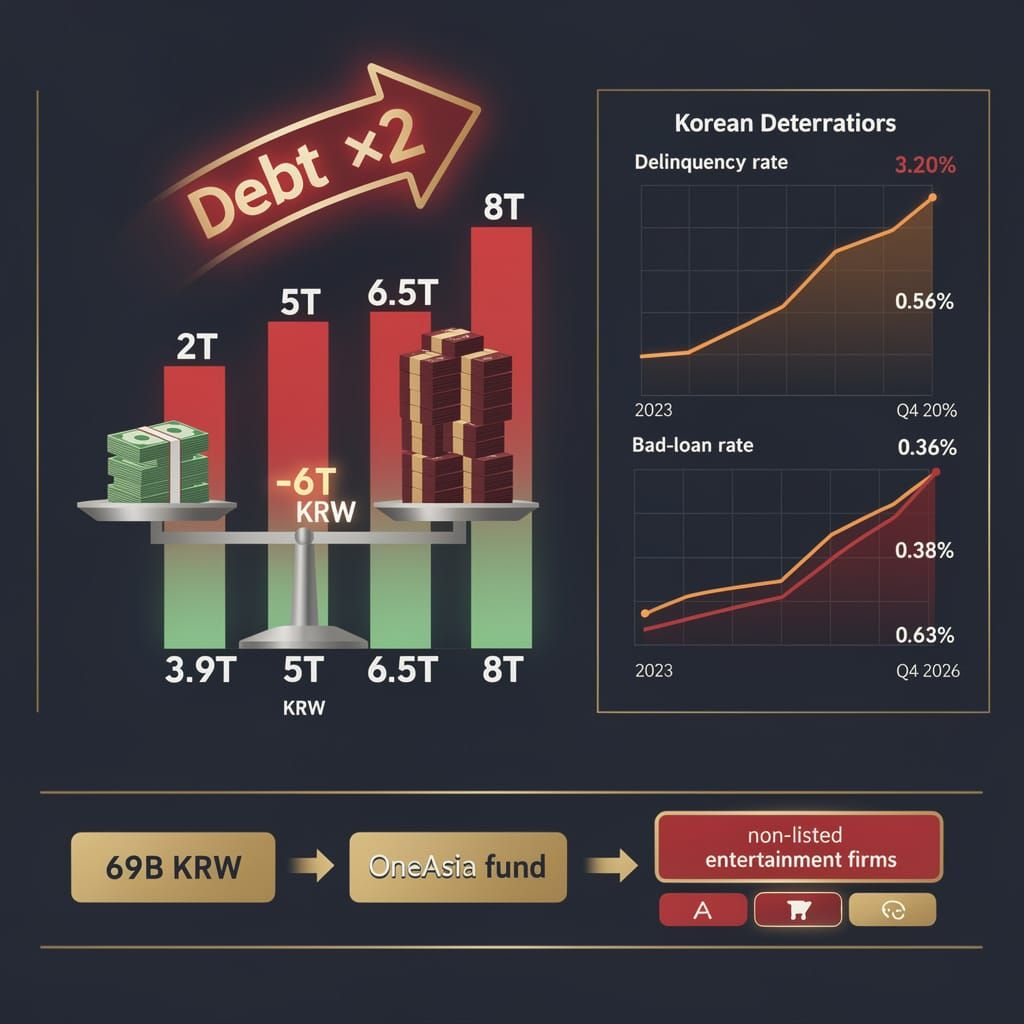
Considera Ayeon's external debt crossed 8 trillion KRW by late H1 2026, against just ~2 trillion in cash—a ~6 trillion gap that reframes the governance fight as a balance-sheet story 📉 The climb from 3.876 trillion (2023) came as interest costs jumped from 25.6B to 153.1B KRW. Meanwhile, Korean banks' Q2 delinquency hit 0.56%, ~3x the 2022 level. A 69B KRW outflow to non-listed entertainment firms sits against that 8T stack. Small in ratio, but it produces no booked revenue for the core metals and acid lines. The board renewal in March 2027 now carries the real stakes. Will borrowing velocity plateau—or keep climbing? That's the signal that separates a contained episode from a spreading one. Who's most exposed as refinancing pressure lands in a softening credit market?
When MBK Partners and Youngpoong went public on September 28 demanding the removal of Chairman Choi Young-paek, they weren't really making a governance argument. They were reading a balance sheet. The numbers do the talking—and they're uncomfortable on nearly every line.
The leverage trajectory
Take external borrowings, the cleanest single metric in the saga. Considera Ayeon carried 3.876 trillion KRW in external debt at year-end 2023. By end-2024, that figure had climbed to roughly 4 trillion KRW as interest expense jumped from 25.6 billion to 153.1 billion KRW. By late June 2026, borrowings crossed 7 trillion KRW. Spend another quarter, and the accumulation broke past 8 trillion KRW. Meanwhile, cash on hand had slipped to about 2 trillion KRW. That gap—roughly 6 trillion KRW between cash and total borrowings—isn't a working-capital squeeze. It's a fundamental change in what this company is.
None of this is a revenue problem in the accounting sense; it's a balance-sheet and financing-structure problem. The company went from a financially sound, low-leverage operator to a firm whose equity cushion is thin against a debt stack that keeps growing.
This trajectory fits a pattern visible across the Korean financial system this year. Domestic banks' H1 2026 operating profit fell 900 billion KRW year-over-year to 13.8 trillion KRW, while the delinquency rate hit 0.56% in Q2 2026, nearly triple the 0.20% recorded in Q2 2022. Bad loan ratios rose to 0.63% from 0.38% over the same span. The lending climate that let Considera Ayeon's borrowings compound so quickly is itself deteriorating—easier to extend credit, harder to collect. Refinancing pressure on an 8-trillion-KRW debt stack lands in a market where credit quality is broadly softening.
Where the cash went
The contested outflow sits inside a single investment vehicle. Choi's faction reportedly moved 69 billion KRW into non-listed entertainment firms—Aak Media, Hitech, and Slingshot—through the OneAsia Partners fund. The allegation is sequencing: personal funds went in first, ahead of Considera Ayeon's own investment, which the accusers say drained corporate assets for private enrichment.
That 69 billion sits against the 8 trillion KRW debt figure. Small in ratio, but the operating point is different: this isn't the kind of spending that produces booked revenue for Considera Ayeon's core non-ferrous metals and semiconductor-grade sulfuric acid lines. The impairment trail is already visible—Hi-Hat and Slingshot are marked down, with Arc Media at risk. It's diversification into unrelated, non-listed assets whose realized proceeds could land at zero and produce no contracted revenue stream back into the parent.
Governance turnover as an early-warning signal
Watch the actual departures, because they precede the disclosure. Independent director Ming Kim retired after a conflict. Banker Park Ji-dok was dismissed on suspected misuse of company resources. Board composition shifted: Lee Jun-bong and Shim Hye-seop joined as independents, lifting new independent representation to about 36.8% of a 19-member board. Nine seats expire in March 2027—the renewal cycle now carries the real stakes.
The sequence matters as a control signal. Personnel exits tied to misuse suspicions, then a liquidity shortfall after an abrupt equity infusion, then an SEC inquiry within days of the public declaration—that's a control-failure pattern, not a one-off dispute.
What to monitor next
Three signals will separate a contained episode from a spreading one:
- Borrowing velocity: Does external debt keep climbing past 8 trillion KRW through Q4 2026, or plateau? The trend, not the level, tells you whether refinancing pressure is structural—especially against a Korean banking sector where delinquency (0.56%) and bad-loan ratios (0.63%) are both rising from 2022 baselines.
- The OneAsia asset realizations: Do the non-listed holdings (Aak Media, Hitech, Slingshot) produce any recoverable value after the impairments already recorded, or do they write down further? Their realized proceeds—or lack thereof—determine how much of that 69 billion KRW is simply gone.
- Audit and board posture: Watch whether the March 2027 board renewal produces further independent-director additions and whether any material weakness or restatement surfaces in the annual close. That's the accounting-treatment confirmation of what the balance sheet already implies.
On the current evidence, Considera Ayeon's liquidity, leverage, and cash position point in one direction. The governance dispute is real, but it's downstream of the balance sheet—and the balance sheet is the part that will be hardest to repair.
Comments ()