Palantir's growth vs. its multiple: a reckoning
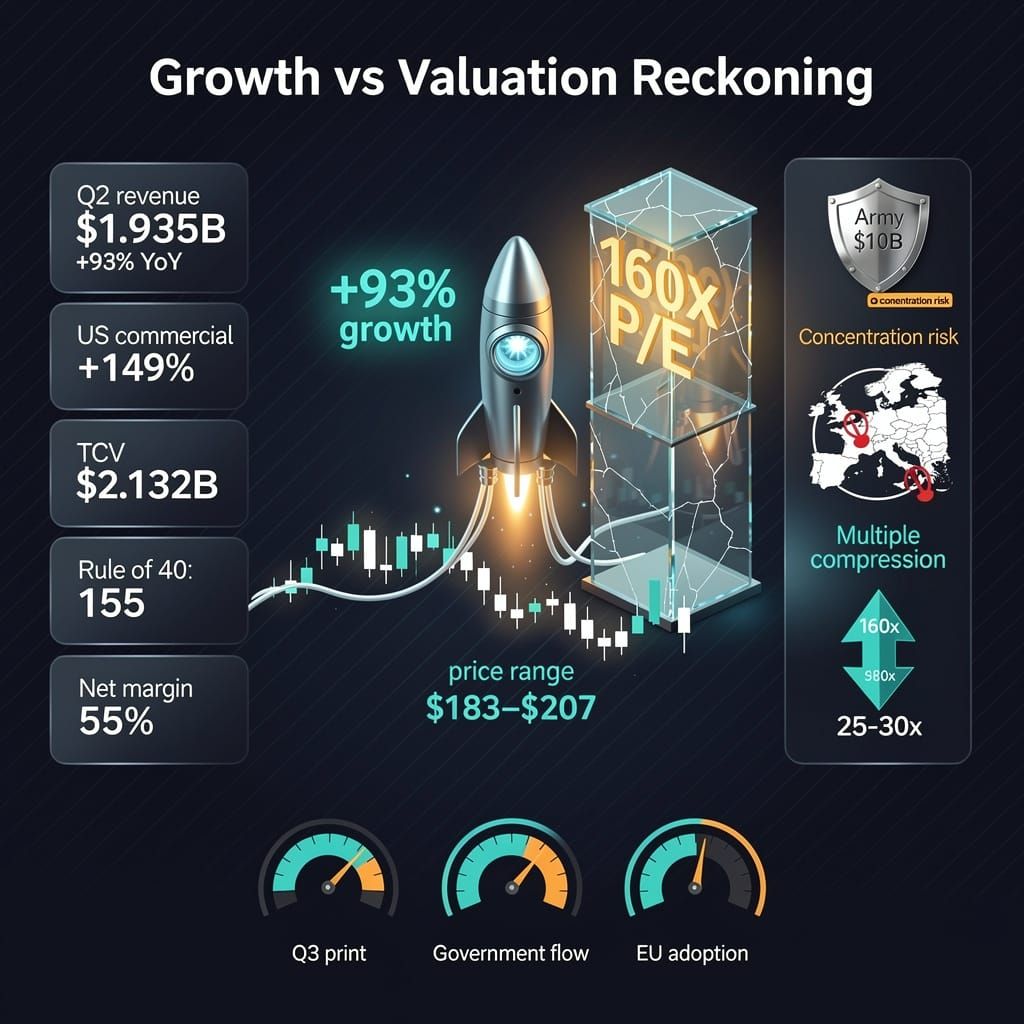
Palantir is growing commercial revenue 149% YoY yet trades flat since August, at $183–190 vs a $207.52 high. 📉 A 93% growth engine carries a >160x earnings multiple—and management guidance implies the pace decelerates. Procurement now funds nearly half the top line, and EU institutions are withdrawing. Does growth need to re-accelerate to justify the price, or will the multiple compress? Are you in high-growth software names?
A 93% growth engine carrying a >160x earnings multiple hits its reckoning
On September 28, 2026, Palantir closed a week that distilled the sharpest tension in AI infrastructure investing: a company growing commercial revenue by 149% year over year yet trading essentially flat since August, at $183–190 against an all-time high of $207.52. The stock has now spent four weeks unable to reclaim its peak despite the strongest operating quarter in its history—Q2 2026 revenue of $1.935 billion, up 93% year on year, with US commercial revenue at $764 million (+149%) and record total contract value of $2.132 billion in US commercial deals.
The market is not disputing the growth. It is pricing what sustained growth would require—and that math looks unforgiving.
The mechanics of an unusually priced growth engine
Palantir's rule-of-40 score sits at 155, a figure that combines its growth rate with its 55% GAAP net margin and 63% adjusted free-cash-flow margin. By profitability standards, the company is nearly unprecedented among software names of its scale. But the valuation translates to more than 160 times trailing earnings, and roughly 60 times a revenue base of $8.15 billion in 2026 guidance against a market cap approaching $491 billion.
The mechanism behind the current standoff is straightforward. For the multiple to hold at current levels without compression, growth must not merely continue—it must re-accelerate. Management's own full-year guidance ($8.150–8.158 billion) implies a deceleration from the Q2 93% print. Even a 100% growth rate through 2027 would produce revenue in the mid-$16 billion range—a denominator that still leaves a >30x multiple. Analysts at UBS and Bank of America are reported to frame the path as multiple compression to the 25x–30x range unless US commercial growth exceeds 100% consistently—a scenario the Q2 print, which accelerated from 85% to 93%, has not yet delivered.
The counterpoint is real. Q2's $1.062 billion in GAAP net income and the $13.1 billion in executive-sales-pipeline total revenue management volume indicate the underlying business is compounding faster than even recent quarters suggested. The post-earnings price action tells a different story than the fundamentals: after the August 3 report—which beat revenue estimates and annualized profit projections, pushing the stock up roughly 13%—shares rose 43% over the subsequent month while still finishing down about 3% year to date. That gain ran in parallel with a broad software rotation that lifted Salesforce (+25%) and ServiceNow (+28%) even higher on a year-to-date basis, leaving Palantir with the smallest drawdown among the three. The lopsided valuation is not lost on the market: a trailing price-to-earnings ratio near 154x and a price-to-sales ratio around 69x leave little room for execution error at any point in the chain.
Who holds the leverage
The critical structural fact is that Palantir's growth concentration is split between two clients with very different pricing power: the US government, where a $10 billion ceiling on contracts creates concentration risk, and US commercial enterprises. US government revenue rose 90% to $809 million, and federal procurement now funds nearly half the top line.
On the government side, that concentration just got more embedded. On June 29, 2026, Palantir signed a $10 billion, ten-year Enterprise Agreement with the US Army that merges 75 existing contracts into a unified structure, eliminates reseller intermediaries, and lifts switching costs for competitors—positioning its software as core infrastructure. But the same event flags the concentration risk: annual spend averages just above $1.1 billion, the full $10 billion is not guaranteed to materialize, and the deal rests on sustained deployment success and freedom from federal contract terminations. Management cites a 90% reduction in manual effort in federal compliance pilots as the driver pulling in the Datadog and Snowflake dual-dataflow partnerships—though those two names have themselves rotated lower in recent sessions (Datadog fell 6% on September 2 on sector rotation with no company-specific catalyst). The revenue concentration win is real, but it rises and falls on a single prime relationship.
That raises the unresolved uncertainty. Data-governance scrutiny has been intensifying across the sector, and it has a concrete regulatory spine: venture and compliance reviews through 2026 have pushed unified metadata catalogs and row-level access policies toward the norm, driven by GDPR, PIPL, and data-localization pressure. Palantir's cross-platform dataflow integrations sit directly in that regulatory path—and the company has already met institutional resistance abroad. On August 3–4, 2026, Swiss federal police rejected a Palantir security deployment and French firms replaced it in other contracts, a documented pattern of EU institutional withdrawal that carries reputational and revenue risk even as US contracts expand. No immediate US regime shift has been detected, but the stock appears to track regulatory readjustment as much as domestic demand.
The August surge notwithstanding, the trading pattern since Q2 results shows that momentum has come in waves—a 6% sell-off on a product reveal in July, a 29% single-day jump on August 4—rather than a sustained re-rating. Analysts carry 19 Buy ratings and 10 Holds with a consensus target near $191.68, or roughly $188.99 net of upside skew. The year-to-date drawdown being smaller than Salesforce's (-22%) and ServiceNow's (-17%) reflects relative strength, not political pressure—and provides some evidence that institutional conviction is holding even as price targets cluster near the current quote.
Three indicators to watch through Q3
- The Q3 growth print (expected early November): whether US commercial growth holds above 100% and whether full-year guidance is raised again—the single most direct test of the multiple-compression thesis.
- US government contract flow: whether the Army enterprise agreement's annualized >$1.1 billion spend holds, expands, or faces terminations, since procurement now funds nearly half the top line and carries the $10 billion concentration ceiling.
- EU institutional adoption, not just rulings: whether continued rejections like the Swiss and French withdrawals accelerate or stabilize, since that governs whether cross-platform monetization supports or undercuts the international revenue trajectory.
As reporting, the picture is of a genuinely exceptional operating engine priced for perpetually accelerating demand—a configuration that tends to resolve in one direction or the other, often abruptly.
Comments ()