🎰 Kalshi's $50 Promo Is Volume Bait, Not Seed Capital
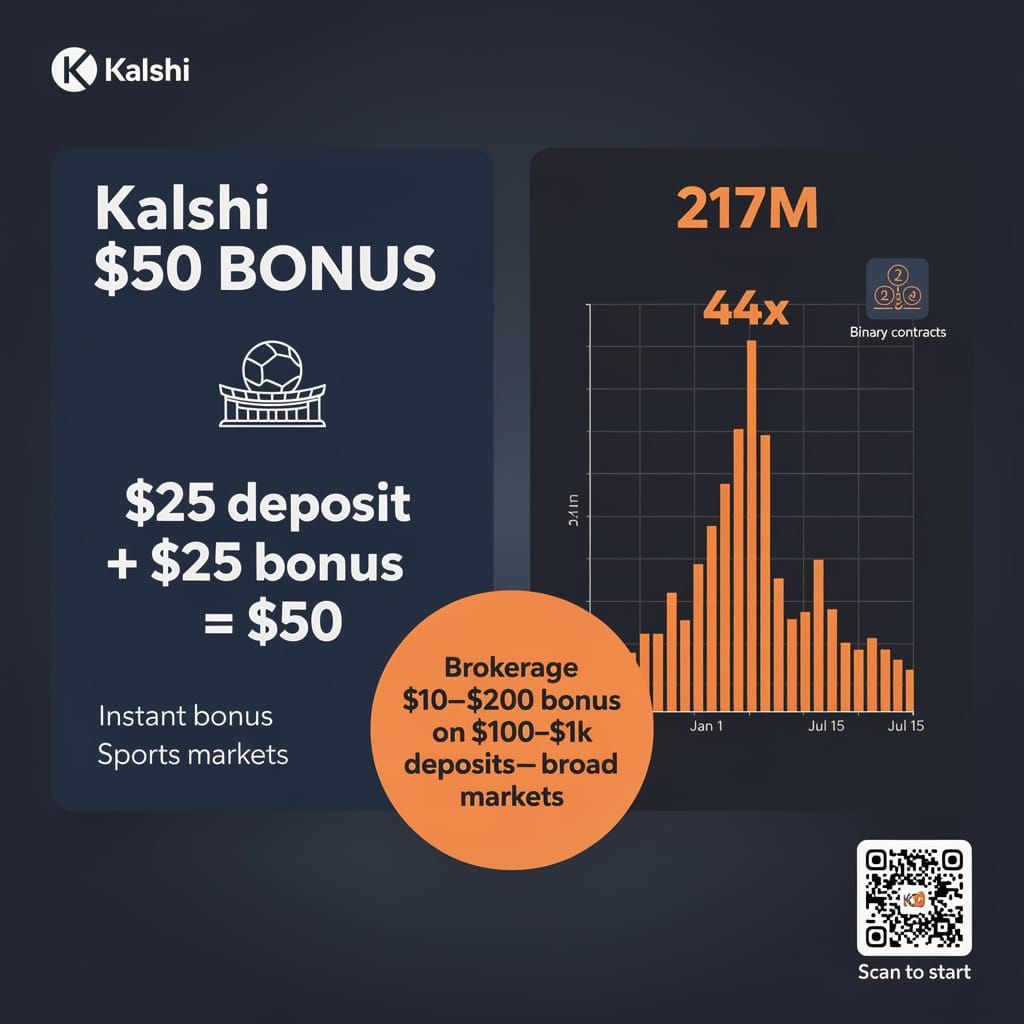
Kalshi offers new users $50 ($25 deposit + $25 bonus) via code CLEVELAND — but that's less than 0.00002% of its single-day volume of $217.98M. 🎰 The $50 is gated to binary sports-event contracts where one loss wipes 25–50% of capital. Robinhood and Webull offer cash bonuses for deposits of $100–$1,000 with no market restrictions. Kalshi's promo is narrower, gated, and structurally identical to at least four sports-betting promos since June. This is user-acquisition volume bait, not seed capital. Users should treat the $50 as a participation fee — paid by Kalshi to harvest attention, data, and settlement fees. Does a gated $50 bonus on binary sports contracts make prediction markets more accessible — or does it just lower the quality of retail participation?
On August 29, 2026, Kalshi launched promo code CLEVELAND, offering new users a $25 bonus on a $25 deposit — netting $50 in total trading capital. The platform frames this as lowering barriers. A $50 stake, a few clicks, and suddenly a registered user is supposed to feel empowered.
The Mechanics
- $25 deposit + $25 bonus → $50 total to trade.
- Restricted to new accounts created after August 29.
- Funds usable on college and NFL preseason events — not broader equity or macroeconomic markets.
- Code also functions as a referral and bonus code across multiple aliases (CLEVELAND, CLEVE), identically across distribution channels.
Kalshi positions this as a lower barrier to entry. More users, broader demographics, expanded participation across prediction markets. That sounds inclusive — until you inspect the numbers closely.
The Real Signal
A $50 wallet spread across event contracts with binary outcomes is not a serious capital base. It is entertainment money. Kalshi knows this. The platform generated $217.98 million in single-day crypto event volume on July 15, 2026 — a 44x increase from January 1 and 84% of all crypto prediction volume. The $25-on-$25 template feeds exactly that volume machine.
The promo code launched August 29 and was still live on September 11 — exact same terms — capturing users for Browns vs. Jaguars NFL Week 1. That is a two-week promotional runway, not a limited-drop event. Meanwhile, campaigns from July 2026 offered $10–$15 bonuses tied to World Cup and UFC events using identical gated mechanics. The July 1 ALCOM15 code, the June 20 WTOP15 code, the July 4 WTOP15 code — all $10–$15 bonuses requiring a minimum trade to unlock. This is a template, not a test.
What $50 Actually Buys
Traditional brokerage acquisition: Robinhood and Webull — the same platforms distributing Kalshi's contracts — have offered $10–$200 cash bonuses for deposits of $100–$1,000, with no market restrictions. Funds usable across equities, ETFs, options, and bonds. Kalshi's offer is narrower in scope and gated to binary event contracts on sports outcomes.
What Kalshi's users get: A $50 balance that must be traded on binary markets where a single loss eliminates 25–50% of capital. The code's identical terms for referral and promo distribution suggest volume targets, not user-quality metrics. The CFTC-regulated structure provides legal cover but does not change the product economics.
The Cumulative Picture
Kalshi hit $1.2 billion in peak volume by June 2026, enabled by Wintermute's $3.5 trillion annual crypto-liquidity integration and institutional expansion into prediction markets. By July 17, daily volume hit $217.98 million — a 44x increase from January 1, 2026 — during a period when Bitcoin was down 30% year-to-date. Promo codes like CLEVELAND feed that volume machine with low-cost user acquisition: $25 per registrant for a gated, non-withdrawable bonus that requires trading to unlock. The user data is the product. Settlements generate fees. Retention is not the primary metric.
Gaps and Silences
No mention of whether the $25 bonus can be withdrawn as cash, or whether it must be traded once before any proceeds become withdrawable — a common requirement across earlier Kalshi promos (ALCOM15, WTOP15 all demanded $10 in trades before releasing the bonus). No detail on the fund lifecycle, which remains opaque. The promise of "weekly tournament settlements" recycles small sums to keep screens lit and clicks coming.
The Outlook
Promotional campaigns like CLEVELAND generate new account registrations and near-term trading volume. Between June and August 2026, Kalshi ran at least four structurally identical sports-betting promos — ALCOM15, WTOP15 (June), WTOP15 (July), and CLEVELAND — each requiring a minimum trade before unlocking a gated bonus. They do not demonstrate durable retail-investor engagement, nor do they signal structural demand for prediction markets as an asset class. Short-term user-acquisition metrics will look elevated through mid-September. Retention, average deposit size, and cross-market participation across non-sports verticals will tell a more honest story.
The $50 is not seed capital. It is a participation fee — paid by Kalshi to harvest attention, data, and settlement volume. Users should treat it accordingly.
Comments ()