🧠 On's Cloud 6 holds price while rivals discount — heel lift test looms
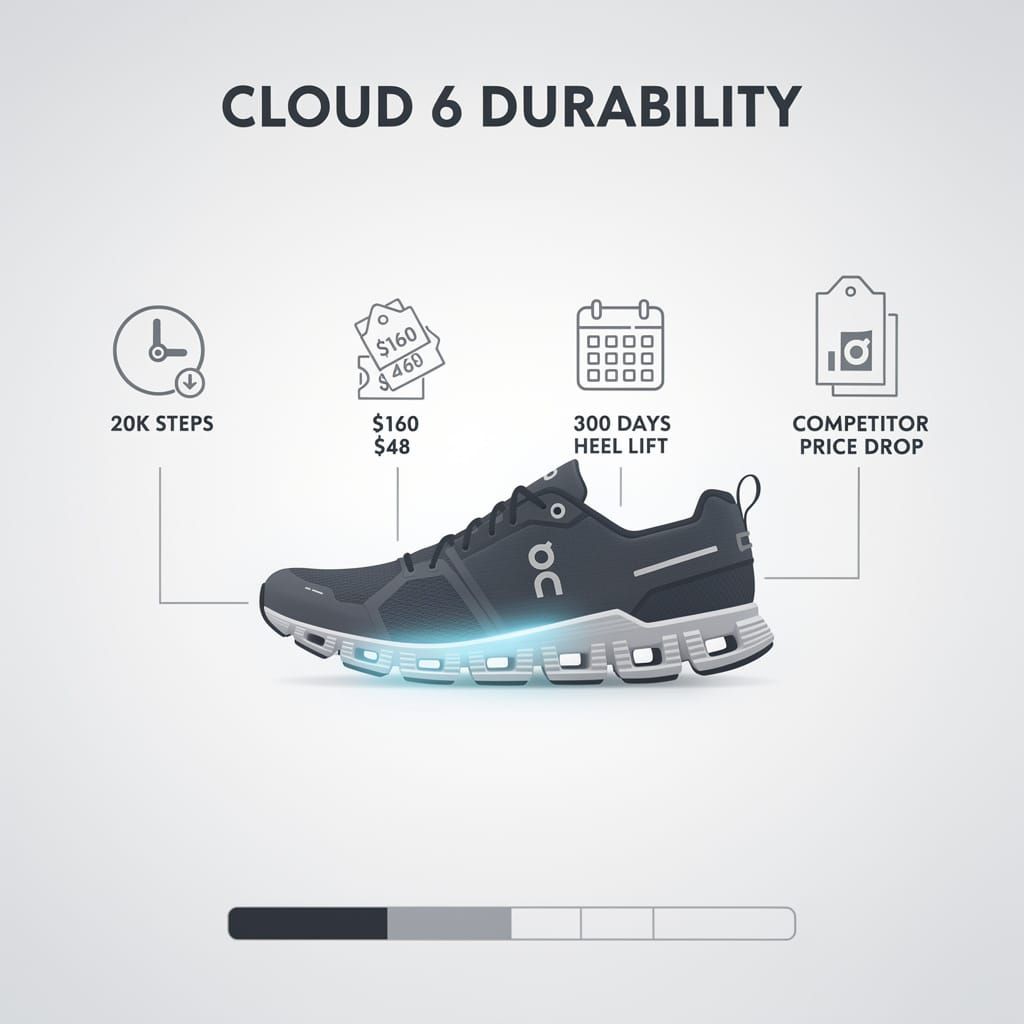
On's Cloud 6 holds at $160 while Brooks discounted the Ghost Max to $119 by week three. 🧠 That's atypical for footwear—most shoes peak fast and fade. Podiatrist-backed ergonomics and zero pressure-point complaints at 8-12 mi/day. The catch: mild heel lift after ~300 days, unaddressed by On. Does durability beat discounting for your next shoe buy?
Swiss sneaker brand On has done something quietly remarkable. Their Cloud 6—the everyday trainer launched in August through Nordstrom at $160 a pair—held Norway's leading activewear product position through mid-August, per retail tracking data. No mid-season markdown, no fire sale. Sixteen dollars and change of net gain per unit, and the stock keeps moving.
That's not supposed to happen in footwear. Most shoes peak in week three, then fade—Brooks dropped the Ghost Max 3 to $119.95 by June 7th and the Ghost 17 to $109.95 by June 17th. On hasn't budged. Meanwhile, REI slashed the Cloud 6 to as low as $48 during their August 25th promotion. Different channel, different game.
What Keeps People Coming Back
The Cloud 6 uses Responsive SpringBoard tech—a midsole geometry distributing weight evenly across the foot rather than concentrating pressure under heel or forefoot. Combined with CloudTec cushioning, the shoe absorbs impact across up to 20,000 daily steps without breaking down the foam structure prematurely. Podiatrist endorsements—including from Anne Sharkey and Nasim Kalhor—link this ergonomic fit directly to reduced injury rates.
The ergonomic lace system reduces common pressure points along the top of the foot. Sounds minor. It isn't. People walking 8–12 miles a day report zero lace-bite or circulation issues—consistent with the orthopedic consensus linking foot-type suitability to injury prevention.
The One Catch
A small but consistent pattern has emerged among heavy users: after roughly 300 days of regular wear, some notice mild heel lift—the rear loses its snugness. Not a structural failure. The sole, cushioning, and upper remain intact. But the fit loosens, and for trail runners or anyone doing lateral movement, it becomes noticeable.
On has not addressed this publicly, and the Cloudmonster 3—their limited-edition release with Flower Power and IPA colorways—uses the same heel construction. The question remains: design trade-off for breathability, or genuine flaw?
Short Term Outlook
For now, On owns the $150–$170 everyday-trainer segment. Nordstrom keeps the Cloud 6 front-of-store through Q4 2026—though their July Anniversary Sale knocked the Cloud Surfer 2 to $109, and REI's 70%-off fire sale suggests tactical comfort with deep discounts on On's other models. The real test arrives in early 2027, when the first 300-day cohort crosses that heel-lift threshold in volume. If users churn, On needs a mid-cycle refresh. If they don't, they've built the most durable comfortable sneaker under $200 on the market.
Either way, the startup that started with a garden hose and a drill press is now playing a very different game.

Comments ()