IRDAI's commission caps just realigned who gets paid to sell insurance in India
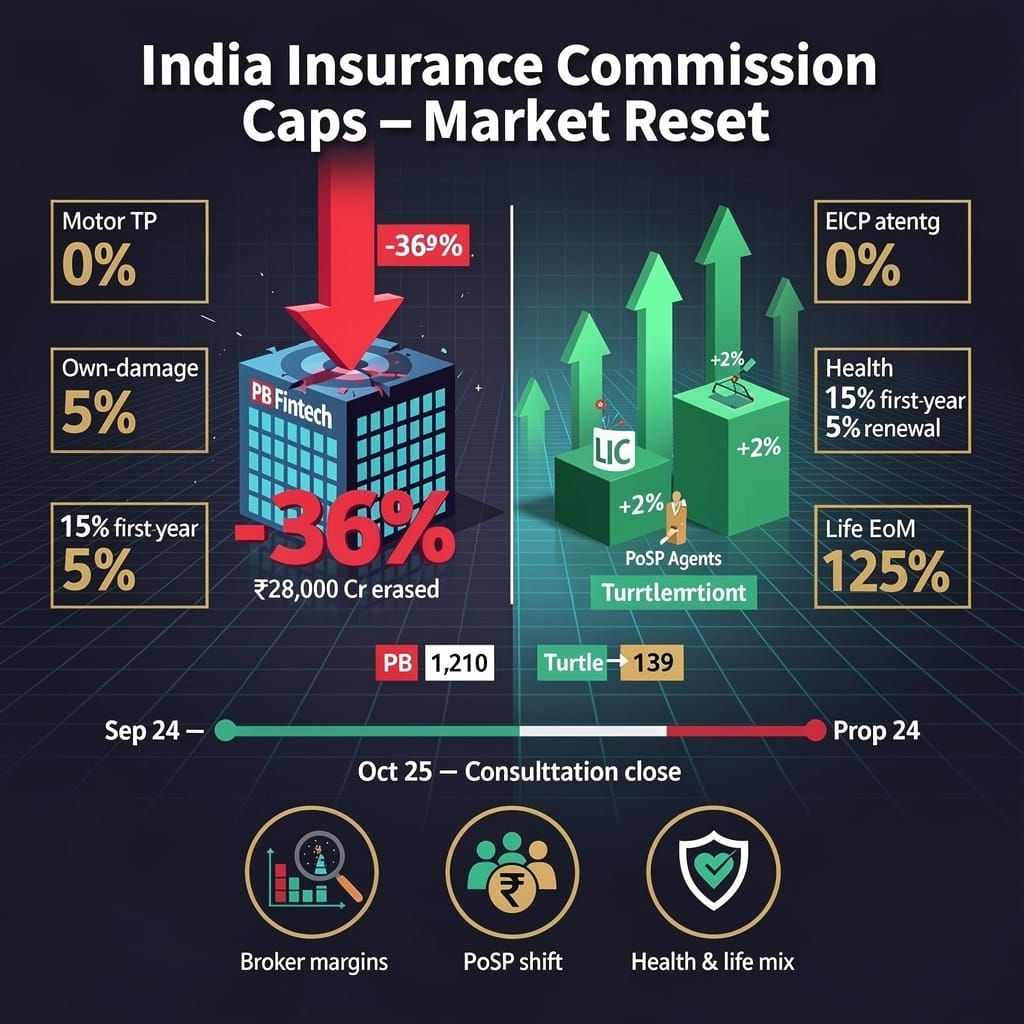
India's insurance regulator just wiped ₹28,000 crore (~$3.4 Bn) off PB Fintech in two sessions — in a proposal, not even a rule. 📉 The caps target the highest-take-rate channels digital brokers monetize: motor third-party goes to zero, first-year health to 15%. Distributors bear the brunt; insurers like LIC and ICICI Lombard actually rose. Brokerages now price a bifurcation: Turtlemint's PoSP-led channel defends its economics (~24% CAGR), while PB Fintech targets slide to ₹1,150. The final IRDAI notification, due after October 25 comments, decides who keeps leverage — and who loses it. Is this the end of the acquisition-led insurance playbook, or just a repricing before recovery?
On September 24, 2026, India's insurance regulator published a consultation paper titled "Recalibrating Economics of Insurance Distribution" — and within two sessions it erased roughly ₹28,000 crore (~$3.4 Bn) from PB Fintech alone. The parent of Policybazaar closed at ₹1,210 on the BSE, down 35.98% from pre-proposal levels, its market cap settling at ₹55,993 crore (~$5.8 Bn). Distributor peer Turtlemint fell 19.99% to ₹109.10.
The trigger was not a company fault line but a structural rewrite of who gets paid to sell insurance in India — and how much.
What actually changed
The IRDAI proposal replaces the expense-of-management (EoM) regime introduced in April 2023 — which had removed hard commission ceilings in favor of aggregate expense limits — with a return to product- and channel-specific maximum commissions:
- Motor third-party: zero commission on new-vehicle policies; own-damage capped at 5%.
- Health insurance: 15% on first-time sales, 5% on renewals (individual agents would get higher: 20% first-year, 10% renewal).
- Life insurance: EoM restricted to 15% within two years and 12.5% within five years for life insurers; 25% and 20% respectively for general insurers. Single-premium policies face caps of 1–7.5%, versus up to 25% for multi-year terms.
Crucially, the regulator treats all distributor payments — including incentives and payouts — as commission, closing the loophole insurers used to shift "marketing" costs outside cap. The consultation closes for stakeholder comment on October 25.
The mechanism and who loses leverage
Digital brokers earn their economics on take rates — the commission they extract per premium sold. Policybazaar and Turtlemint monetize precisely the channels the caps strike hardest: high-commission motor third-party and first-year health policies, where their unit economics depend on acquisition fees that now face hard, low ceilings.
The shock is visible beyond the two listed distributors. Info Edge, which owns 12.43% of PB Fintech (6.47% direct plus 5.95% via subsidiaries such as Makesense Technologies), saw its share value tied to that stake sliced from ₹5,649.09 crore to ₹3,615.32 crore within two sessions — a 36% markdown on the holding — while Info Edge's own shares slipped 8.5% over the past month and 9.4% over twelve months as the indirect exposure repriced.
Morgan Stanley projects a 60–70% decline in the net present value of PB Fintech's health insurance book under the proposal. Motilal Oswal estimates a 30% hit to FY28 core online insurance revenue and cut its target to ₹1,150. Jefferies models a 10% cut in new-business commission rates translating to a 10–12% earnings decline for both distributors. Brokerages have downgraded: HSBC to Hold, Morgan Stanley to Underweight (₹1,390 target), while one house cut EPS estimates 48% for FY28 and 35% for FY29.
The market has already repriced this. By the September 23 close, PB Fintech's valuation had been marked down to ₹6,696.74 crore from ₹10,845.06 crore at end-September — a broader re-rating that predates and now compounds the regulator's action.
Importantly, this is a proposal, not a rule — and the mechanics warrant qualification. The caps hit distributors hardest, but they also compress insurer distribution costs, which is why LIC and ICICI Lombard rose over 2% in the same session. IRDAI's broader package — a ban on bundling insurance with home and motor loans, standardized disclosures, and clawback mechanisms for mis-sold policies — shifts leverage away from acquisition-led digital brokers and toward insurers, bancassurance, and captive distribution.
The counter-signal
The picture is not uniformly bearish. One brokerage maintains a Buy rating with a ₹1,400 target (~20% upside), arguing most regulatory risk is already priced in and that volume recovery to FY29 could deliver a 15–20% offset. On September 22, Motilal Oswal turned constructive on Turtlemint, initiating a Buy rating with a ₹180 target and arguing the company's PoSP-driven premium growth is accelerating at nearly double the industry rate. It projects 24% premium CAGR through FY26–29 as the mix shifts toward PoSP agents — a channel the caps don't compress as hard. Turtlemint responded with a 9% intraday surge to ₹142.90 and a 6.6% close gain to ₹139.75. Its operating revenue grew 40% year-over-year to ₹294.1 crore in Q1 FY27, with net loss down 19% to ₹37.8 crore.
That counter-signal cuts both ways. Motilal Oswal's own thesis projects only ~11% margin expansion by FY29 — modest even in its constructive case — and the same regulator redefinition of commission applies to PoSP payout structures, including the proposed ban on volume- and reward-linked incentives. The bullish case rests on volume and channel mix offsetting lower per-policy take rates; neither the regulator's final stance nor either broker's execution is confirmed. The consultation period still allows amendment.
The divergent broker calls — Buy on Turtlemint at ₹180 versus PB Fintech targets down to ₹1,150 — indicate the market is pricing a bifurcation: distributors with defensible, lower-take-rate channels versus those exposed to the highest-capped products.
What to watch
Three indicators tied to the thesis over the next quarters:
- The final IRDAI notification (post-October 25 comments) — whether caps are softened, and how the premium-linked expenditure model binds life insurers versus distributors.
- PB Fintech's disclosed per-policy take rate in its next quarterly disclosure — evidence of whether volume growth can offset lower commission-per-policy.
- Gross written premium mix shift across the motor, health, and PoSP verticals for both brokers — the metric that determines whether the premium pool can substitute for lost take rate, and whether Turtlemint's PoSP activation engine actually delivers the 24% CAGR its Buy rating assumes.
This is reporting and market analysis, not a recommendation. The distribution economics of Indian insurance have been reset; the question is which intermediaries emerge with leverage under the new structure.
Comments ()