Disney cuts ~1,000 legal roles as new CTO rebuilds workflows around AI
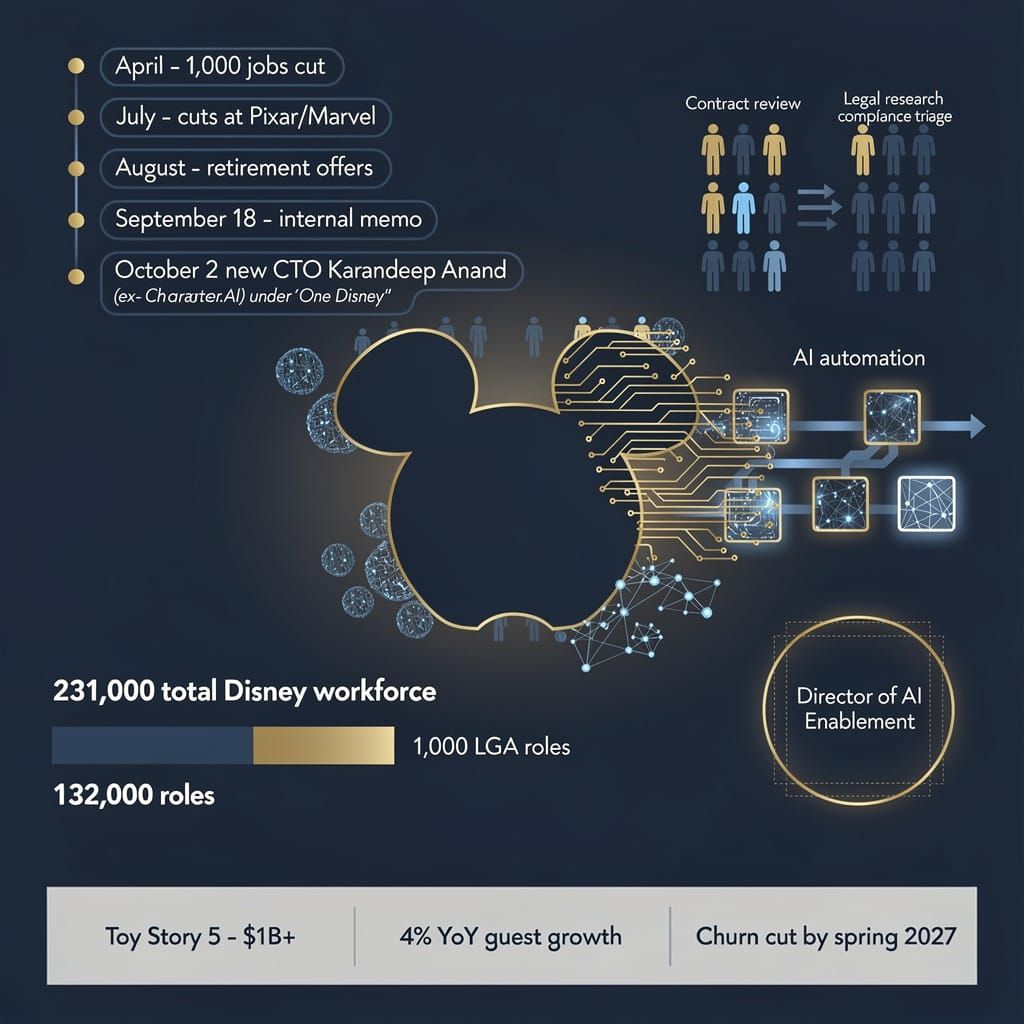
Disney is cutting ~1,000 legal roles. That's about 4 of every 1,000 workers across its 231,000-person workforce. ⚖️🤖 The trigger: incoming CTO Karandeep Anand (ex-Character.AI CEO) is rebuilding workflows around AI—contract review, research, and compliance triage. The bet is that automation replaces volume faster than complexity rises. The risk: losing the institutional knowledge, risk judgment, and relationship capital those specialists carried. For the ~1,000 in Disney's legal arm, the question is personal. For the rest of us, it's whether this becomes the template for every corporate function. Is your industry next in line for this automation-first reset?
On September 18, Horacio Gutierrez, Disney's Chief Legal and Global Affairs Officer, sent his roughly 1,000-person LGA department a mid-morning memo that carried a blunt warning: the organization was about to become "much smaller." The transformation, he wrote, involved "automation" and reimagined workflows. Layoffs were expected to begin within weeks.
The memo did not come out of nowhere. Disney had already cut roughly 1,000 jobs in April and hundreds more in July across Pixar, Marvel Studios' visual development teams, and other units. August brought voluntary retirement offers. This round, however, targets the company's own legal and regulatory apparatus—the function usually insulating an entertainment giant from disputes, not absorbing them.
Automation landing inside the legal team
The structural driver is explicit. On the same day the memo circulated, Disney confirmed Karandeep Anand—formerly CEO of Character.AI, and earlier at Meta and Microsoft—as its first-ever CTO, a newly created Senior EVP role effective October 2, reporting directly to CEO Josh D'Amaro. The appointment signals a reset in how the company views technology leadership: Anand inherits oversight of enterprise technology, infrastructure, data, AI platforms, product, and engineering, all aligned under D'Amaro's "One Disney" consolidation.
The hire carries logistical weight beyond the title. Anand's appointment lands shortly after Disney's March 2026 exit from its OpenAI Sora partnership, and roughly a year after a cease-and-desist exchange with Character.AI over IP concerns. In bringing over the founder who ran that company, Disney is folding rival AI capability and its technical team into its own operations rather than licensing from outside. Notably, no one has yet been named to the newly posted role of Director of AI Enablement & Legal Engineering—the position tasked with deploying AI across contract review, legal research, and compliance, and deciding whether to build internally or buy externally.
The mechanics of the tradeoff are visible. Legal workflow has historically run on a stack of manual review, human judgment, and specialist knowledge. Automating contract review, research, and compliance triage reduces the labor needed per matter—at the cost of the institutional knowledge, risk judgment, and relationship capital those specialists carried. Disney's leadership is explicitly betting the volume of work drops faster than its complexity rises, or that external providers and self-service models can absorb the remainder.
That bet carries measurable consequences. The department's ~1,000-person footprint is the obvious near-term number. But the reorganization also changes authority: systems engineers and AI tooling now sit inside or adjacent to legal decision-making, shifting where judgment gets applied and who gets to apply it.
What the numbers say at the group level
Disney's total workforce runs about 231,000, so LGA's ~1,000 is a narrow slice. But the memo frames this as an operating-model reinvention, not a one-off. CFO Hugh Johnston linked earlier cuts to a "culture of efficiency," and D'Amaro, in the August Q3 earnings presentation, pledged "AI-enhanced storytelling" to cut churn from spring 2027, citing 4% YoY global guest growth and Toy Story 5's $1B-plus box office.
Counterevidence and limits
Not everything supports a clean "AI replaces lawyers" story. The restructuring also reflects cost discipline independent of automation—Disney cut Marvel's visual development teams and canceled Daredevil: Born Again season 3, moves more about content portfolio management than AI. And the LGA cuts were flagged, in at least one report, as potentially distinct from the broader layoff rounds rather than confirmed components of them. Automation is one lever in a broader cost program, not necessarily the only one.
The CTO appointment itself carries open questions. Our second CTO event dated September 18 describes the role as effective October 2, yet another account lists "October 2 (post)" as the start under a transition note. Those discrepancies aside, the strategic direction is consistent: Anand's brief explicitly names the "One Disney" integration, and the departed Sora partnership and prior Character.AI cease-and-desist suggest the vendor relationship is being internalized rather than merely renewed.
There is also counterevidence on how well such transitions hold. Layoff rounds in April, July, and now September within a year signal that the efficiency target is moving rather than stable—each round ahead of confirmed results.
Indicators worth watching
- How many LGA roles actually move to external providers or self-service channels versus being absorbed internally, which tests whether the reduction is substitution or pure subtraction.
- Whether the Director of AI Enablement & Legal Engineering role gets filled and who it reports to—legal or technology owns the redesign's decision rights, given the incoming CTO's mandate over both the tooling and the platform beneath legal.
- Whether contract and compliance cycle times measurably change in the quarters after the cuts, which tests whether the automation materially replaced human throughput or simply reduced headcount.
The observable test is whether Disney's own legal deliverables—contract turnaround, regulatory filings, dispute handling—stay stable while roughly 1,000 people exit the function. That is a measurable outcome, not an opinion. Right now, the company is betting the workflows hold. The evidence for that bet is, so far, a memo, a job posting, and the arrival of a CTO with a track record of building AI products rather than legal operations.

Comments ()