23,000 Glasgow workers face dismiss-and-rehire in £11,500 pay shake-up
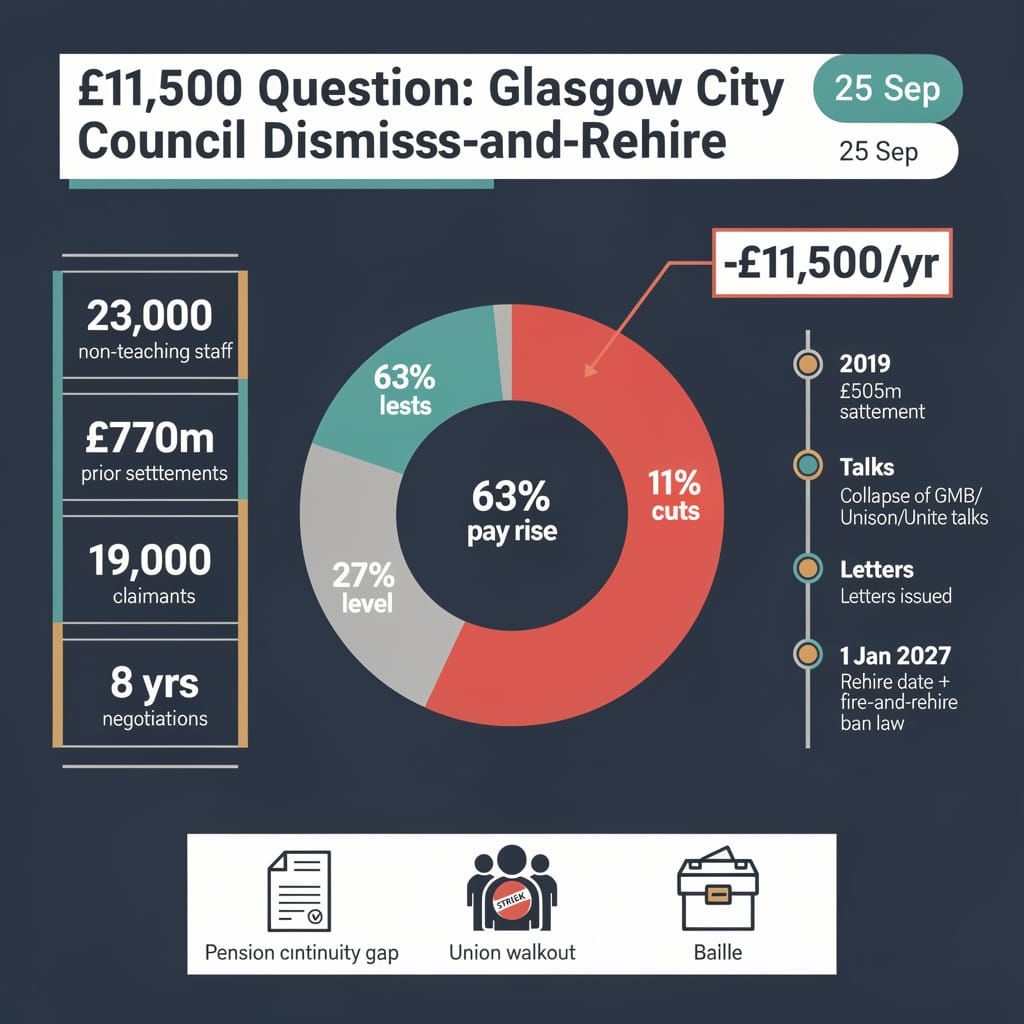
23,000 Glasgow City Council workers—nursery staff to refuse collectors—face dismissal-and-rehire, with ~11% losing up to £11,500/yr 😱. The aim: fix a grading system found to discriminate against women. Some 63% would gain, ~90% stay level or better. Re-engagement may strip continuity of service, hitting pensions and sick pay. Union walkouts and a fire-and-rehire ban landing 1 Jan 2027 make this a race against the law ⚖️. Could a deal still save the contracts? 💼
On 25 September, Glasgow City Council told its roughly 23,000 non-teaching employees—nursery staff, refuse collectors, administrative workers—that dismissal letters would go out within days, with replacement contracts effective 1 January 2027. The move follows eight years of negotiations on a new pay and grading structure, and the collapse of talks with GMB, Unison, and Unite over how to fix a system that job evaluations found discriminating against female workers.
The numbers show why this is not a simple layoff story. Under the proposed structure, an estimated 63% of employees would see pay increases, and roughly 90% would gain or stay level. That leaves about 11% facing cuts, with the worst hit losing up to £11,500 a year. On the surface, that tradeoff looks rational: correct a discriminatory pay regime by redistributing toward the workers it shortchanged. The council has already paid over £770 million to 19,000 claimants in prior gender pay settlements—including £505 million covering 15,000-plus historic claims in 2019—so the incentive to restructure is concrete.
Why dismiss-and-rehire, and why it matters
The mechanism is what draws the union fire. The council is not merely adjusting salaries; it is terminating every non-teaching contract and offering new terms, conditional on acceptance. Unions call this "fire-and-rehire," a tool soon to be restricted by UK legislation effective 1 January 2027. Union officials have publicly labeled the council a potential "pariah employer," and Unison has withdrawn support after earlier backing—accusations of bullying in the process have added to the friction.
The operational logic is traceable. Historical pay inequality was embedded in a grading matrix that undervalued roles held predominantly by women. Re-tariffing those grades while keeping the existing workforce on old contracts would create two parallel pay systems, one legally defensible and one not, and would breach equal pay obligations going forward. Dismiss-and-rehire forces uniform migration to the new structure. The tradeoff is stark: the council believes it cannot achieve pay equity across a legally uniform contract base without breaking the old contracts first.
The continuity gap
For accepted workers, the risk goes beyond salary. Continuity of service—which protects pension rights, sick pay, and redundancy entitlements—may not carry across a dismissal and re-engagement. That is a second, quieter cost embedded in the same letter, and it may be the more durable source of distrust.
Workers describe the treatment as "heartbreaking," a word that signals something specific: people who perceive the end result as fair can still judge the process as illegitimate. Trust here is not morale. It is measured in whether employees accept the change, share accurate context with managers, and coordinate during a forced transition on a fixed 1 January deadline. The current trajectory—mass notification, union walkout from talks, and legal pressure scheduled to ban the exact tactic being used—undermines each.
Counterevidence and the pause
Notably, reports diverge on whether this is proceeding or paused. One account flags suspension of the dismissals to allow renewed talks with the Scottish government; another notes dismissal letters were expected imminently. Deputy First Minister Jenny Gilruth has called for a pause and a return to the table. The council's position is that further negotiation with unions that will not ballot members leaves "no option" but imposition. The distinction matters: if the plan is merely suspended pending a ballot, the workforce remains in limbo but employed. If it proceeds, 23,000 people will experience termination and rehiring in one calendar quarter.
What to watch
- Ballot outcome: Will GMB, Unison, or Unite put the revised grading structure to members, and does acceptance drop the dismissal notices entirely or convert them to routine re-grade process?
- Continuity rulings: Whether re-engaged employees retain service for pension and protected rights—a decision that determines whether the financial cut for the 11% is a wage floor or the start of a larger loss.
- The 1 January 2027 legal deadline: Implementation lands the day the fire-and-rehire ban takes effect, testing whether the council completes migration in time and what liability—equal pay or employment law—follows either way.



Comments ()